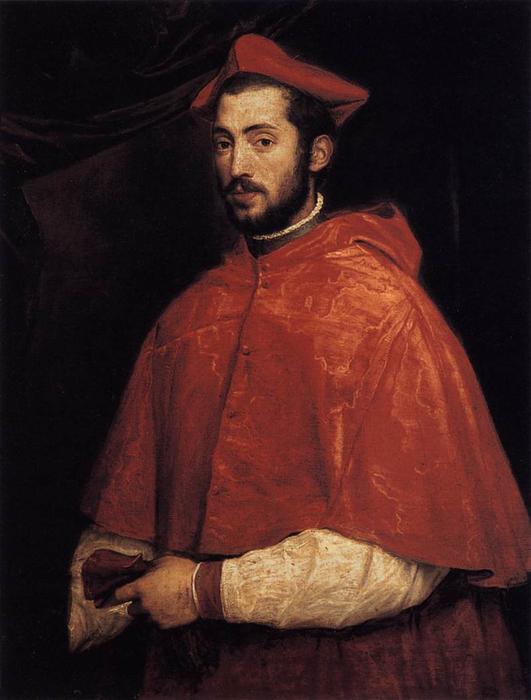
The Regal Presence of Cardinal Farnese
Tiziano Vecellio’s “Portrait of Cardinal Alessandro Farnese,” painted in 1545-46, is more than just a depiction of a Renaissance nobleman; it's an embodiment of power, piety, and the burgeoning artistic spirit of Venice. This three-quarter-length portrait captures Cardinal Alessandro Farnese the Younger at his height – both literally and figuratively – presenting him as a figure of considerable authority and refined elegance. The painting’s immediate impact stems from Titian’s masterful manipulation of color; deep reds dominate, reflecting the cardinal's ecclesiastical status while simultaneously conveying wealth and influence. The dark green curtain behind the subject isn't merely a backdrop but subtly directs the viewer's gaze, emphasizing the cardinal’s dignified posture and the luxurious textures of his robes.
- Subject: Cardinal Alessandro Farnese the Younger, a prominent figure in the Papal court.
- Composition: A carefully constructed three-quarter pose that emphasizes the cardinal's status and confidence.
- Color Palette: Dominated by rich reds, greens, and dark tones – symbolic of power, wealth, and religious authority.
Titian’s Signature Style & Venetian Innovation
Titian was a revolutionary figure in the world of painting, and this portrait exemplifies his unique approach. His brushwork is immediately recognizable: dense, layered strokes create a palpable sense of texture – from the velvet of the cardinal's robes to the sheen of the gloves he holds. This technique, combined with Titian’s audacious use of color, lends the work an almost three-dimensional quality, drawing the viewer into the scene. The painting’s similarity to Pope Paul III and His Grandsons—painted around the same time—highlights Titian's consistent style and his ability to create works that resonate with established artistic conventions while still retaining a distinctly Venetian sensibility. This shared date suggests a deliberate comparison, perhaps intended to showcase Titian’s mastery across various subjects.
Symbolism & The Cardinal’s Gesture
The inclusion of the gloves in the cardinal's right hand is particularly noteworthy. While not typical for clerical portraits, it subtly elevates the image beyond a purely religious depiction, suggesting worldly sophistication and perhaps even a hint of vanity – a common characteristic explored by Renaissance portraitists. The pose itself—standing confidently before the curtain—conveys authority and self-assurance. The dark background serves to isolate the subject, further emphasizing his importance and creating a sense of depth within the composition. This careful arrangement speaks volumes about Titian’s understanding of visual hierarchy and his ability to imbue a portrait with layers of meaning.
Historical Context & Artistic Legacy
"Portrait of Cardinal Alessandro Farnese" stands as a testament to Titian's enduring legacy, a pivotal work within the artist's oeuvre. Painted during a period of immense political and religious upheaval in Europe, it reflects the power and influence of the Papal States. Furthermore, Titian’s influence extended far beyond Venice; artists like Polidoro De Rienzo Da Lanciano were directly influenced by his techniques and style, demonstrating the breadth of Titian's artistic impact. This portrait is a valuable window into the world of 16th-century Italian nobility and a stunning example of Titian’s unparalleled skill in capturing human character and conveying power through masterful brushwork.