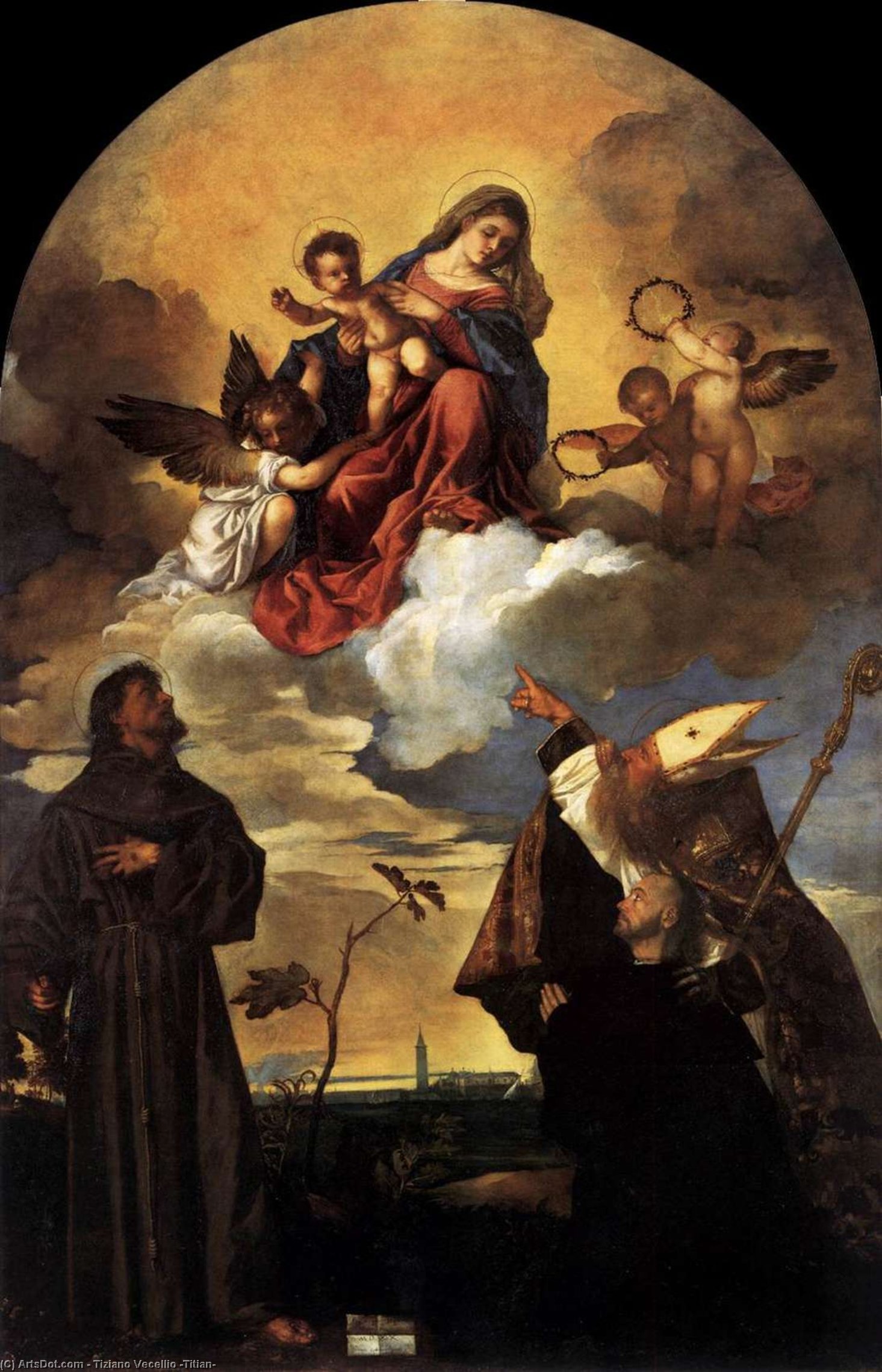
Titian’s "Madonna in Glory" masterpiece! Explore this stunning Renaissance oil painting featuring Mary, Christ & saints. A vibrant Baroque work by a legendary artist.
Titian
(1490 - 1576)
Titian (1488-1576): Venetian master of color & light, renowned for his portraits, mythological scenes, and innovative painting techniques. Explore a life of artistic brilliance.
Explore Ancona's rich artistic heritage at the Museo Civico! Discover Renaissance masterpieces by Titian & Podesti, local talent, and captivating Italian art within a historic setting.
A Celestial Embrace: Exploring Titian’s Madonna in Glory
The Venetian painter Titian Vecellio (1490 – 1576) remains an unrivaled champion of color and luminosity, a figure whose canvases continue to captivate audiences centuries after his death. His magnum opus, “Madonna in Glory with the Christ Child and Sts Francis and Anthony,” completed in 1520, transcends mere representation; it embodies the spiritual fervor of the High Renaissance while simultaneously establishing a new paradigm for artistic expression. Commissioned by Philip II of Spain—a pivotal moment in European history marked by papal schism and imperial ambition—the painting serves as both a devotional emblem and a testament to Titian’s unparalleled mastery of technique.
The Landscape Backdrop: Echoes of Venetian Grandeur
Beyond the luminous figures at its center lies a meticulously crafted landscape, reflecting the grandeur of Venice itself. The distant buildings—recognizable as architectural landmarks of the Serenissima Republic—are rendered with atmospheric perspective, subtly blurring into the misty horizon. This deliberate choice isn’t merely decorative; it establishes a symbolic connection between Mary and Jesus' divine realm and the earthly city they inhabit. The undulating clouds dominate the upper portion of the canvas, bathed in ethereal blues and whites—a masterful illusion achieved through layering oil paint to create depth and luminosity. These swirling formations convey a sense of movement and transcendence, mirroring the spiritual journey undertaken by those contemplating the sacred scene.
A Symphony of Color: Titian’s Revolutionary Palette
Titian's brilliance lay not only in his compositional skill but also in his audacious use of color—a characteristic that distinguishes him from many of his contemporaries. He eschewed the muted palettes favored by artists like Raphael and Michelangelo, opting instead for a vibrant tapestry of hues that would revolutionize painting practice. The dominant colors—gold, crimson, azure—are applied with astonishing precision, capturing subtle variations in tone and saturation. This technique—known as glazing—involved applying thin layers of translucent pigment over previously painted surfaces, resulting in an unparalleled richness and depth of color. The radiant glow emanating from Mary’s robes and Jesus’ infant form underscores Titian's commitment to conveying emotion through visual means; the colors themselves seem to vibrate with spiritual energy.
Symbolism Woven into Every Detail: Saints and Divine Grace
“Madonna in Glory” is replete with symbolic elements that enrich its theological significance. St Francis of Assisi, depicted kneeling before Mary, embodies humility and piety—qualities revered throughout Christendom. Beside him stands St Anthony the Abbot, symbolizing ascetic devotion and spiritual contemplation. The angel hovering above Mary’s head represents divine grace and protection, guiding her towards salvation. Furthermore, the radiant halo encircling Mary's head reinforces her status as Mother of God—a central dogma of Christian faith. These figures are rendered with meticulous anatomical accuracy, reflecting Titian’s profound understanding of human anatomy—a pursuit that fueled his artistic innovation and cemented his reputation as a pioneer of realism.
Emotional Resonance: A Vision of Heavenly Perfection
Ultimately, “Madonna in Glory” succeeds in conveying an overwhelming sense of serenity and spiritual contemplation. The harmonious composition, coupled with Titian's masterful use of color and light, draws the viewer into a realm beyond earthly concerns—a space where beauty transcends materiality and elevates the soul. It’s a painting that speaks to the deepest aspirations of human experience: the yearning for divine grace, the pursuit of moral virtue, and the affirmation of faith as an enduring source of solace and inspiration. Its legacy persists today, serving as a timeless exemplar of artistic excellence and a poignant reminder of the transformative power of art.