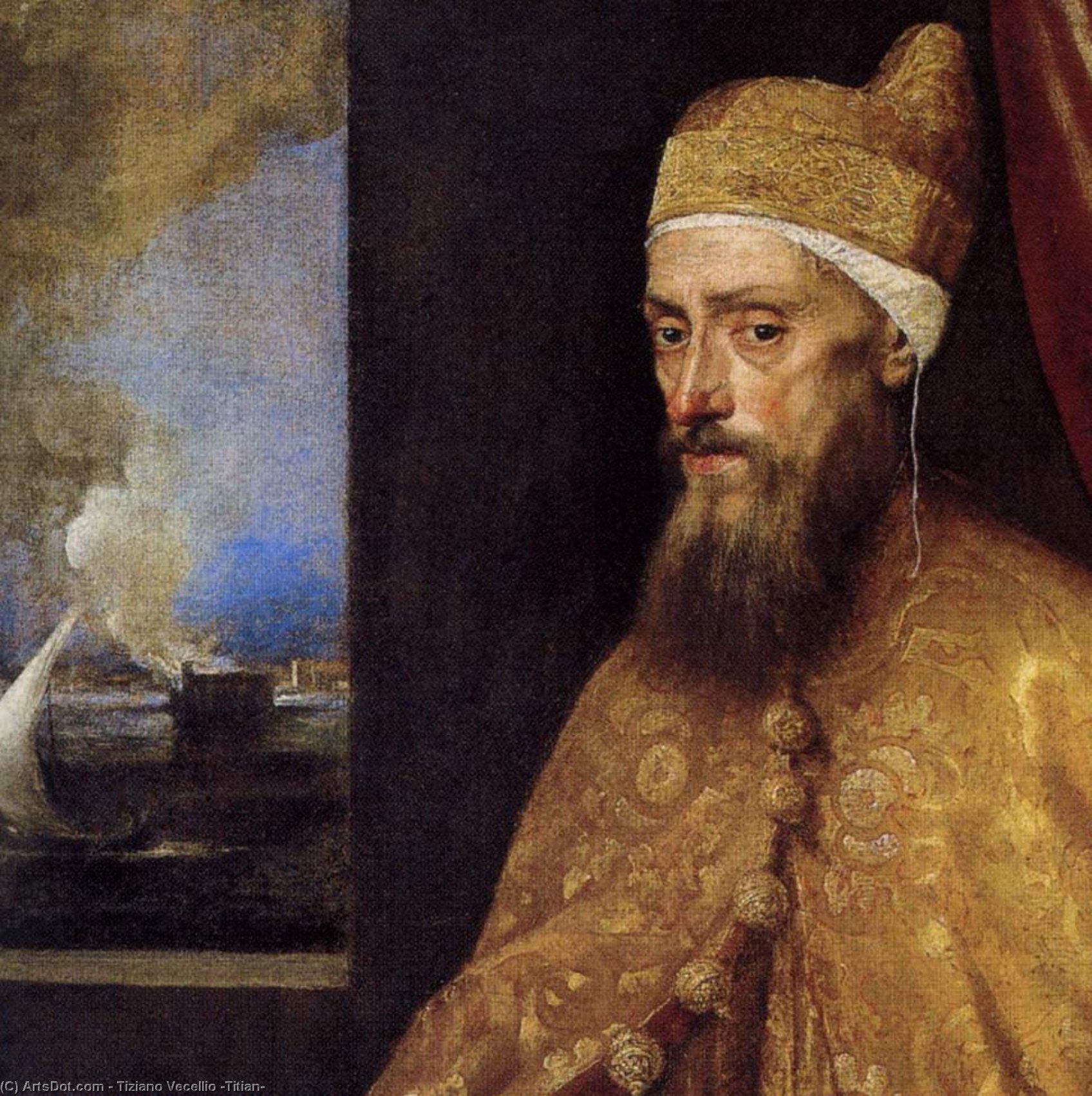
A Regal Gaze: Unveiling Titian’s Portrait of Doge Francesco Venier
Titian's Portrait of the Doge Francesco Venier (detail), painted in 1554, isn’t merely a likeness; it’s a carefully constructed embodiment of Venetian power and prestige. Housed within the Museo Thyssen-Bornemisza in Madrid, this intimate study offers a rare glimpse into the mind of a man who presided over one of Europe's most influential republics – Francesco Venier himself. The painting immediately commands attention with its masterful use of color, a hallmark of Titian’s distinctive style, and the subtle yet potent portrayal of authority radiating from the Doge’s countenance.
The scene unfolds with a quiet dignity. Doge Venier, rendered in rich, layered oils on canvas, sits poised against a backdrop that subtly anchors him within the context of his office. Two boats, painted with an almost dreamlike quality, drift across the horizon – a deliberate inclusion by Titian, suggesting both the maritime heart of Venice and perhaps hinting at the Doge’s role as protector of its vital trade routes. The composition isn't overly dramatic; instead, it favors a measured restraint that allows Venier’s presence to dominate. The careful placement of the boats creates depth and atmosphere, drawing the viewer into this carefully orchestrated tableau.
The Language of Power: Symbolism and Technique
Titian’s genius lies not just in his technical skill but also in his ability to imbue a portrait with layers of meaning. The gold crown and scepter are undeniably symbols of Venier's elevated status, representing the authority vested in him as Doge – Venice’s elected ruler. However, it is the Doge’s expression that truly captivates. It’s not a boisterous display of power, but rather a carefully controlled sternness, a gaze that suggests both wisdom and an unwavering commitment to his duty. This deliberate restraint speaks volumes about Venetian political culture – a blend of outward grandeur and underlying strategic calculation.
Technically, the painting showcases Titian’s evolution as an artist. He departs from earlier Venetian practices, moving away from the reliance on preparatory drawings that characterized many of his predecessors. Instead, he embraced a more intuitive approach, making significant changes during the painting process – a technique reminiscent of Giorgionesque methods but executed with Titian's unparalleled coloristic brilliance. The layering of glazes creates an incredible sense of luminosity and depth, particularly noticeable in the folds of Venier’s robes and the reflective surfaces of his crown. The subtle variations in tone and hue contribute to the painting’s overall richness and complexity.
A Renaissance Masterpiece: Context and Influence
Portrait of the Doge Francesco Venier (detail) is a pivotal work within Titian's oeuvre, marking an important stage in his development. It aligns with a series of early Madonna paintings featuring landscapes – a stylistic choice that distinguished Titian from many of his contemporaries. His use of dark eyes in these Madonnas, as noted by art historians, created a unique and emotionally resonant effect, setting him apart within the Venetian artistic landscape.
Titian’s work was profoundly influenced by figures like Giovanni Bellini, whose paintings often prioritized spiritual contemplation over earthly representation. However, Titian's approach – exemplified in this portrait – embraced physicality and sensuality, reflecting a shift towards a more humanist perspective within the Renaissance. The painting stands as a testament to Titian’s ability to synthesize these influences into a distinctly personal and powerful style. It is a window into the vibrant world of 16th-century Venice, offering a compelling glimpse into the life and legacy of one of its most influential figures.
Bringing the Detail Home: Reproductions and Artistic Inspiration
ArtsDot offers meticulously crafted hand-painted reproductions that capture the essence of Titian’s masterpiece. Each reproduction is created by skilled artists who understand the nuances of Titian's technique, ensuring a faithful representation of the original painting’s color, texture, and emotional impact. Whether adorning a grand salon or adding a touch of Renaissance elegance to a contemporary space, this portrait offers an unparalleled opportunity to experience the enduring beauty and power of one of art history’s greatest masters.