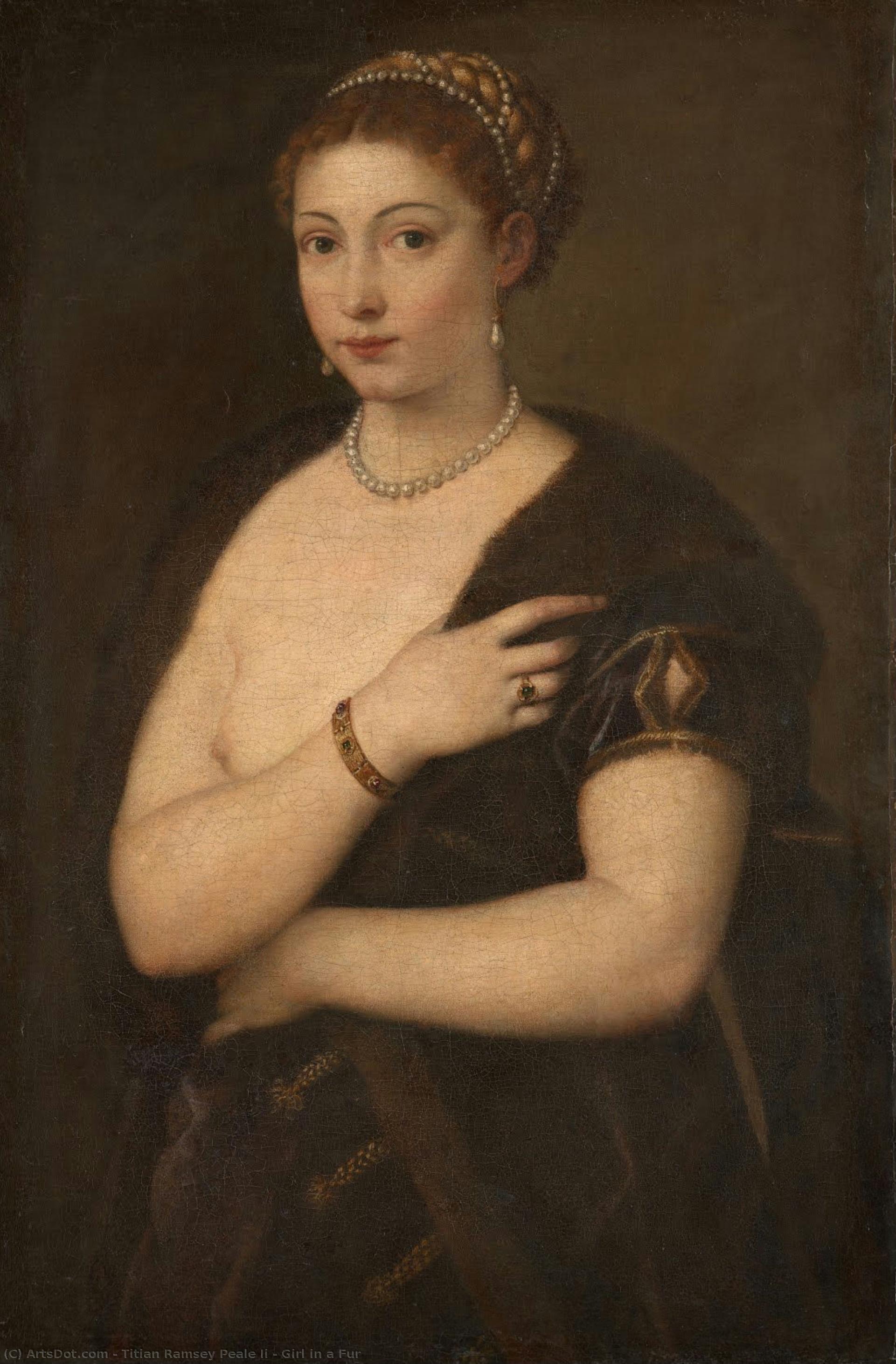
A Glimpse of Venetian Sensuality: Titian Ramsay Peale II’s Reimagining of “Girl in a Fur”
Titian Ramsay Peale II's masterful rendition of "Girl in a Fur," completed around 1540, isn’t merely a copy; it’s an echo of Venice resonating within the burgeoning artistic landscape of 19th-century America. Born into a family deeply entwined with the history of American art – his father, Charles Willson Peale, was a celebrated portraitist and founder of the first museum in the nation – Peale II inherited a profound respect for classical aesthetics, particularly those championed by the Venetian masters. This painting stands as a testament to that inheritance, a deliberate invocation of Titian’s original “Girl in a Fur,” yet imbued with Peale's own distinctive sensibility.
The subject herself remains an enigma, though scholars believe she was a recurring model for Titian, posing repeatedly for the Duke of Urbino and his son. Peale II captures this ambiguity beautifully, presenting her as a figure of alluring mystery rather than a straightforward portrait. The composition immediately draws the eye to the woman’s posture – a deliberate blend of modesty and provocation. She holds a luxurious fur cloak loosely draped across her shoulder, revealing a tantalizing glimpse of her breast, an element that speaks directly to Titian's original intention: not simply to depict beauty, but to explore the potent interplay between flesh and fabric, a theme powerfully explored in Giorgione’s “Laura.” The subtle shift in her stance, a hesitant beginning to unveiling further, hints at a carefully constructed narrative of desire and restraint.
Decoding Symbolism and Ornamentation
Beyond the immediate sensuality, Peale II's painting is rich with symbolic detail. The opulent jewelry – strings of pearls, delicate earrings, a bracelet, and a ring adorning her hand – elevates the scene beyond a simple depiction of beauty. These adornments weren’t merely decorative; they functioned as markers of status and wealth, subtly referencing the Venetian courtesans who frequented the courts of the time. The choice of jewelry also introduces a layer of complexity, suggesting a world of intrigue and perhaps even danger. The reference to the classical Venus Pudica is particularly significant, grounding the image in ancient ideals of chastity and beauty while simultaneously challenging them through the woman’s exposed form.
Notice, too, the careful attention to texture – the plushness of the fur contrasting with the smoothness of her skin. This tactile quality invites the viewer to engage with the painting on a sensory level, enhancing the overall emotional impact. The empty chair in the background further contributes to this sense of poised anticipation, as if the scene is about to unfold.
A Bridge Between Renaissance and American Art
Peale II’s interpretation of “Girl in a Fur” reveals a fascinating dialogue between the artistic traditions of Europe and the emerging identity of America. While deeply influenced by the High Renaissance – particularly Titian's mastery of color, light, and composition – Peale II infuses his work with a distinctly American sensibility. His meticulous attention to detail, reminiscent of his father’s naturalist studies, combined with his vibrant palette, creates an image that is both formally sophisticated and emotionally resonant.
The painting's journey through history—copied by Rubens and later admired by English collectors—underscores its enduring appeal. It represents a pivotal moment in the exchange of artistic ideas, demonstrating how European masters continued to inspire artists across continents and generations. Today, ArtsDot offers exquisite hand-painted reproductions that faithfully capture the beauty, mystery, and historical significance of Peale II’s “Girl in a Fur,” allowing art lovers worldwide to experience this captivating masterpiece firsthand.
Technical Details & Reproduction Quality
This reproduction is meticulously crafted using traditional oil painting techniques, mirroring the artistry of Titian Ramsay Peale II. The scale of 637 x 955 cm allows for a truly immersive viewing experience, capturing the full richness and detail of the original. We utilize archival-quality pigments and canvas to ensure that the colors remain vibrant and true for generations to come. The hand-painted process guarantees an unparalleled level of authenticity, surpassing the limitations of digital reproductions.
Whether you’re a seasoned collector or simply seeking a stunning addition to your home décor, this reproduction offers a unique opportunity to own a piece of art history – a tangible connection to the Venetian Renaissance and the artistic legacy of Titian Ramsay Peale II.