The Raw Essence of Anatomy: A Glimpse into Titian's Preparatory Mind
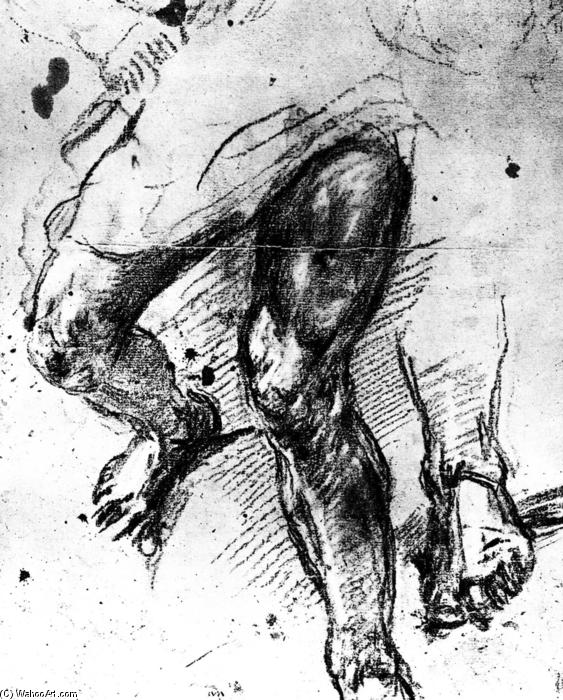
In the quiet, focused moments of a master’s studio, far from the grand canvases and finished mythological epics that define his legacy, lies the true heartbeat of creation. Titian’s Study of Legs (1557) offers an intimate, unvarnished window into this sacred process. This black and white drawing is not merely a sketch; it is a profound exploration of the human form in its most fundamental state. Through the masterful application of charcoal or pencil, the artist captures the tension of muscle and the structural grace of bone, presenting an anatomical study that feels both clinical in its precision and deeply alive in its execution. The dynamic pose of the figure suggests a moment caught in transition, a fleeting snapshot of movement that invites the viewer to witness the very mechanics of life being mapped out on paper.
The technique employed here is a testament to the Venetian master's unparalleled ability to manipulate light and shadow without the aid of color. Using heavy cross-hatching and deliberate shading, Titian creates a sense of immense volume and tactile texture. The lines do not merely outline; they sculpt. Every stroke contributes to a sense of weight and presence, where the interplay of dark tones and bright highlights mimics the way light falls across skin and sinew. This monochromatic approach strips away the distractions of palette, forcing the eye to focus entirely on the structural integrity of the subject. For the discerning collector or interior designer, this piece offers a sophisticated, minimalist aesthetic that brings the intellectual rigor of the Renaissance into a contemporary setting.
A Legacy of Precision and Artistic Intent
To understand this study, one must consider its historical context within the late Renaissance. By 1557, Titian was an established titan of the art world, yet his commitment to foundational mastery never wavered. This drawing serves as a vital link between the artist's observational studies and his finished masterpieces. There is no overt symbolism or narrative drama here; instead, the "symbolism" lies in the pursuit of truth through anatomy. The piece embodies the Renaissance ideal of mimesis—the imitation of nature—where the artist seeks to understand the underlying architecture of the human body to better portray the soul through its physical vessel.
For those looking to curate a space with depth and historical resonance, this reproduction provides an unparalleled opportunity. The artwork’s ability to command attention through form alone makes it a versatile choice for high-end galleries, study rooms, or modern living spaces where understated elegance is paramount. It evokes a sense of timelessness, bridging the gap between the 16th-century workshop and the modern eye. Owning such a piece is not just about decorating a wall; it is about hosting a conversation with history, celebrating the raw, preparatory brilliance that paved the way for the greatest era of European painting.