The Shadow of Betrayal: Titian’s Dramatic Depiction
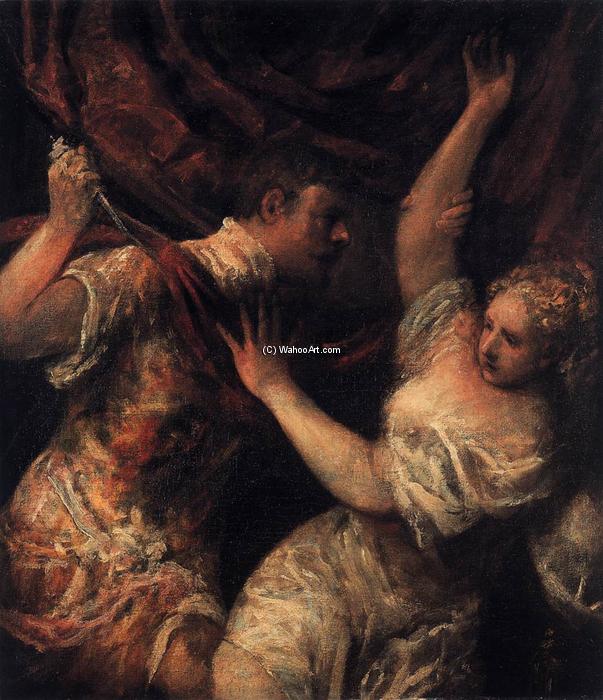
Titian’s “Tarquin and Lucretia,” completed in 1571 during the twilight years of his illustrious career, is not merely a painting; it's a visceral plunge into the heart of Roman legend. More than just recounting a tragic tale, Titian transforms a historical event—the rape of Lucretia by her husband’s brother, Sextus Tarquinius – into a profoundly moving exploration of power, betrayal, and the devastating consequences of unchecked ambition. The scene unfolds with an arresting immediacy, capturing a pivotal moment suspended between violence and despair, a frozen tableau of shattered innocence and impending revolution.
The painting’s immediate impact stems from Titian's masterful manipulation of light and shadow. A stark, almost theatrical illumination focuses on the central figures – Tarquin, looming over Lucretia with brutal force, and the woman herself, caught in a desperate struggle. The deep shadows that engulf much of the composition contribute to an atmosphere of foreboding and impending doom, mirroring the tragic fate that awaits them both. The use of pure white highlights—a deliberate choice by Titian—draws attention to the dagger poised above Lucretia’s hand, emphasizing her imminent act of self-destruction and adding a chilling intensity to the scene.
A Venetian Renaissance at its Finest: Style and Technique
“Tarquin and Lucretia” exemplifies the height of Venetian Renaissance painting. Titian, renowned for his vibrant color palettes and loose, expressive brushwork, eschews the rigid formality of earlier Italian masters in favor of a dynamic, almost turbulent style. His application of paint is remarkably free-flowing, creating a sense of movement and immediacy that draws the viewer directly into the drama unfolding before them. The figures are rendered with a remarkable degree of naturalism, yet imbued with an emotional intensity rarely seen in Renaissance art.
Titian’s technique is particularly evident in his masterful use of color. He employs a rich, saturated palette—deep reds, vibrant blues, and earthy browns—to create a visually arresting image. The luxurious fabrics worn by Tarquin and Lucretia further emphasize the decadence and corruption associated with the Roman monarchy. The subtle variations in tone and hue contribute to the painting’s overall sense of drama and emotional depth.
Echoes of Legend: Symbolism and Historical Context
The story of Tarquin and Lucretia is deeply rooted in Roman mythology and history, serving as a potent allegory for the overthrow of tyranny. Lucretia's suicide—a desperate act of defiance against an oppressive regime—became a symbol of female virtue and resistance. The painting’s enduring appeal lies in its ability to tap into universal themes of betrayal, injustice, and the struggle for freedom.
Titian was deeply aware of the historical context surrounding this narrative. He drew inspiration from classical sources, including Livy's *Ab Urbe Condita* (From the Founding of Rome), which recounts the events leading up to the establishment of the Roman Republic. The inclusion of details such as Lucretia’s jewelry and Tarquin’s opulent attire underscore the contrast between the moral decay of the monarchy and the ideals of republican virtue.
A Legacy of Emotion: The Painting's Enduring Power
“Tarquin and Lucretia” remains a profoundly moving work of art, captivating viewers with its dramatic intensity and emotional resonance. It’s more than just a historical depiction; it’s a meditation on the human condition—a poignant reminder of the devastating consequences of power abuse and the enduring strength of the human spirit. Reproductions of this masterpiece offer an opportunity to experience Titian's genius firsthand, bringing this dramatic tale to life in any setting.