A Celestial Vision in Color
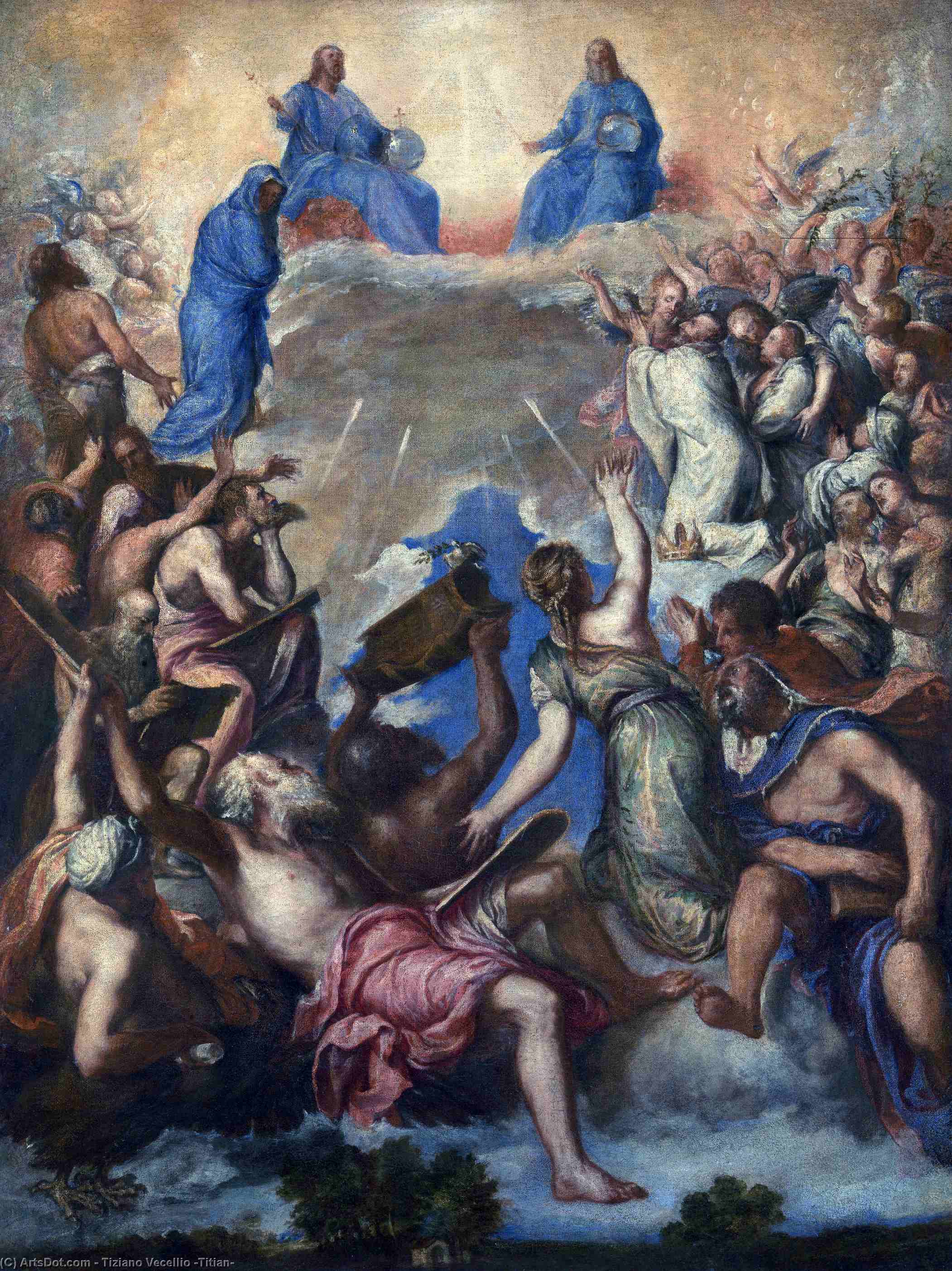
In the realm of High Renaissance mastery, few works capture the profound mystery of the divine as intimately as Titian’s The Trinity (La Gloria). This breathtaking composition serves as a window into the heavens, inviting the viewer to witness a sacred convergence of the eternal. At its heart lies the Holy Trinity—God the Father, Jesus Christ, and the Holy Spirit—arranged in a celestial circle that suggests both infinite unity and a rhythmic, divine movement. Titian, the undisputed master of the Venetian school, utilizes his legendary command over color to breathe life into this theological concept, transforming a complex religious dogma into a visceral, emotional experience that resonates across the centuries.
The painting is far more than a static icon; it is a swirling, atmospheric drama. Beyond the central figures, a host of angels and saints populate the periphery, scattered throughout the composition like stars in a cosmic firmament. Some appear close enough to touch, their forms rendered with soft, luminous edges, while others recede into a hazy, golden distance. This layering of figures creates an incredible sense of depth and scale, drawing the eye through layers of light and shadow, ultimately leading the soul toward the radiant center of the divine circle.
The Mastery of Venetian Light and Technique
To behold this work is to witness the pinnacle of Venetian colorism. Titian was a pioneer in using oil paint not merely as a medium for detail, but as a tool for sculpting light itself. In La Gloria, the technique is characterized by a rich, painterly texture where brushstrokes blend into one another to create a sense of "sfumato" or atmospheric softness. This approach allows the divine figures to emerge from a background that feels less like painted canvas and more like a living, breathing atmosphere of gold and ether.
For the discerning collector or interior designer, this piece offers an unparalleled opportunity to introduce a sense of grandeur and spiritual depth into a space. The painting’s complex composition—a delicate balance of many individual elements working toward a singular, harmonious whole—makes it a profound focal point for any curated collection. Whether placed in a formal gallery setting or as a commanding centerpiece in a sophisticated living space, the artwork radiates an aura of timelessness and prestige.
Symbolism and Emotional Resonance
Every element within this masterpiece is imbued with deep symbolic significance. The circular arrangement of the Trinity represents the eternal nature of God, having no beginning and no end. The interplay between the figures suggests a continuous cycle of creation, sacrifice, and grace. As the eye wanders through the crowded celestial landscape, the viewer encounters the saints and angels, whose presence serves as a bridge between the earthly realm and the divine heights depicted in the center.
The emotional impact of The Trinity is one of overwhelming awe and quiet contemplation. It evokes a sense of peace found within complexity, and a feeling of transcendence that transcends mere visual appreciation. For those seeking to decorate with art that possesses both historical weight and an evocative soul, this reproduction of Titian’s genius offers a profound connection to the heights of human creativity and the enduring power of sacred storytelling.