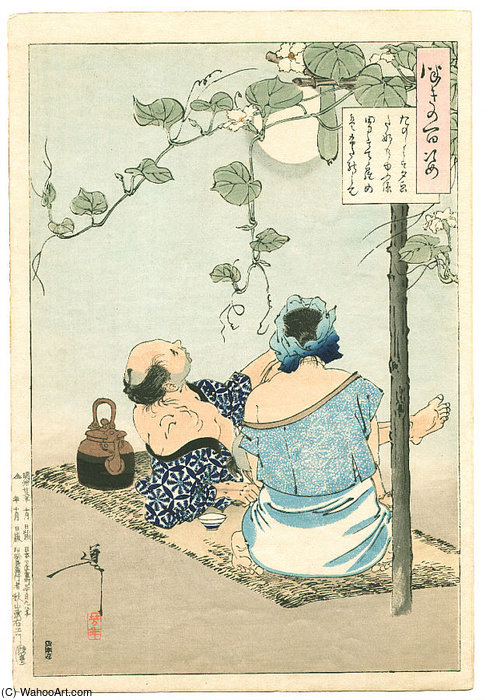
Discover 'Peasant Couple' by tsukioka yoshitoshi – a serene Ukiyo-e woodblock print featuring a contemplative elderly couple. Explore its symbolism & timeless beauty.
Tsukioka Yoshitoshi (1839-1892): Last master of Ukiyo-e woodblock printing, famed for dramatic scenes & innovative artistry reflecting Japan's turbulent transition. Explore his warrior prints and legacy.
A Moment of Quiet Contemplation: Tsukioka Yoshitoshi’s ‘Peasant Couple’
This captivating woodblock print by Tsukioka Yoshitoshi, a leading figure in the late Edo and Meiji periods, offers a serene glimpse into rural Japanese life. The artwork depicts an elderly man and woman engaged in what appears to be a thoughtful exchange beneath the protective canopy of a flourishing vine heavy with gourds. It’s a scene imbued with stillness and subtle narrative potential, characteristic of Ukiyo-e – “pictures of the floating world” – yet possessing a unique depth reflective of Yoshitoshi's artistic vision. The composition is vertically oriented, drawing the eye upwards along the vine, emphasizing its abundance and symbolic weight.
Masterful Technique & Ukiyo-e Conventions
Yoshitoshi expertly employs the traditional Ukiyo-e woodblock printing technique. Bold outlines define the figures and forms, while flat planes of color create a stylized aesthetic. Notice the deliberate absence of complex shading; instead, Yoshitoshi relies on line work and carefully chosen hues – predominantly greens, blues, and browns – to establish form and atmosphere. The texture inherent in the woodblock process lends a subtle graininess to the print, enhancing its tactile quality. This technique, combined with atmospheric perspective, creates a sense of depth despite the flattened spatial representation typical of the genre. Yoshitoshi’s skill lies not just in replicating these conventions but in refining them, imbuing his work with a distinctive emotional resonance.
Symbolism & Narrative Threads
The imagery within ‘Peasant Couple’ is rich with potential symbolism. The sprawling vine and its abundant gourds are particularly noteworthy. Vines often represent longevity and enduring connection, while gourds in Japanese art can symbolize wisdom, good fortune, or even serve as a visual pun – their shape sometimes referencing riddles or proverbs. The couple's contemplative posture suggests they may be discussing such a riddle, adding a layer of intellectual engagement to the scene. Yoshitoshi frequently incorporated subtle narratives and allegorical elements into his work, inviting viewers to interpret the meaning behind the imagery. This piece is no exception; it’s a quiet story waiting to unfold in the mind of the observer.
Yoshitoshi: The Last Great Master
Born Owariya Yonejiro in 1839, Tsukioka Yoshitoshi became one of the most celebrated and innovative artists of his time. Apprenticed to Utagawa Kuniyoshi, he initially gained recognition for his dramatic and often violent depictions of historical events – earning him the moniker “the last great master” of Ukiyo-e. However, Yoshitoshi’s artistic range extended far beyond these ‘bloody prints’. He was a keen observer of social change in Meiji Japan, and his work reflects both the turbulence and beauty of this transformative period. 'Peasant Couple' showcases a different facet of his talent – a quiet sensitivity and appreciation for everyday life that resonates with viewers even today. This print offers not only an aesthetic pleasure but also a window into the artistic legacy of a true master.