Carlo Carrà: A Pioneer of Expressionism’s Quiet Revolution
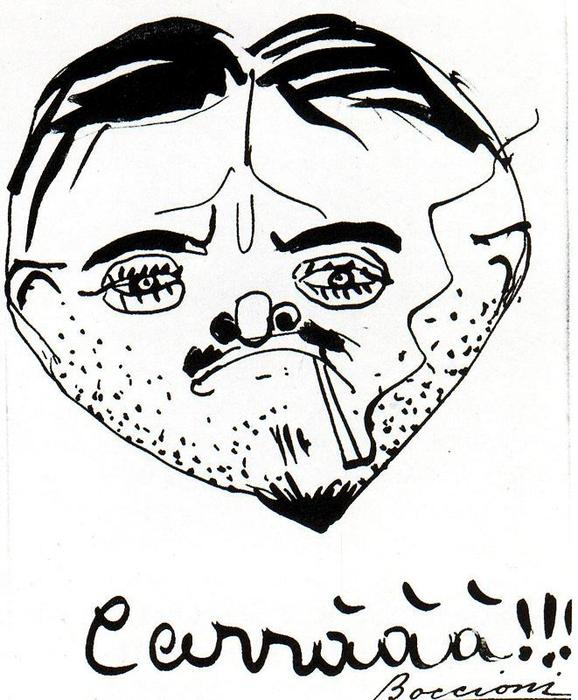
Umberto Boccioni's charcoal sketch of Carlo Carrá stands as a testament to the understated brilliance of Expressionist art—a movement that sought to convey emotion and psychological depth rather than merely replicating visual reality. Unlike the frenetic dynamism championed by Futurists like Marinetti, Boccioni’s approach here prioritizes capturing the essence of Carrà's presence through meticulous linework and tonal modulation. The drawing embodies a profound sensitivity to form and texture, reflecting the influence of Giotto and foreshadowing the groundbreaking explorations of Giorgio de Chirico that would soon follow.
- Subject Matter: The portrait focuses intently on Carrá’s head and shoulders, presenting him with unwavering gaze—a deliberate choice that underscores the artist's commitment to portraying inner states alongside external appearances.
- Style & Technique: Boccioni employs a charcoal pencil on paper, utilizing hatching and cross-hatching techniques to build up subtle gradations of tone and create an illusion of palpable surface texture. This method lends itself beautifully to capturing the nuances of Carrá’s facial features and hair—a masterful demonstration of expressive drawing.
- Composition: The cropped framing emphasizes the figure's centrality, creating a sense of intimacy and immediacy. The placement of handwritten text beneath the image adds another layer of complexity, hinting at personal reflection or perhaps an attempt to contextualize Carrá’s artistic legacy.
Echoes of Giotto: An Archaic Resonance
Boccioni's stylistic choices reveal a deliberate harkening back to the frescoes of Giotto di Bondone—a Florentine painter who revolutionized art by prioritizing emotional truth over idealized representation. Just as Giotto sought to convey spiritual significance through simplified forms and expressive gestures, Boccioni similarly strives to distill Carrá’s character into its most fundamental elements. This stylistic affinity speaks to a broader artistic impulse toward reclaiming the purity of early Renaissance aesthetics—a reaction against the perceived excesses of academic art and a celebration of timeless beauty.
- Influence: The artist's fascination with Giotto’s work is palpable in his meticulous attention to detail and his preference for organic shapes—characteristics that resonate deeply with Giotto’s groundbreaking approach to portraying human figures.
- Emotional Impact: Boccioni’s drawing succeeds in conveying a sense of quiet contemplation and understated dignity—qualities that align perfectly with the spiritual ethos of Giotto’s frescoes.
Metaphysical Hints: Exploring Depth Beyond Surface Appearance
The influence of Giorgio de Chirico, whom Boccioni encountered during his travels to Paris in 1912, further expands the artistic horizons of this portrait. Like De Chirico, Boccioni investigates psychological states through unsettling juxtapositions and dreamlike imagery—a technique that anticipates the emergence of “metaphysical painting.” The subtle inclusion of mannequin figures—a recurring motif in De Chirico’s oeuvre—suggests a preoccupation with themes of alienation and existential uncertainty—ideas that find their expression in Carrá's solemn gaze.
- Symbolism: The use of mannequins serves as a visual metaphor for the artist’s exploration of psychological landscapes—a deliberate departure from traditional portraiture conventions.
- Historical Context: This stylistic convergence reflects the broader artistic currents of the early 20th century—a period marked by experimentation and intellectual ferment—and underscores Boccioni's commitment to pushing the boundaries of artistic expression.
A Legacy of Quiet Intensity
Ultimately, Umberto Boccioni’s charcoal sketch of Carlo Carrá embodies a profound appreciation for both Giotto’s spiritual vision and De Chirico’s unsettling explorations of psychological depth—a synthesis that secures Carrá's portrait as an enduring masterpiece of Expressionist art. Its understated elegance and masterful technique invite viewers to contemplate the complexities of human experience—a testament to Boccioni’s unwavering belief in the transformative power of art.