A Window into Modernity: Decoding Boccioni’s “Portrait of Ferruccio Busoni”
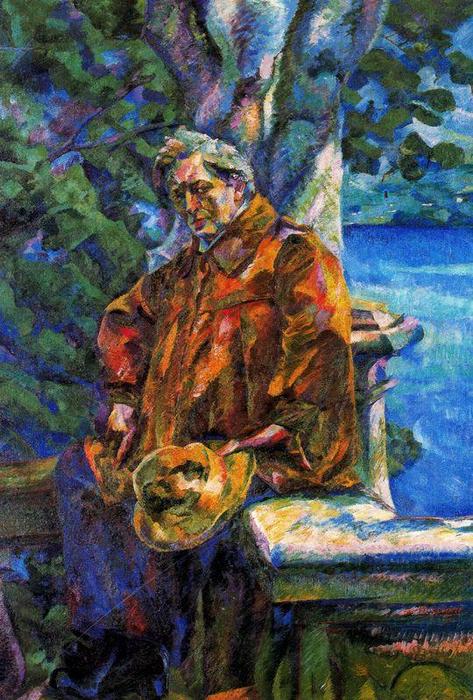
Umberto Boccioni's 1916 portrait of the celebrated composer Ferruccio Busoni is more than a likeness captured on canvas; it’s a vibrant distillation of an era, a testament to artistic kinship, and a poignant reflection on the cusp of change. Painted in the final months of Boccioni’s tragically short life, the work embodies the core tenets of Futurism while simultaneously reaching beyond its boundaries, hinting at a deeper exploration of form and emotion. The scene unfolds outdoors, immersing Busoni within a lush environment that feels both grounding and dynamic. He is seated, partially obscured by a hat, creating an intriguing sense of mystery – not hiding, but rather inviting contemplation on the intellectual energy radiating from within.
The Energetic Brushstroke: Technique and Futurist Principles
Boccioni’s masterful technique is immediately apparent in the vigorous impasto—the thick application of oil paint that lends a tactile quality to the surface. This isn't merely about depicting texture; it’s about conveying energy, mirroring the dynamism Busoni himself embodied as a composer constantly pushing boundaries. The brushstrokes aren’t blended or smoothed but remain visible, swirling and flowing like currents of thought. Lines are predominantly organic, echoing the natural forms surrounding Busoni, yet they possess an underlying sense of controlled chaos characteristic of Futurist principles. Boccioni wasn't interested in strict realism; he sought to capture not just *what* Busoni looked like but the very essence of his presence and the intellectual atmosphere that enveloped him. The layering of colors builds depth while deliberately flattening perspective, prioritizing emotional impact over photographic accuracy. This approach allows the painting to vibrate with life, a visual equivalent of Busoni’s complex musical compositions.
A Moment Suspended: Historical Context and Artistic Dialogue
The year 1916 was a pivotal one, shadowed by the immense upheaval of World War I. Italy found itself embroiled in conflict, and even the celebratory fervor that initially defined Futurism began to grapple with the harsh realities of war. This portrait emerges from this tumultuous context as a quiet moment of contemplation amidst chaos. It’s a tribute not just to Busoni as an artist but also to the power of intellectual connection during times of uncertainty. Boccioni and Busoni shared a mutual respect, both innovators in their respective fields who challenged conventional norms. The painting can be seen as a visual dialogue between two forward-thinking minds, a recognition of kindred spirits navigating a rapidly changing world. The warm hues dominating Busoni’s clothing – oranges, reds, and yellows – contrast beautifully with the cooler blues and greens of the foliage, drawing the eye and creating a harmonious tension that reflects this artistic exchange.
Beyond Representation: Emotional Resonance and Interior Appeal
“Portrait of Ferruccio Busoni” transcends mere representation; it’s an evocation of mood and atmosphere. The swirling brushstrokes, vibrant colors, and dynamic composition create a sense of movement and energy that draws the viewer in. The partially obscured face invites projection, fostering a personal connection with the artwork. It's a painting that doesn't simply *show* you Busoni; it allows you to *feel* his presence. For collectors and interior designers, this piece offers a striking focal point for modern or eclectic spaces. Its Italian avant-garde sophistication adds depth and character to any room, particularly living rooms, studies, or music rooms where its energy and intellectual weight can be fully appreciated. It’s an investment not just in a beautiful object but in a powerful statement about artistic vision and the enduring legacy of Futurism.