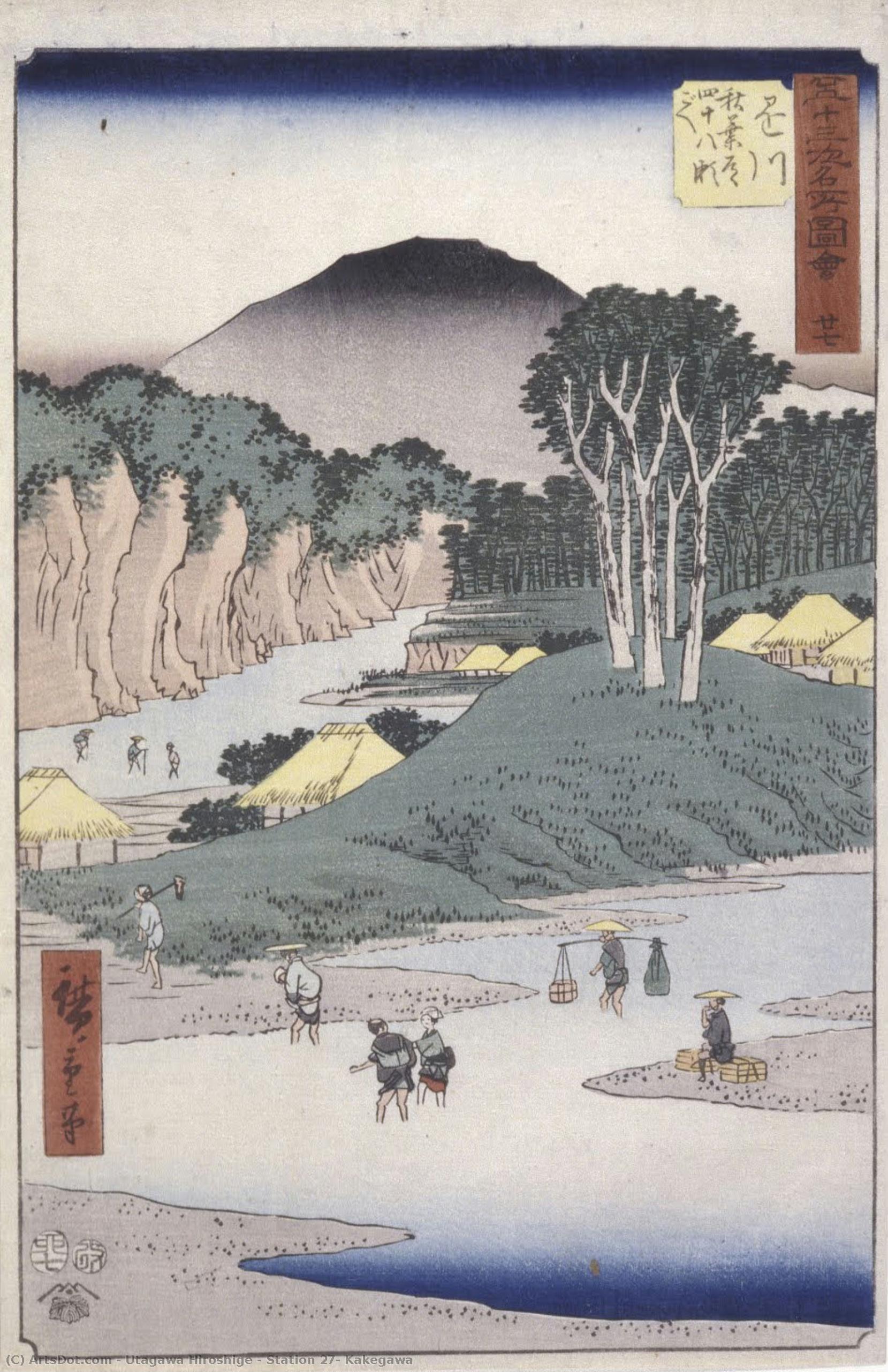
A Snapshot of a River’s Flow: Utagawa Hiroshige's "Station 27, Kakegawa"
Utagawa Hiroshige’s “Station 27, Kakegawa” isn’t merely a depiction of a riverbank; it’s a carefully constructed moment suspended in time. Created in 1855 during the twilight years of the Edo period, this woodblock print offers a serene glimpse into the heart of Japan's landscape and social fabric. The scene unfolds along the Kakegawa River, winding its way through the mountainous region of Shizuoka Prefecture – a vital artery for travelers on the Tokaido Road, one of Japan’s main arteries connecting Edo (modern Tokyo) with Kyoto.
Hiroshige, considered the last great master of *ukiyo-e* (pictures of the floating world), eschewed the typical subject matter of this genre – courtesans and actors – to focus on capturing the essence of Japan’s natural beauty. He sought to evoke a feeling, a mood, rather than simply reproduce a scene. This print is a testament to that ambition; it's less about precise detail and more about conveying the quiet dignity and inherent harmony of the landscape.
The Art of *Ukiyo-e*: Technique and Vision
This particular work exemplifies Hiroshige’s mastery of *nivatō-zuri* printing, a complex technique that allowed for multiple colors to be applied in layers. The print is composed of at least seven distinct colors – Prussian blue, red, green, yellow, black, and white – meticulously hand-carved into wooden blocks and carefully printed onto rice paper. Notice the subtle gradations of color, particularly in the distant mountains and the reflections on the water; these are achieved through *bokashi*, a technique involving applying multiple layers of ink to create soft transitions and atmospheric effects. The composition is deliberately flattened, creating a sense of depth through careful placement of elements and the use of perspective—a key element that Hiroshige adopted from Western art.
The figures in the foreground – nine individuals walking along the riverbank – are rendered with remarkable simplicity, their forms almost dissolving into the landscape. This deliberate blurring emphasizes their connection to nature, suggesting a sense of timelessness and belonging. They aren’t presented as distinct characters but rather as integral parts of the scene's overall composition.
A Window into Edo Japan: Context and Symbolism
“Station 27, Kakegawa” was created during a period of significant social and political change in Japan. The Tokugawa shogunate’s rule was nearing its end, and the country was beginning to open up to Western influences. Hiroshige's work reflects this transition—a longing for the traditional beauty of Japan while simultaneously embracing new artistic techniques. The Tokaido Road itself held immense significance; it represented a vital connection between two major cities and facilitated trade and travel.
The river, with its gentle flow and reflections, symbolizes continuity and the passage of time. The mountains in the background represent strength, stability, and the enduring spirit of Japan. The figures walking along the riverbank embody the everyday lives of ordinary people—a reminder that even amidst societal shifts, the rhythms of nature and human existence continue.
Bringing Hiroshige’s Vision Home: Reproduction and Interpretation
ArtsDot offers meticulously crafted hand-painted reproductions of “Station 27, Kakegawa,” capturing the essence of Hiroshige's original masterpiece. These reproductions are created by skilled artisans who understand the nuances of *ukiyo-e* printing techniques, ensuring that every detail—from the subtle color gradations to the delicate brushstrokes—is faithfully reproduced.
Whether displayed in a traditional Japanese room or a modern interior, this print evokes a sense of tranquility and connection to nature. It’s more than just a decoration; it's a portal into Edo Japan, inviting viewers to contemplate the beauty of the landscape and the enduring spirit of a bygone era. Consider how its serene composition can bring a sense of calm and reflection to your space – a timeless reminder of the power of art to transport us beyond our everyday lives.