Utagawa Kuniyoshi: A Titan of Tranquil Strength
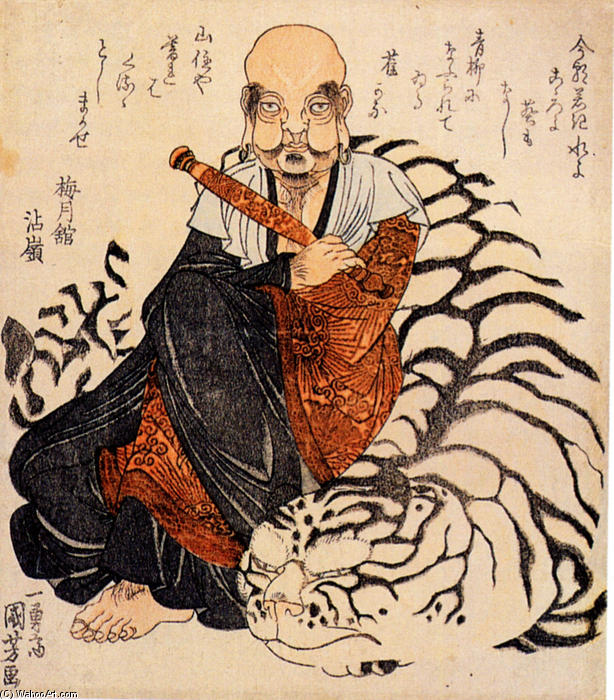
The artwork, titled “Hattara Sonja with his white tiger,” is a portrait by the esteemed artist Utagawa Kuniyoshi and belongs to the Ukiyo-e art movement. It’s a masterful depiction of serenity interwoven with formidable power—a hallmark of Kuniyoshi's distinctive style and a testament to his profound understanding of Japanese culture. This monochrome woodblock print captures not merely an image, but an essence: the dignified composure of an elder statesman accompanied by the unwavering courage symbolized by his companion tiger.
- Subject Matter & Composition: Kuniyoshi’s focus is singular—a seated man, Hattara Sonja, positioned centrally against a backdrop of densely layered foliage and swirling clouds. This deliberate arrangement draws the viewer's eye immediately to his face, conveying an aura of profound contemplation despite the imposing presence of the tiger at his feet.
- Style & Technique: Characteristic of Ukiyo-e, “Hattara Sonja” employs bold outlines and simplified forms—techniques honed through years of apprenticeship within Toyokuni’s studio. Kuniyoshi's masterful use of hatching and cross-hatching creates a rich textural effect, particularly noticeable on Sonja’s robes and the tiger’s fur, lending an unparalleled sense of realism to this stylized representation.
The tiger itself is more than just an animal; it embodies strength, vigilance, and protection—concepts deeply rooted in Japanese mythology and symbolism. Its placement beneath Sonja underscores a harmonious balance between wisdom and courage—a recurring motif throughout Kuniyoshi’s oeuvre. The artist skillfully utilizes perspective to flatten the scene, prioritizing emotional impact over strict spatial accuracy—a stylistic choice that aligns perfectly with the contemplative mood of the portrait.
- Historical Context: Kuniyoshi flourished during the twilight years of Edo Japan (1798-1861), a period marked by social conservatism and artistic innovation. His work reflects both these forces—embracing traditional motifs while simultaneously experimenting with Western influences in landscape painting, notably shading techniques.
- Symbolism & Emotional Impact: “Hattara Sonja” transcends mere visual depiction; it communicates profound ideas about honor, resilience, and the acceptance of mortality. The artwork evokes a feeling of quiet dignity—a reminder that true strength resides not only in physical prowess but also in inner peace.
Kuniyoshi’s legacy extends far beyond individual prints. He revolutionized Ukiyo-e by elevating its expressive capabilities, establishing himself as one of the last great masters of this influential art form. Reproductions of “Hattara Sonja” offer a captivating glimpse into Japanese artistic tradition—a timeless masterpiece that continues to inspire admiration and contemplation centuries after its creation.
Kuniyoshi's Revolutionary Approach to Landscape Painting
Utagawa Kuniyoshi (1798-1861), a titan of Japanese Ukiyo-e, stands as a beacon of artistic brilliance at the cusp of this celebrated art movement. His journey began not amidst formal academies but within the practical confines of his father’s silk dyeing business—a formative experience that subtly imbued his later works with an unmistakable vibrancy. Yet, from boyhood, Kuniyoshi was captivated by the dramatic world of Ukiyo-e, particularly heroic imagery—warriors and artisans—that populated popular prints. This passion ignited within him a dedication that would define his life’s artistic pursuit. He entered Toyokuni I's studio in 1811, adopting Kuniyoshi as his name and embarking on a rigorous apprenticeship that honed his skills and introduced him to the conventions of the Utagawa school.
- Western Influence: Kuniyoshi’s groundbreaking contribution wasn’t merely stylistic consistency; it was an audacious embrace of Western perspective—a technique pioneered by artists like Canaletto—which dramatically transformed landscape painting within Ukiyo-e.
This innovation signaled a pivotal moment in Japanese art history, demonstrating Kuniyoshi's willingness to transcend established boundaries and forge new paths toward artistic expression. His prints are characterized by bold outlines, simplified forms, and dramatic contrasts—a stylistic hallmark that distinguishes him from his contemporaries. The artist’s meticulous attention to detail—particularly in rendering foliage and clouds—elevates “Hattara Sonja” beyond mere representation; it achieves a level of emotional resonance unmatched by many other Ukiyo-e prints.
The Maestro's Signature Style: Bold Outlines & Textured Surfaces
Kuniyoshi’s artistic prowess manifested itself not only in his subject matter but also in his unparalleled mastery of technique—a cornerstone of his enduring fame. He perfected the art of woodblock printing, transforming it into a medium capable of conveying profound emotion and capturing breathtaking beauty. The process involved carving intricate designs onto wooden blocks—a labor-intensive undertaking that demanded unwavering precision and artistic vision.
Hatching & Cross-hatching: Kuniyoshi’s signature technique—hatching and cross-hatching—created a remarkable textural effect, particularly noticeable on Sonja’s robes and the tiger’s fur. This meticulous layering of lines produced an illusion of depth and volume—a feat rarely accomplished by other Ukiyo-e artists.
His dedication to craftsmanship ensured that each print possessed an exceptional quality—a testament to his unwavering commitment to artistic excellence. Kuniyoshi's legacy continues to inspire admiration and scholarship, cementing his position as one of the final luminaries of Ukiyo-e—a timeless masterpiece that transcends temporal boundaries.
Kuniyoshi’s Enduring Legacy: A Symbol of Artistic Innovation
Utagawa Kuniyoshi (1798-1861) remains an unparalleled figure in Japanese art history—a testament to his transformative influence on the Ukiyo-e tradition. His willingness to experiment with Western perspective and shading techniques revolutionized landscape painting, establishing him as a pioneer of artistic innovation.
Influence on Subsequent Artists: Kuniyoshi’s stylistic breakthroughs reverberated throughout the art world—inspiring generations of artists who followed in his footsteps and furthering the evolution of Ukiyo-e into an enduring cultural icon.
His prints—including “The One Hundred and Eight Heroes of the Popular Suikoden”—continue to captivate audiences worldwide—a testament to their timeless beauty and profound artistic merit. Kuniyoshi’s unwavering dedication to craftsmanship ensured that each print possessed exceptional quality—a legacy that secures his place among the greatest masters of Japanese art.