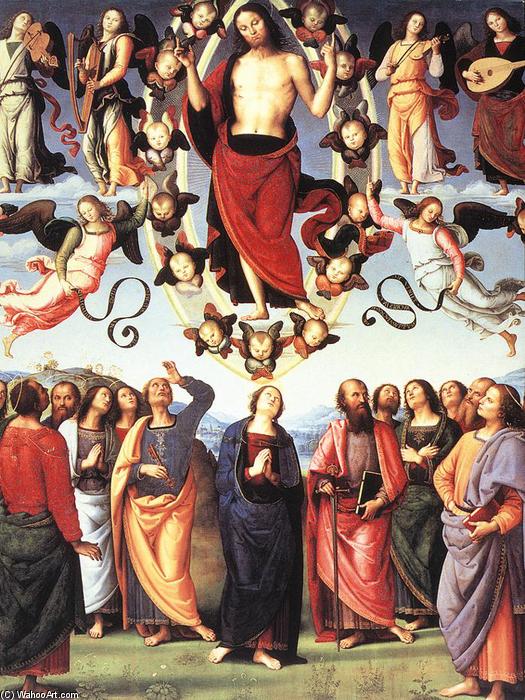
The
Ascension of Christ is a renowned painting created by the Italian artist
Vannucci Pietro (Le Perugin) in 1496. This oil on panel piece measures 342 x 263 cm and is housed at the
Musée Municipal des Beaux-Arts in Lyon, France. The painting depicts a pivotal moment in Christian theology, showcasing Jesus Christ's ascension into heaven after his resurrection.
Artistic Style and Composition
The
Ascension of Christ exemplifies the artistic style of the late Renaissance period, characterized by dramatic composition and rich coloration. The central figure of Jesus Christ is surrounded by a group of people, including angels and disciples, who are looking upwards in awe and contemplation. The use of light and shadow creates a sense of depth, drawing the viewer's attention to the central figure.
Key Features of the painting include:
- Detailed drapery and lifelike figures
- A strong use of light to highlight the central figure
- A clear blue sky, symbolizing the heavens and the divine realm
Artist's Background and Other Works
Vannucci Pietro (Le Perugin) was a prominent Italian artist of the Renaissance period. His other notable works include Piet, housed at the
Galleria degli Uffizi in Florence, Italy, and
Madonna and Child with Four Saints. More information about the artist and his works can be found on
ArtsDot.com. The
Ascension of Christ is a significant work of art that showcases the artist's skill and contribution to the Renaissance period. For those interested in learning more about this painting and other works by
Vannucci Pietro (Le Perugin), visit
ArtsDot.com or the
Musée Municipal des Beaux-Arts in Lyon, France.
The painting's historical and cultural significance can also be explored on
Wikipedia.