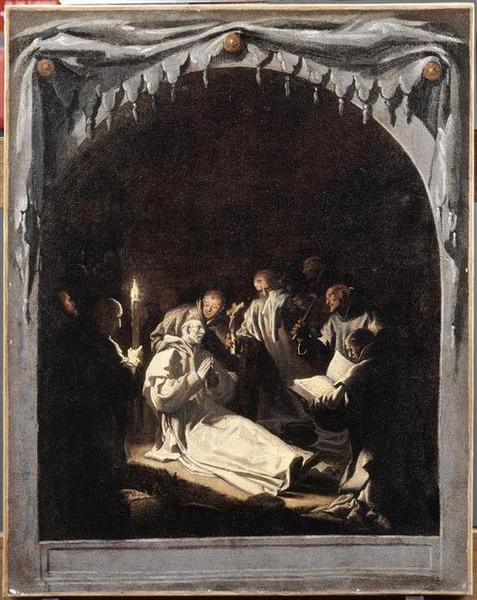
Vicente Carducho’s “Mort de Saint Bruno”: A Baroque Drama of Faith and Mortality
“Mort de Saint Bruno,” painted by Vicente Carducho in the early 17th century, is not merely a depiction of death; it's a profound meditation on faith, devotion, and the acceptance of fate rendered with the dramatic intensity characteristic of Spanish Baroque art. The painting, currently housed at the Louvre Museum in Paris, offers a glimpse into a pivotal moment in the life of Saint Bruno of Pontefract, founder of the Carthusian Order, and invites viewers to contemplate the solemn beauty of his final moments.
Carducho’s composition immediately establishes a sense of theatrical grandeur. The scene unfolds within a dimly lit chamber, dominated by a central pyramidal structure anchored by the figure of Saint Bruno himself. He lies serenely in repose, clad in monastic robes, his face exhibiting an expression of profound peace rather than anguish. Around him, a group of monks – some in mourning, others offering prayers – swirl with a restrained energy, their gestures conveying both grief and reverence. The use of a heavy curtain draped across the upper portion of the canvas serves to isolate this intimate scene, creating a sense of theatrical enclosure and drawing our focus entirely onto the central drama.
A Symphony of Light and Shadow: Technique and Style
The painting’s power resides significantly in Carducho's masterful manipulation of light and shadow – a hallmark of the Baroque style. He employs *chiaroscuro* with exquisite precision, bathing Saint Bruno’s face in a soft, ethereal glow while casting the surrounding figures and the chamber itself into deep shadows. This dramatic contrast not only highlights the saint’s peaceful countenance but also amplifies the overall mood of solemnity and reverence. The artist's meticulous attention to detail is evident in the rendering of textures – from the smooth fabric of the robes to the rough stone of the chamber walls – adding a remarkable sense of realism to the scene.
Carducho’s technique reveals a deep understanding of oil painting, utilizing layering and glazing to achieve rich colors and subtle gradations. The palette is predominantly dark—browns, grays, and blacks— punctuated by the warm light emanating from a single candle, which serves as a potent symbol of divine grace and hope. The figures are rendered with a naturalism that belies their symbolic significance; they aren’t idealized representations but rather believable human beings experiencing profound emotion.
Symbolism and Spiritual Depth
Beyond its visual impact, “Mort de Saint Bruno” is laden with symbolism. The candle, as previously mentioned, represents divine light and the promise of salvation. The monks' gestures—bowing heads, extending hands in prayer—underscore their devotion and acceptance of the saint’s passing. Saint Bruno himself embodies a quiet dignity and serenity, suggesting an acceptance of his fate that transcends earthly suffering. The setting within a Carthusian monastery further reinforces the painting’s spiritual themes, highlighting the order's commitment to contemplation and service.
The inclusion of the crucifix held by one of the monks is particularly significant. It serves as a visual reminder of Christ’s sacrifice and underscores the connection between Saint Bruno’s death and the broader Christian narrative of redemption. The entire scene, therefore, becomes a powerful meditation on mortality, faith, and the enduring power of spiritual devotion.
Historical Context and Artistic Legacy
Painted during the height of Spanish Baroque art—a period marked by dramatic intensity and emotional expression— “Mort de Saint Bruno” reflects the artistic sensibilities of its time. Carducho’s work stands as a testament to the influence of Italian Renaissance masters, particularly Caravaggio, whose use of *chiaroscuro* profoundly shaped the course of Baroque painting. His commission to decorate the Carthusian monastery at El Paular marked a significant turning point in his career, establishing him as one of Spain’s leading artists.
Today, “Mort de Saint Bruno” remains a captivating masterpiece—a poignant reminder of the beauty and complexity of faith, mortality, and the enduring legacy of Vicente Carducho. Its dramatic composition, masterful technique, and profound symbolism continue to resonate with viewers centuries after its creation, solidifying its place as a cornerstone of Spanish Baroque art.