A Symphony of Sorrow and Ascent: Exploring Vincent van Gogh’s Cypresses
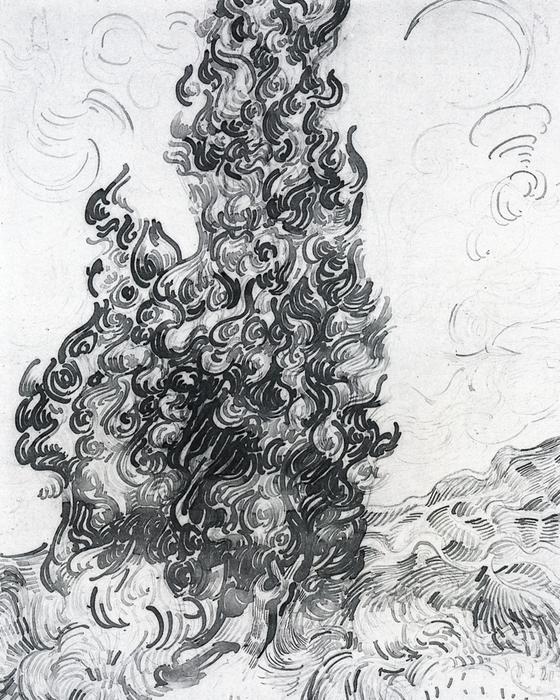
Vincent van Gogh's "Cypresses," painted in 1889 during his tumultuous stay at Saint-Rémy asylum, transcends mere landscape depiction; it embodies a profound meditation on mortality and spiritual aspiration—themes inextricably linked within the artist’s oeuvre. Captured in stark black and white photography, this reproduction faithfully conveys the textural dynamism of the original canvas, inviting viewers to delve into the complexities of Van Gogh's artistic vision. The photograph itself serves as an excellent gateway to understanding the artwork's significance within the broader context of Post-Impressionism and its enduring influence on modern art.
- Composition & Perspective: The image presents a vertically oriented composition dominated by a towering cypress tree, positioned centrally against a rolling hillside and punctuated by a hazy azure sky. Van Gogh’s characteristic flattened perspective subtly diminishes spatial depth, prioritizing expressive lines and conveying an immediacy of experience—a hallmark of his style.
- Texture & Technique: The photograph meticulously captures the impasto technique employed by Van Gogh, where thick layers of paint create palpable surface texture. This tactile quality mirrors the artist’s emotional intensity, mirroring the swirling brushstrokes that define both the cypress trees and the landscape background.
- Symbolism & Emotion: Cypress trees are universally recognized as symbols of death and mourning—a poignant reflection of Van Gogh's personal struggles with mental illness during his time at Saint-Rémy. Simultaneously, their upward reaching branches represent a connection to heaven, embodying hope and transcendence amidst despair.
- Color Palette & Line Work: As a monochrome reproduction, the photograph skillfully highlights the expressive power of line work—bold, swirling lines delineate the cypress tree’s form and contribute to its flame-like appearance. These lines are complemented by subtle gradations in tone, creating depth and visual interest.
- Historical Context & Artistic Style: “Cypresses” exemplifies Post-Impressionism, rejecting photographic realism in favor of subjective interpretation and emotional resonance. Influenced by Cézanne and Gauguin, Van Gogh sought to convey inner feelings rather than objective observation—a revolutionary approach that paved the way for subsequent artistic movements.
Further Exploration: To gain a deeper appreciation for this masterpiece, consider visiting the Van Gogh Museum in Amsterdam (
) or exploring reproductions at institutions like The Metropolitan Museum of Art (). Examining related artworks and biographical accounts will illuminate the artist’s motivations and enrich your understanding of “Cypresses”' enduring legacy.