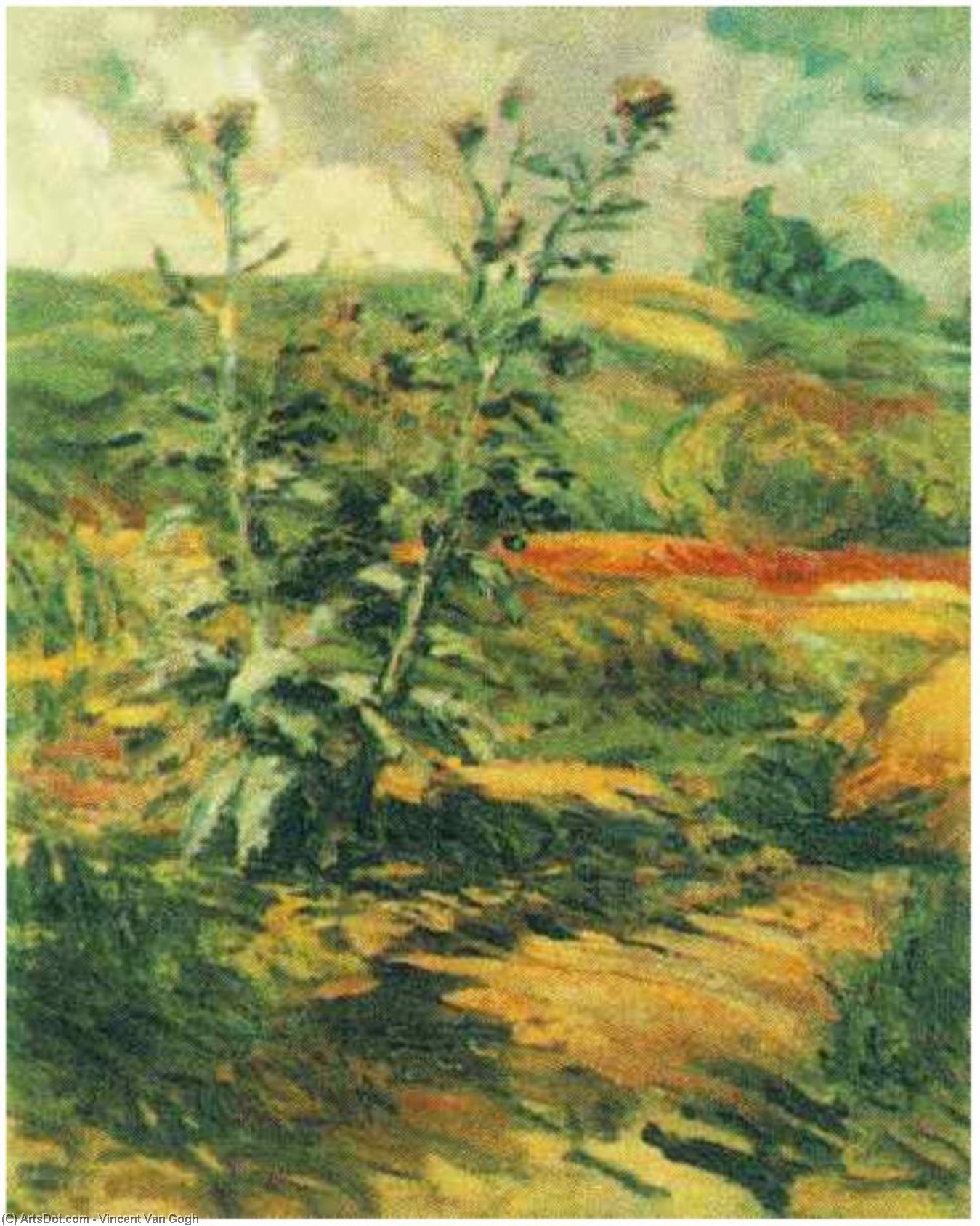
Experience the serene beauty of Vincent van Gogh’s ‘Deux Chardons.’ This captivating landscape painting captures a tranquil sunset scene featuring two flowering trees against a grassy hillside – a testament to Van Gogh's emotive style.
Vincent van Gogh (1853-1890): Explore the life & art of the Dutch Post-Impressionist master behind 'Starry Night' and 'Sunflowers'. Discover his bold style & lasting impact on modern art.
Deux Chardons: A Study in Tranquility and Violet Hue
Vincent van Gogh’s “Deux Chardons” – French for “Two Sheep” – is more than just a depiction of pastoral scenery; it's an embodiment of the artist’s deeply felt connection to nature and his masterful exploration of color and texture. Painted in 1890, during his prolific period at Saint-Rémy Hospital following a debilitating mental breakdown, this artwork offers a poignant glimpse into Van Gogh’s inner world as much as it celebrates the beauty of the Provençal countryside. The painting captures a simple scene: two sheep grazing peacefully on a hillside bathed in the warm glow of sunset. Yet, within this apparent simplicity lies a wealth of artistic considerations that solidify its place among Van Gogh's most enduring masterpieces.
Style and Technique – Impressionistic Echoes
While firmly rooted in Post-Impressionism—a movement characterized by rejecting strict realism in favor of capturing subjective impressions—"Deux Chardons" possesses an unmistakable stylistic signature that distinguishes it from many other works of the era. Van Gogh’s brushstrokes are thick, impastoed, applying paint directly onto the canvas with energetic swirls and dashes. This technique isn't merely decorative; it conveys a palpable sense of movement and vitality, mirroring the restless energy of the artist himself. The artist deliberately eschewed blending colors smoothly, opting instead for juxtaposing vibrant hues to heighten their impact—a hallmark of Impressionism that Van Gogh adapted to express his emotional state. Notice particularly how he utilizes violet shades within the flowers – an unusual choice considering the prevailing palette of yellows and oranges typical of sunset scenes. This deliberate deviation serves to emphasize the melancholic beauty of the moment, hinting at a profound contemplation on life and mortality.
Historical Context: Seeking Solace Amidst Turmoil
Painted during Van Gogh’s confinement at Saint-Rémy Hospital – where he voluntarily sought treatment for his mental illness – “Deux Chardons” represents a crucial juncture in his artistic trajectory. Following the infamous episode involving self-mutilation, Van Gogh wrestled with intense psychological distress and struggled to maintain stability. Despite these challenges, however, he continued to paint obsessively, driven by an unwavering desire to transform his inner turmoil into outward expression. The hillside landscape served as a refuge from the pressures of Parisian society and a source of inspiration for capturing the serenity he craved. It reflects the broader preoccupation with spirituality and contemplation that permeated European art during this period—a reaction against the materialism and anxieties of industrialization.
Symbolism – Violet Flowers and Inner Reflection
The violet flowers adorning the trees are not merely ornamental; they carry significant symbolic weight. Violet has historically been associated with mourning, remembrance, and spiritual devotion—themes deeply resonant within Van Gogh’s personal experience. Their presence underscores the artist's preoccupation with themes of loss and longing, mirroring his own struggles to reconcile himself with reality after experiencing profound emotional upheaval. Simultaneously, the sheep themselves symbolize innocence, simplicity, and pastoral tranquility – qualities that Van Gogh sought to embody in his art as a means of achieving inner peace. The overall composition invites contemplation on the cyclical nature of life and death, reflecting Van Gogh’s unwavering belief in the transformative power of beauty and artistic expression.
Emotional Impact – A Moment Frozen in Time
“Deux Chardons” transcends its visual description to evoke a powerful emotional response in the viewer. The warm hues of sunset imbue the scene with a sense of warmth and comfort, juxtaposed against the melancholic violet shades of the flowers—creating a dynamic interplay that captures the complexities of human emotion. It’s a painting that speaks to our innate desire for connection with nature and reminds us of the importance of finding solace in moments of quiet contemplation. Reproductions of this artwork offer an opportunity to bring this evocative vision into any interior space, fostering a feeling of serenity and inspiring appreciation for Van Gogh's unparalleled ability to convey profound psychological depth through deceptively simple imagery.