A Quiet Moment: Unveiling Van Gogh’s ‘Deux Fillettes’
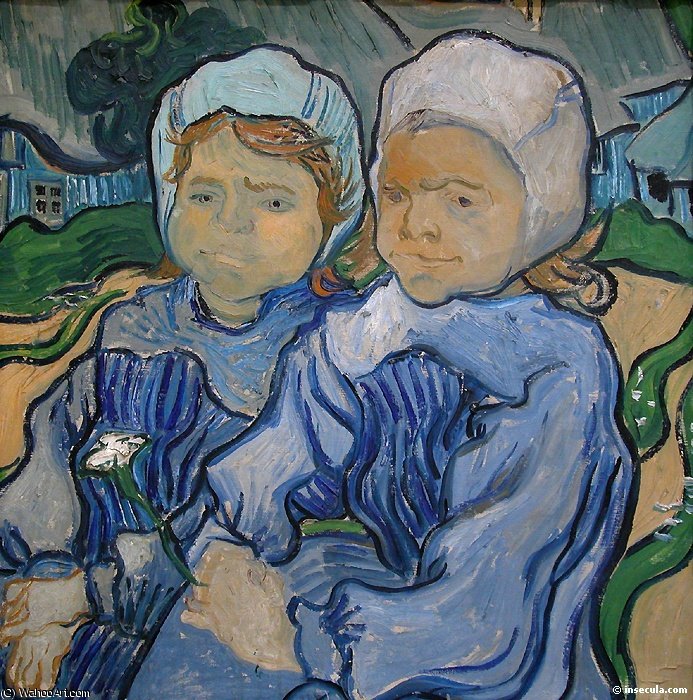
Vincent van Gogh's ‘Deux Fillettes’ (Two Little Girls) is a tender and intimate work, offering a glimpse into a fleeting moment of childhood serenity. Painted in June 1890, during his stay at Auvers-sur-Oise – the final months of his life – this painting departs somewhat from the dramatic landscapes and turbulent brushwork that often define his most celebrated pieces. Instead, it presents a scene of quietude, focusing on two young girls seated side-by-side with eyes closed, seemingly lost in their own peaceful reveries. The simplicity of the composition is profoundly affecting; we are invited to share in this private moment, a shared secret between the sisters.
The Palette of Innocence and Impressionistic Echoes
The painting’s color palette is remarkably harmonious, dominated by shades of blue in the girls' dresses. This unifying hue creates a sense of calm and unity, drawing the viewer’s eye to their central figures. While Van Gogh had largely moved beyond the somber tones of his earlier Dutch period – exemplified by works like ‘The Potato Eaters’ – he retained a sensitivity to color’s emotional power. Here, the blue evokes feelings of tranquility and innocence. The technique employed in ‘Deux Fillettes’ reveals subtle influences of Impressionism, though filtered through Van Gogh's uniquely expressive style. Brushstrokes are visible but softened, creating a gentle texture that enhances the painting’s overall mood. It is not the broken color of Monet or Renoir, but rather a controlled application of paint that suggests form and light without sacrificing emotional depth.
A Symbolism of Youth and Hope
The symbolism within ‘Deux Fillettes’ is delicate yet resonant. Children often represented themes of purity, hope, and renewal for Van Gogh, offering a counterpoint to the struggles he faced throughout his life. The closed eyes of the girls suggest an inward focus, a world of imagination and dreams untouched by adult concerns. This resonates with Van Gogh's own yearning for peace and solace. The presence of a partially visible figure on the right side of the canvas adds another layer of intrigue – perhaps a mother or older sibling watching over them, providing a sense of security and familial warmth. The house in the background, though indistinct, grounds the scene in reality, suggesting a safe and nurturing environment.
Van Gogh’s Final Flourishes: A Legacy of Emotion
Painted just months before his tragic death, ‘Deux Fillettes’ stands as a poignant testament to Van Gogh's enduring artistic vision. It demonstrates his ability to find beauty in the everyday, to capture fleeting moments of human connection with profound sensitivity. The painting is now held at the Musée d'Orsay in Paris, and continues to captivate viewers with its quiet power. For those seeking to bring a touch of Van Gogh’s emotional intensity into their homes, a hand-painted reproduction of ‘Deux Fillettes’ offers an opportunity to connect with this masterpiece on a deeply personal level – a reminder of the simple joys and enduring beauty that can be found in the world around us.