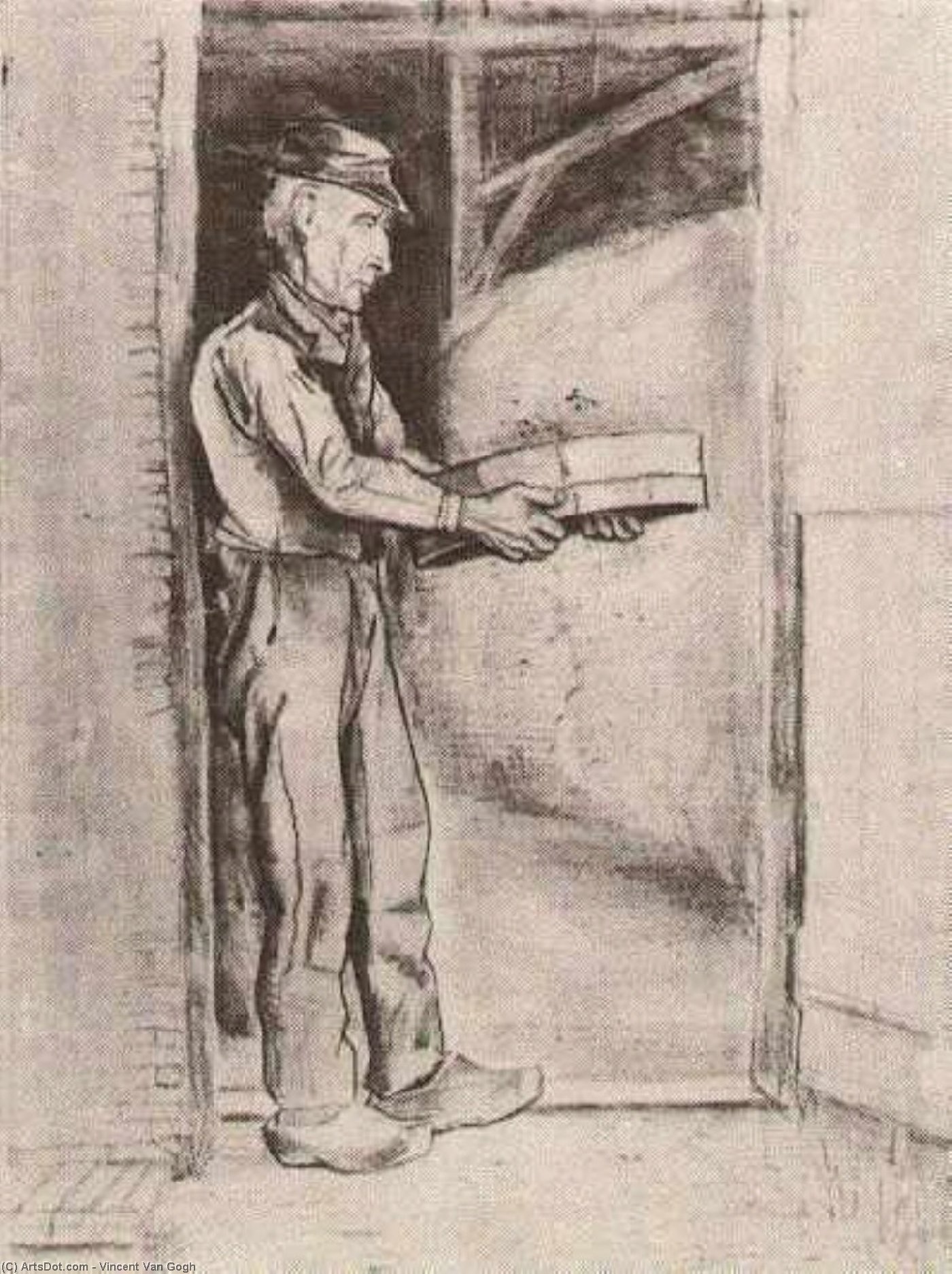
Explore Vincent van Gogh’s "Man with Winnow" – a striking black & white lithograph showcasing his expressive linework & isolation. A captivating piece of 19th-century art.
Vincent van Gogh (1853-1890): Explore the life & art of the Dutch Post-Impressionist master behind 'Starry Night' and 'Sunflowers'. Discover his bold style & lasting impact on modern art.
A Moment of Quiet Delivery: Unveiling Van Gogh’s “Man with Winnow”
This striking black and white drawing, created in 1881, offers a poignant glimpse into the everyday life depicted by Vincent van Gogh during his early artistic period. “Man with Winnow” presents a solitary figure framed within an arched doorway, immediately establishing a sense of both presence and isolation. The subject is a man carrying a package – perhaps letters, documents, or goods – suggesting themes of communication, service, or the simple routines that structure daily existence. Van Gogh’s masterful use of line and shadow transforms this seemingly mundane scene into something deeply evocative.
Technique & Style: Echoes of 19th-Century Masters
The artwork showcases Van Gogh's developing technical skill, reminiscent of etching or lithography, though it is a drawing. The composition relies heavily on detailed linework and carefully considered shading to define form and texture. Thick, expressive lines delineate the man’s clothing, face, and the architectural elements surrounding him. Notice how Van Gogh employs hatching and cross-hatching – building up tonal values with intersecting lines – to create a sense of depth and realism despite the monochromatic palette. The shapes are largely geometric: rectangles for the doorway, cylinders for the figure's body, contributing to a grounded yet stylized aesthetic. This period in Van Gogh’s career was marked by an absorption of artistic influences, including Dutch Masters like Rembrandt and Frans Hals, whose influence is visible in the dramatic lighting and attention to detail.
Symbolism & Emotional Resonance
Beyond its realistic depiction, “Man with Winnow” invites deeper contemplation. The doorway acts as a powerful framing device, not only creating depth but also emphasizing the man’s position – seemingly on the periphery, looking in. This spatial arrangement can be interpreted symbolically, representing isolation, detachment, or perhaps the quiet moments of observation that characterize modern life. The solitary figure, burdened with his package, evokes feelings of empathy and invites viewers to consider their own experiences of connection and disconnection. While Van Gogh would later become renowned for his vibrant colors and emotional intensity, this early work demonstrates his ability to convey profound emotion through subtle means – a testament to his growing artistic maturity.
Historical Context & Van Gogh’s Early Years
Created in 1881, “Man with Winnow” falls within the period before Van Gogh fully embraced the Post-Impressionist style that would define his legacy. He was still experimenting with different techniques and subject matter, deeply influenced by the realities of rural life and the struggles of working people. This drawing offers a valuable insight into his artistic development, revealing his commitment to capturing the human condition with honesty and sensitivity. It’s a period marked by somber palettes and a focus on the hardships faced by those around him – themes that would continue to resonate throughout his career, even as his style evolved towards greater expressiveness and color.