Vincent van Gogh (1853-1890): Explore the life & art of the Dutch Post-Impressionist master behind 'Starry Night' and 'Sunflowers'. Discover his bold style & lasting impact on modern art.
Vincent van Gogh’s ‘Orphan Man with Cap,’ A Study in Somber Realism
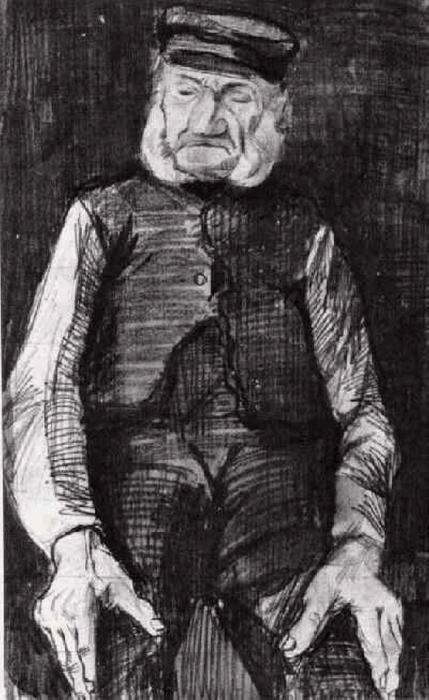
Vincent Willem van Gogh's “Orphan Man with Cap,” completed in 1883, stands as a poignant testament to his early artistic explorations and unwavering empathy for the marginalized individuals inhabiting Europe during his time. Executed in chalk and ink on paper—a relatively unassuming medium considering Van Gogh’s later mastery of oil paints—this piece embodies the core tenets of Realism while simultaneously foreshadowing the expressive fervor that would characterize his subsequent oeuvre. It resides within the Villa Flora Collection in Winterthur, Switzerland, offering visitors a rare glimpse into one of the artist's formative works.
Composition and Technique: Embracing Texture and Tone
The artwork’s composition is remarkably simple yet powerfully effective. Centrally positioned, the elderly man dominates the frame, his body angled subtly towards the viewer—a deliberate gesture designed to invite contemplation and fostering a connection between subject and observer. Minimal tonal shading defines the backdrop, primarily consisting of dense strokes that suggest a plain wall or austere setting – mirroring the bleak realities faced by many impoverished communities during Van Gogh’s era. The artist skillfully employs hatching and cross-hatching techniques extensively, layering lines with meticulous precision to achieve nuanced gradations of gray and black. This painstaking process isn't merely about replicating visual appearance; it’s about conveying texture—the rough fabric of the man’s suit, the wrinkled skin of his face—creating a palpable sense of physicality that transcends mere representation. The energetic lines themselves speak volumes about Van Gogh’s artistic impulse, reflecting an immediacy and emotional intensity rarely found in academic art circles.
Symbolism and Emotional Resonance: Loneliness and Dignity Amidst Adversity
Beyond its technical brilliance, “Orphan Man with Cap” resonates deeply on an emotional level. The man's downward gaze—a hallmark of Van Gogh’s portraits—communicates profound sadness and introspection, encapsulating the pervasive loneliness experienced by those excluded from societal acceptance. His clothing – a humble vest and shirt – underscores his vulnerability and poverty, serving as a visual reminder of the hardships endured by countless individuals during Victorian Britain. Yet, despite the bleak circumstances depicted, Van Gogh imbues the figure with dignity—a quiet resilience that speaks to the enduring human spirit. The cap itself acts as a symbolic element, representing both protection from the elements and perhaps a connection to a bygone era, further enriching the artwork’s narrative depth.
Historical Context: Echoes of Impressionism and Early Modernism
“Orphan Man with Cap” emerged during Van Gogh's formative years—a period marked by experimentation with artistic styles and fueled by an unwavering commitment to portraying the lives of ordinary people. While undeniably influenced by Impressionist techniques – particularly in its subtle tonal shading – the piece diverges from Impressionistic idealism, prioritizing emotional truth over aesthetic beauty. It anticipates the stylistic innovations of Early Modernism, signaling Van Gogh’s burgeoning desire to express inner turmoil and psychological complexity—a characteristic that would become increasingly prominent throughout his prolific artistic career.
Concluding Thoughts: A Window into Van Gogh's Soul
Ultimately, “Orphan Man with Cap” transcends its formal qualities to offer a profound meditation on human suffering and compassion. It remains an enduring symbol of Van Gogh’s humanist vision—a testament to his belief that art should illuminate the realities of everyday life and capture the essence of human emotion. Its understated elegance and evocative texture continue to captivate viewers today, cementing its place as one of the artist's most poignant and unforgettable achievements.