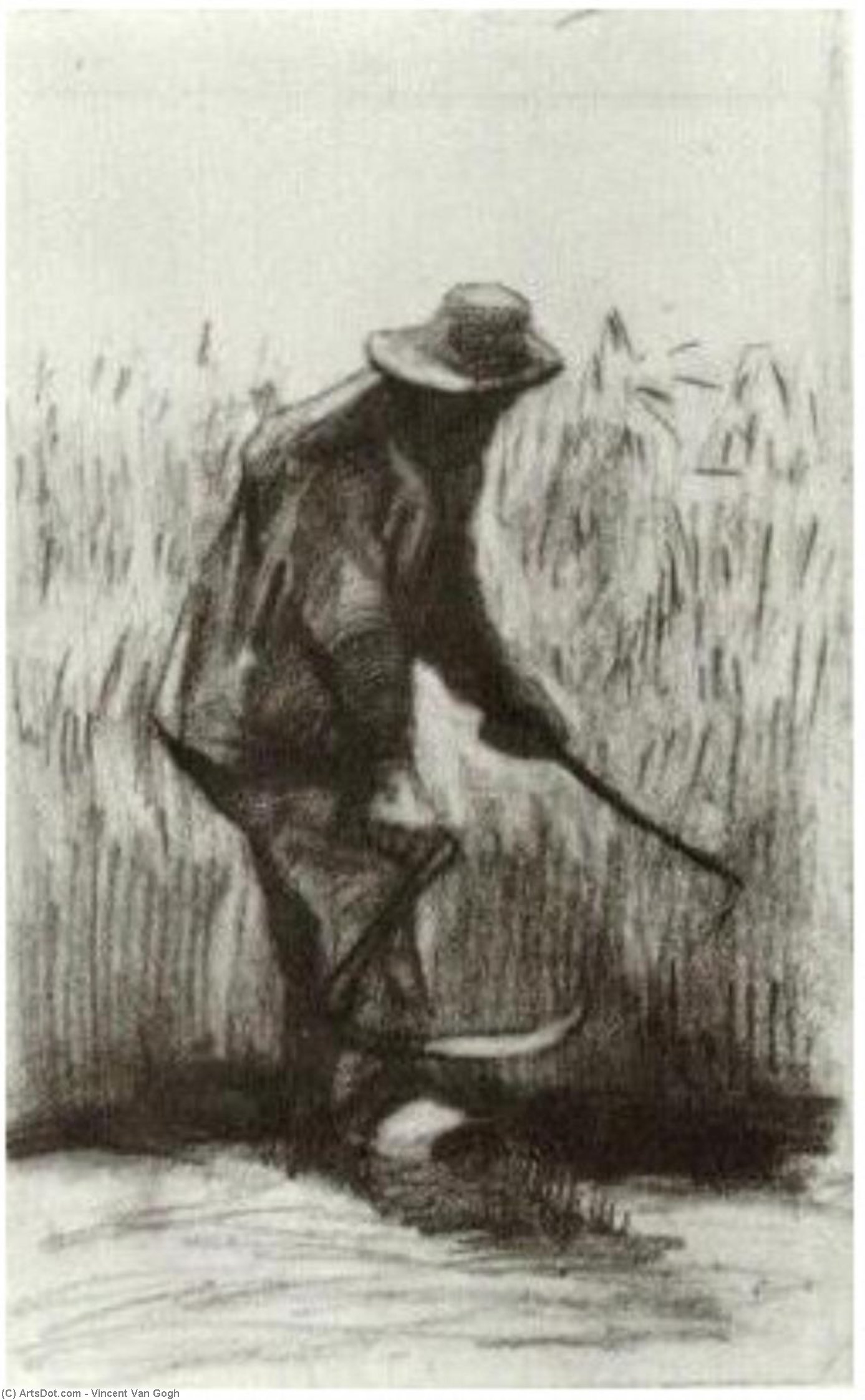
Vincent van Gogh's 'Peasant with Sickle,' viewed from behind, captures the essence of rural labor—a solitary farmer tending his field with unwavering dedication. This evocative black and white drawing embodies Expressionist ideals, showcasing raw emotion and textural detail.
A Solitary Encounter with Labor
In the quiet, monochromatic depths of Vincent van Gogh’s "Peasant with Sickle, Seen from the Back," we are invited into a moment of profound stillness that belies the physical exertion of rural life. Painted in 1885, this evocative work captures a solitary figure—a farmer, perhaps even a reflection of the artist himself—turned away from the viewer to face the vast, untamed expanse of a field. There is an immediate, visceral connection to the earth here; the man stands amidst tall, swaying grasses, his silhouette anchored by the weight of his task. The composition does not seek to charm with bright colors or decorative flourishes, but rather to confront the viewer with the raw, unadorned reality of existence and the rhythmic, repetitive nature of agricultural toil.
The piece functions as a poignant study of resilience. By presenting the subject from behind, Van Gogh strips away the intimacy of facial expression, forcing us instead to find emotion in the posture of the body and the tilt of the head. This perspective creates a sense of introspection, as if we are witnessing a private communion between the laborer and the land. The sickle, gripped firmly in hand, emerges not just as a tool of harvest, but as an emblem of the enduring human spirit—a symbol of the strength required to endure the cycles of growth and decay that define the natural world.
Mastery of Texture and Tonal Depth
While many associate Van Gogh with his later, explosive use of color, this work demonstrates his incredible command over light and texture through a more restrained palette. The technique is deeply rooted in the Impressionistic tradition, yet it pushes toward the emotional intensity of Expressionism. Through a deliberate use of heavy, textured strokes, the artist breathes life into the inanimate. One can almost feel the coarse grain of the wheat and the ruggedness of the farmer's clothing. The way the light catches the edges of the grass creates a sense of movement, as if a sudden breeze has just swept through the meadow.
For the discerning collector or interior designer, this artwork offers a sophisticated versatility. Its monochromatic elegance allows it to serve as a powerful focal point in a modern, minimalist setting, providing a soulful anchor to a room. The interplay of light and shadow within the drawing creates a depth that commands attention without overwhelming a space. It is a piece that invites long periods of contemplation, offering a sense of calm and groundedness. To possess a high-quality reproduction of this masterpiece is to bring a fragment of art history’s most profound emotional journey into one's own home, celebrating the beauty found in simplicity and the dignity of the human struggle.