Vincent van Gogh (1853-1890): Explore the life & art of the Dutch Post-Impressionist master behind 'Starry Night' and 'Sunflowers'. Discover his bold style & lasting impact on modern art.
A Fragment of Form: Exploring Vincent van Gogh’s Plaster Statuette
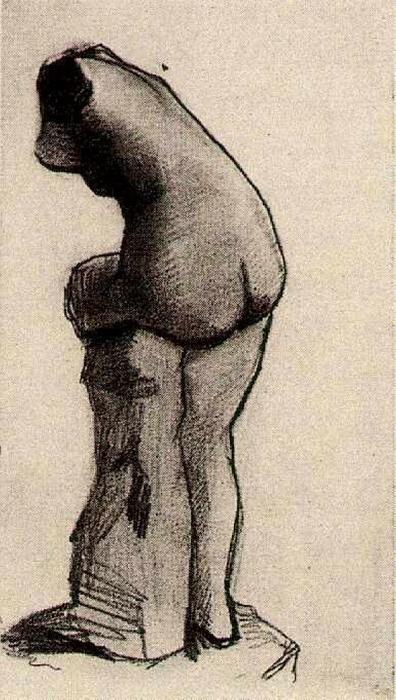
The year is 1886. Zundert, Netherlands – a village nestled amongst rolling hills and steeped in Dutch tradition – serves as the backdrop for one of Vincent van Gogh's most enigmatic sketches. Entitled “Plaster Statuette,” this unassuming drawing offers a glimpse into the artist’s evolving visual language during his formative years, revealing a preoccupation with capturing not just physical likeness but also conveying profound emotional resonance. It’s a piece that speaks volumes about Van Gogh’s artistic process and invites contemplation on themes of vulnerability and artistic exploration.
Style and Technique: Embracing Distortion for Expression
Van Gogh's style at this juncture leans heavily into the burgeoning movement of Post-Impressionism, rejecting the optical realism championed by his predecessors in favor of subjective interpretation. Unlike Impressionists who sought to depict fleeting moments of light and color, Van Gogh deliberately employed distortion – a technique he would refine throughout his career – to heighten emotional impact. The statue’s back is rendered with bold, angular lines that disrupt conventional perspective, creating a sense of unease and emphasizing the contours of the figure's musculature. Notice how the artist utilizes hatching and cross-hatching to build up tonal values, achieving remarkable depth without resorting to traditional shading methods. This deliberate manipulation of form underscores Van Gogh’s conviction that art should transcend mere representation and tap into primal feelings.
Historical Context: Searching for Identity Amidst Artistic Influences
The sketch emerged during a period of intense personal upheaval for Van Gogh. Following his dismissal from the Saint-Paul Hospital in Paris, where he had been attempting to establish himself as an artist’s assistant, he retreated to his parents' farmhouse, seeking solace and inspiration amidst the rural landscape. Simultaneously, he was grappling with anxieties surrounding mental health – a battle that would ultimately claim his life just four years later. These circumstances undoubtedly fueled his artistic experimentation, prompting him to confront questions of self-perception and identity through visual representation. The statue itself can be interpreted as a symbol of resilience—a quiet defiance against the pressures of societal expectations and a courageous assertion of inner conviction.
Symbolism: Anatomy and Vulnerability – A Dialogue Between Form and Feeling
The depiction of the nude statue’s back is particularly significant symbolically. Traditionally, the human torso has been viewed as representing strength and masculinity; however, Van Gogh deliberately reverses this convention, presenting vulnerability rather than power. The exposed musculature speaks to a willingness to confront one's own imperfections—a characteristic that aligns perfectly with Van Gogh’s autobiographical journey. Furthermore, the statue’s posture exudes stillness and contemplation, mirroring the artist’s desire for introspection during his period of seclusion. It’s as if Van Gogh is attempting to distill the essence of human experience into a single visual gesture, capturing both physical form and emotional depth.
Emotional Impact: Capturing Transient Beauty Through Distortion
Ultimately, “Plaster Statuette” transcends its formal qualities to convey a palpable sense of melancholy and yearning. The artist’s masterful use of hatching creates an atmosphere of subdued luminosity—a subtle echo of the Dutch countryside that surrounds him. More importantly, however, is the drawing's ability to evoke empathy for Van Gogh himself – a man wrestling with inner demons while striving to articulate his profound understanding of human emotion. It serves as a poignant reminder that true artistic achievement lies not merely in technical proficiency but also in conveying genuine feeling—a legacy that continues to inspire artists and captivate audiences worldwide.