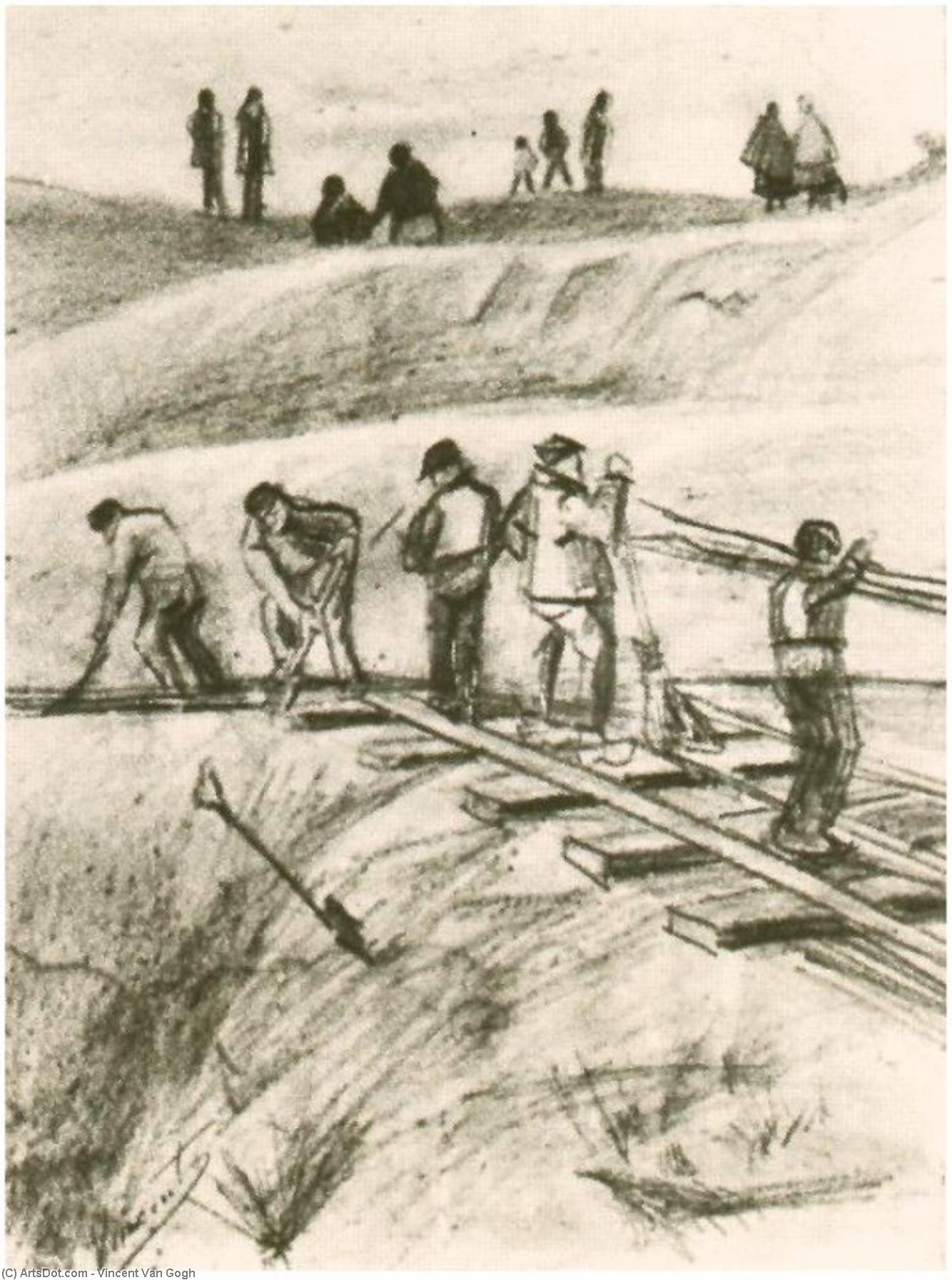
Considered part of Van Gogh's prolific output during his time in Paris, 'Sand Diggers' exemplifies his fascination with capturing everyday life and portraying the dignity of manual labor. It showcases his ability to transform ordinary subjects into powerful visual statements.
Sand Diggers: A Study in Labor and Landscape
Vincent van Gogh’s “Sand Diggers,” completed in 1882 during his time in Paris, represents a pivotal moment in the artist's oeuvre—a departure from the swirling expressive brushstrokes of his Dutch period and an embrace of a more restrained realism. This unassuming sketch offers a glimpse into Van Gogh’s fascination with the everyday lives of ordinary people and his keen observation of the natural world, particularly the coastal dunes near The Hague.
- Subject Matter: The artwork depicts a group of men diligently excavating sand on the beach. Alongside them are two horses pulling carts laden with sand – a scene reflecting the burgeoning railway construction industry prevalent in France at the time.
- Style: “Sand Diggers” firmly establishes Van Gogh’s stylistic evolution toward Realism, albeit imbued with his characteristic emotional intensity. Unlike his earlier canvases dominated by vibrant color and turbulent movement, here he employs muted tones of ochre, brown, and gray to convey a palpable sense of atmosphere and texture.
- Technique: Executed in charcoal on paper, Van Gogh’s technique is characterized by meticulous hatching and cross-hatching—a method that lends remarkable depth and solidity to the figures and horses. The artist painstakingly builds up layers of graphite to capture the contours of the landscape and the physicality of the laborers involved.
Historical Context: Industrial Progress and Artistic Exploration
Painted during Van Gogh’s Parisian sojourn, “Sand Diggers” coincides with a period of significant industrial expansion in France—the rapid construction of railways was transforming the nation's infrastructure. This societal shift undoubtedly influenced Van Gogh’s artistic interests, prompting him to depict scenes of labor and rural life with unprecedented detail. Simultaneously, Paris served as a crucible for artistic experimentation, fostering dialogues between Impressionists and Post-Impressionists like Cézanne and Gauguin—artists who challenged traditional academic conventions.
Symbolism Beyond the Surface
While seemingly simple in its depiction, “Sand Diggers” possesses subtle symbolic resonances. The horses represent not merely transportation but also the forces of progress – mirroring the dynamism of the railway project. More profoundly, however, the figures themselves embody resilience and perseverance—individuals engaged in arduous physical labor under challenging conditions. Van Gogh’s masterful rendering captures a moment of quiet determination amidst the vast expanse of the landscape, suggesting an underlying contemplation on human effort and connection to nature.
Emotional Impact: Quiet Observation, Profound Feeling
"Sand Diggers" transcends mere representation; it communicates a palpable emotional core. Despite its muted palette, the drawing pulsates with Van Gogh’s unmistakable expressive touch—evident in the careful delineation of musculature and the subtle shading that conveys the weight of exertion. The artwork invites viewers to consider not just what is seen but also how it feels—a testament to Van Gogh's ability to transform ordinary subjects into vehicles for profound psychological insight.