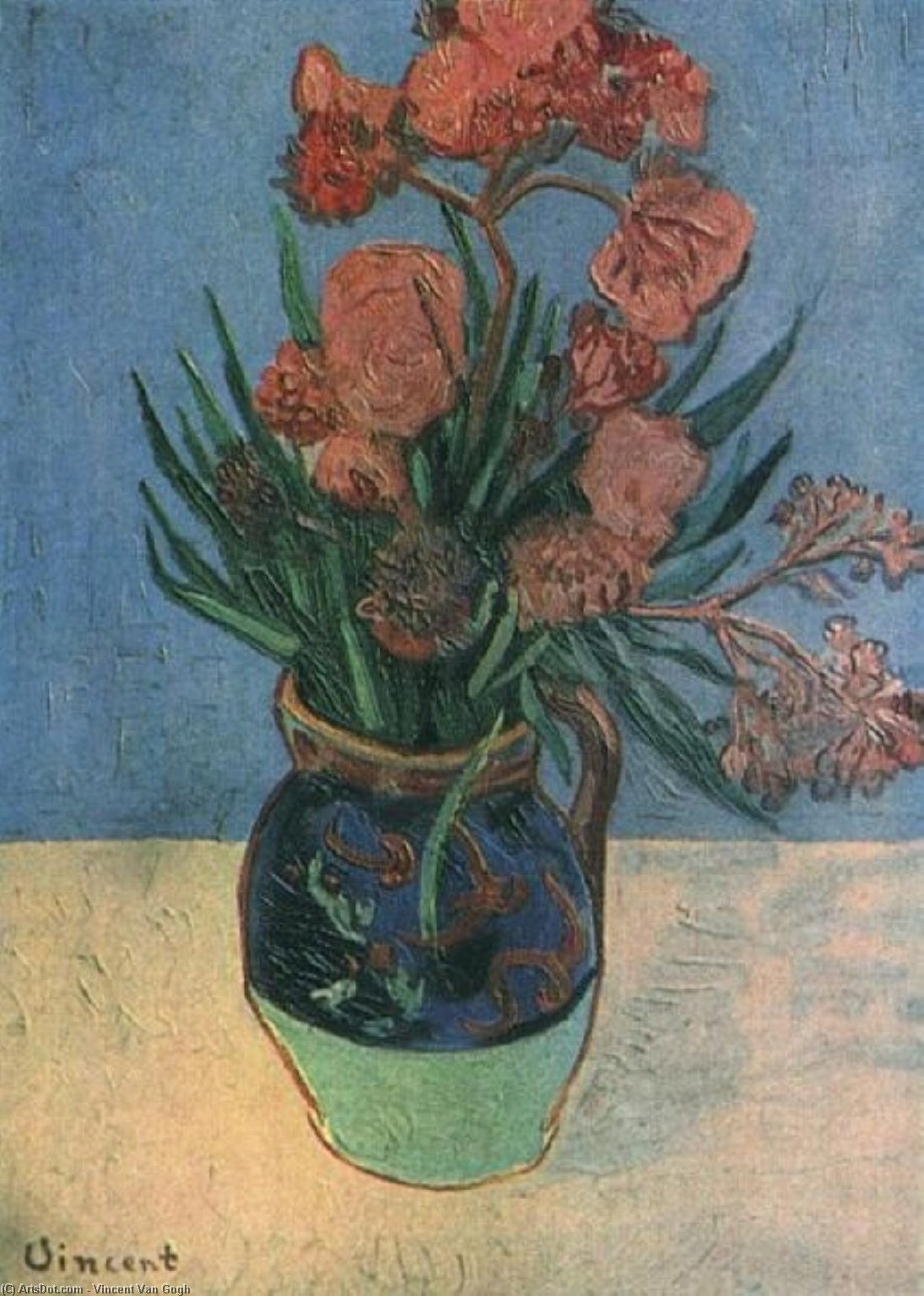
"Still Life Vase with Oleanders" by Vincent van Gogh captures the vibrant beauty of nature and emotional depth—a cornerstone of Post-Impressionism & an enduring symbol of artistic genius.
Vincent van Gogh (1853-1890): Explore the life & art of the Dutch Post-Impressionist master behind 'Starry Night' and 'Sunflowers'. Discover his bold style & lasting impact on modern art.
A Symphony of Color and Resilience
In the sweltering heat of August 1888, amidst the sun-drenched landscapes of Arles, Vincent van Gogh captured a moment of profound vitality in his Still Life Vase with Oleanders. This is not merely a depiction of flora held within a vessel; it is an explosion of life that commands the viewer's attention through a masterful manipulation of color. A deep blue pot, accented by a delicate green rim, serves as the anchor for a breathtaking arrangement of pink and red blossoms. The composition vibrates with an energy that transcends the stillness of the subject, inviting anyone who gazues upon it to feel the very pulse of the natural world.
The Sculptural Power of Impasto
What truly distinguishes this masterpiece is Van Gogh’s revolutionary use of thick impasto. The paint is not simply applied; it is sculpted onto the canvas. Each heavy, rhythmic brushstroke creates a textured landscape of its its own, where ridges and peaks of pigment catch the light and cast miniature shadows. This technique lends the artwork a sculptural quality, transforming the soft petals of the oleanders into something palpable and physical. For the collector or interior designer, this tactile depth provides a remarkable dimension that brings movement and three-dimensional life to any wall, making a high-quality reproduction feel like a living piece of history within a modern space.
An Enduring Legacy for the Modern Home
Beyond its visual splendor, the painting is steeped in the emotional landscape of the artist’s most prolific period. To Van Gogh, oleanders were more than just beautiful specimens; they were life-affirming symbols of resilience. Known for their ability to bloom vigorously even in harsh conditions, these flowers mirrored the artist's own intense pursuit of joy and light during his time in Southern France. To possess such a work is to invite a sense of enduring strength and optimism into one's personal sanctuary. Whether placed as a bold focal point in a contemporary gallery or as a soft, colorful accent in a classic study, this piece serves as an eternal testament to the beauty that emerges from the most vibrant struggles.