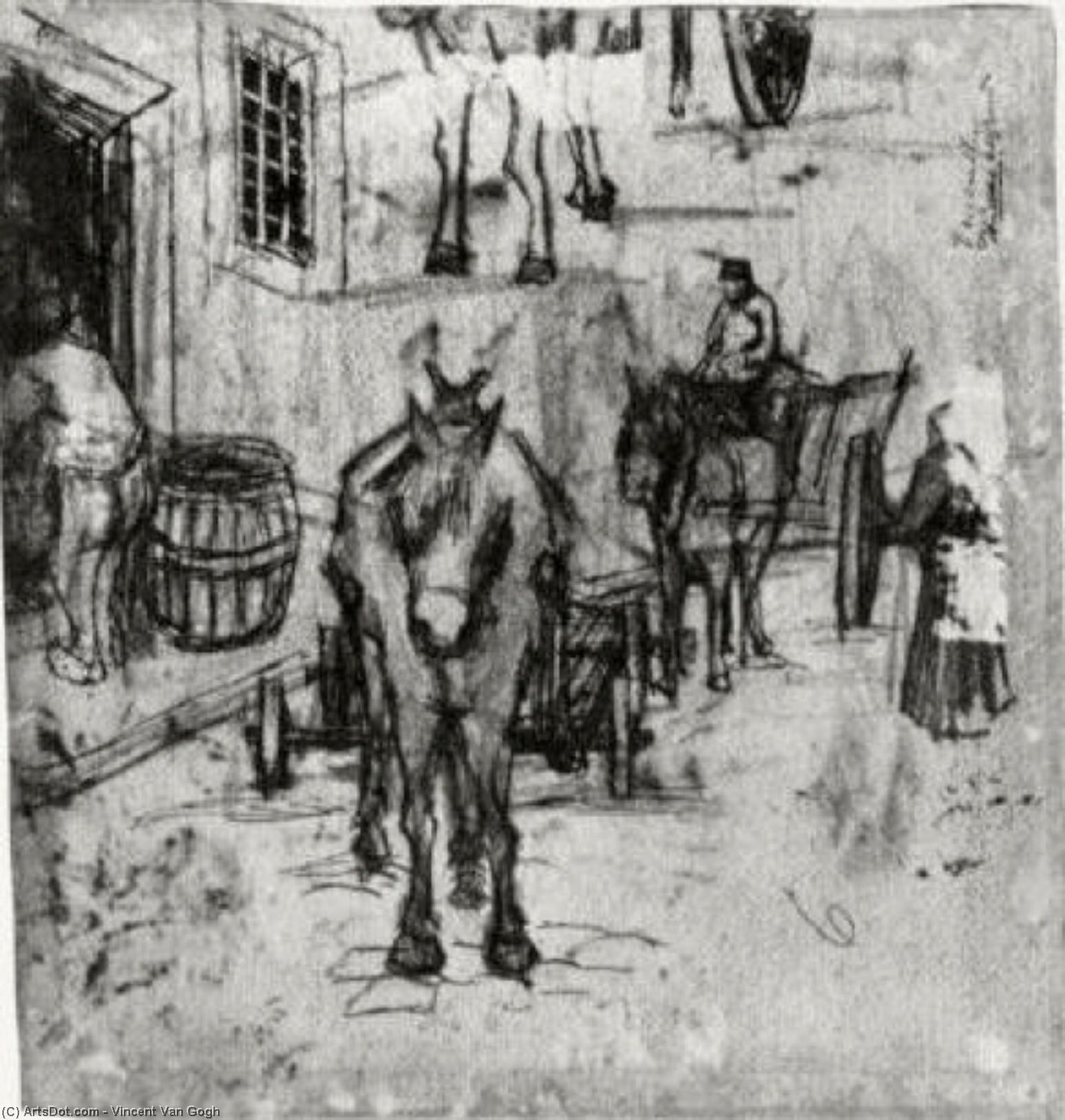
A Snapshot of Rural Life: Vincent van Gogh’s ‘Studies of Donkey Carts’
Vincent van Gogh's 'Studies of Donkey Carts,' created in 1882, offers a poignant glimpse into the everyday rhythms of rural Dutch life. More than just a depiction of working animals and village activity, this drawing embodies Van Gogh’s burgeoning artistic voice – a raw, emotive response to the world around him. It's a piece that speaks volumes through its simplicity, revealing a profound understanding of human experience and the beauty found in the mundane.
The artwork presents a densely populated scene centered on a donkey pulling a cart, an image immediately anchoring us within this small community. Buildings recede into the background, sketched with loose, confident lines that suggest a village square or marketplace. The composition isn’t concerned with photographic realism; instead, Van Gogh prioritizes capturing the *feeling* of the moment – the hustle and bustle, the shared labor, and the quiet dignity of rural existence. The figures are rendered with an immediacy and directness, reflecting his early experimentation with drawing as a means of intense observation and emotional expression.
Technique and Materiality: The Language of Pencil
Executed entirely in graphite pencil on paper, ‘Studies of Donkey Carts’ is a testament to Van Gogh's innovative approach to drawing. He eschews the meticulous detail favored by many of his contemporaries, opting instead for short, energetic strokes and a generous application of cross-hatching. This technique isn’t merely about creating form; it’s about conveying movement and texture with remarkable efficiency. The visible pencil marks themselves contribute to the artwork's rough, immediate quality – an impression of spontaneity that is characteristic of Van Gogh’s early work.
The monochromatic palette—a range of grays—further emphasizes this sense of immediacy. Van Gogh masterfully uses contrast to define shapes and create a sense of volume, suggesting light and shadow without resorting to color. The lack of precise lines and the deliberate roughness of the surface invite us to engage with the drawing on a tactile level, as if we could almost feel the grit of the paper beneath our fingertips.
Symbolism and Context: A Portrait of Working Life
‘Studies of Donkey Carts’ transcends a simple depiction of rural activity; it carries a subtle symbolic weight. Van Gogh, having spent time amongst laborers during his early missionary work, possessed a deep empathy for the working class. This drawing serves as a quiet tribute to their hard labor and the fundamental role they played in society. The donkey cart itself represents not just transportation but also sustenance – connecting people to the land and providing essential goods.
Created during a period of intense personal struggle for Van Gogh, this work reflects his evolving artistic philosophy. He was beginning to move away from purely representational art, experimenting with expressive lines and textures to convey emotion and inner experience. The drawing’s raw energy and emotional intensity foreshadow the vibrant colors and swirling brushstrokes that would define his later masterpieces.
Collecting a Van Gogh: Reproduction and Legacy
ArtsDot offers meticulously crafted hand-painted reproductions of ‘Studies of Donkey Carts,’ allowing you to bring this evocative artwork into your home or office. Our skilled artists faithfully recreate Van Gogh’s unique technique, capturing the drawing's textural richness and emotional depth with exceptional accuracy. Whether you are an art enthusiast, a collector seeking to expand your collection, or simply someone drawn to the beauty of rural life, this reproduction provides a stunning window into Van Gogh’s artistic vision.
Explore more works by Vincent van Gogh at ‘Morning, Leaving for Work’ and discover the breadth of his artistic legacy. For further insights into Van Gogh's life and work, visit the Rijksmuseum Vincent van Gogh or the Van Gogh Museum in Amsterdam.