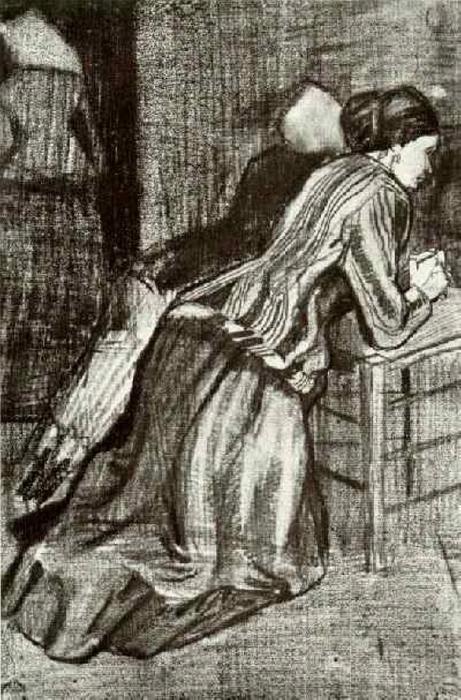
A Portrait of Quiet Despair: Unveiling Van Gogh's 'Two Women Kneeling'
Vincent van Gogh’s 1883 painting, “Two Women Kneeling,” is not a grand statement of heroism or triumph. Instead, it offers a profoundly intimate and melancholic glimpse into the lives of two unknown women, rendered with an almost unbearable tenderness. Painted during his time in Paris, a period marked by experimentation with Impressionistic techniques and Post-Impressionist explorations of emotion, this work stands as a testament to Van Gogh’s evolving style – one increasingly focused on conveying psychological depth rather than simply depicting the external world.

The Technique of Sorrow: Brushstrokes and Emotional Resonance
Executed in oil on canvas, “Two Women Kneeling” showcases Van Gogh’s masterful manipulation of impasto – thick layers of paint applied directly to the surface. This technique isn't merely decorative; it’s integral to the painting’s emotional impact. The swirling, almost turbulent brushstrokes, particularly evident in the women’s clothing and the background, create a sense of unrest and vulnerability. Notice how he builds up the paint in areas like the hands and faces, emphasizing texture and subtly suggesting age and weariness. The limited color palette – primarily blues, browns, and ochres – contributes to the painting's somber mood, reflecting the prevalent atmosphere of Parisian life at the time, often characterized by poverty and hardship. The use of directional brushstrokes guides the viewer’s eye, intensifying the feeling of observation and drawing us into the scene.
Historical Context: Paris and the Rise of Modern Emotion
Van Gogh's move to Paris in 1886 marked a crucial turning point in his artistic development. He was deeply influenced by the Impressionists’ focus on capturing fleeting moments of light and color, but he quickly moved beyond mere optical representation. He spent time with artists like Toulouse-Lautrec and Émile Bernard, absorbing their ideas about depicting emotion through form and color. This period saw a shift in art towards subjective experience – an emphasis on conveying the artist's inner feelings rather than objective reality. “Two Women Kneeling” embodies this trend perfectly, anticipating the rise of Expressionism with its raw emotional honesty.
Symbolic Weight: Intimacy, Vulnerability, and the Unspoken
The precise meaning behind the painting remains open to interpretation, adding to its enduring power. The two women are positioned close together, almost touching, suggesting a deep connection – perhaps of friendship, kinship, or even shared sorrow. Their bowed heads and downcast eyes convey a sense of vulnerability and quiet contemplation. Some scholars suggest they represent Van Gogh’s own struggles with mental illness and isolation, while others see them as archetypes of female suffering. The lack of dialogue or overt action forces the viewer to confront the unspoken emotions radiating from the scene. The simple setting – a sparsely furnished room – further emphasizes their isolation and vulnerability. Ultimately, “Two Women Kneeling” is less about depicting specific individuals than it is about capturing a universal human experience: the quiet weight of sadness and the profound comfort found in shared intimacy.