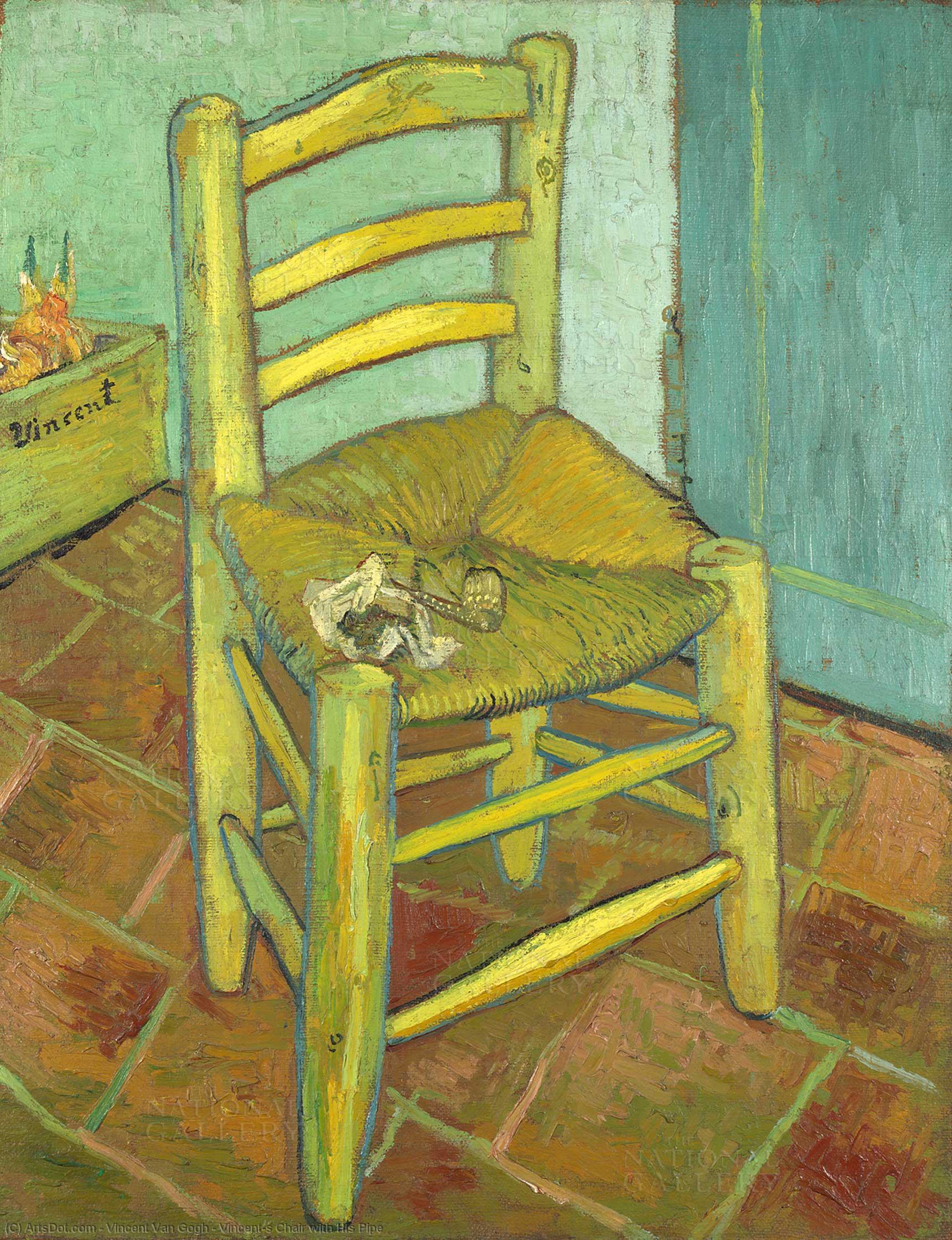
Discover Vincent van Gogh’s ‘Vincent’s Chair’! A captivating oil painting showcasing his signature impasto & vibrant colors. Explore post-Impressionism's beauty – buy art online!
Vincent van Gogh (1853-1890): Explore the life & art of the Dutch Post-Impressionist master behind 'Starry Night' and 'Sunflowers'. Discover his bold style & lasting impact on modern art.
A Quiet Intimacy: Decoding Van Gogh’s “Vincent's Chair with His Pipe”
This evocative oil painting offers a poignant glimpse into the personal world of Vincent van Gogh. Completed in 1888, during his time in Arles, France, *Vincent's Chair with His Pipe* is not merely a still life; it’s an intimate self-portrait by proxy. The simple wooden chair, bathed in warm yellows and oranges, occupies the center stage, its woven seat holding a pipe and tobacco pouch – everyday objects imbued with personal significance. Against a backdrop of cool blue wall tiles, the scene exudes a sense of quiet contemplation and solitude. It’s a powerful statement about presence and absence, inviting viewers to consider the artist's inner life.
Post-Impressionism & The Language of Emotion
Van Gogh was a pivotal figure in the Post-Impressionist movement, rejecting the objective realism of Impressionism in favor of subjective expression. This is vividly apparent in *Vincent's Chair with His Pipe*. The painting isn’t about accurately depicting a chair; it’s about conveying a feeling. The thick, visible brushstrokes – a hallmark of Van Gogh’s style – create texture and movement, imbuing the scene with energy and emotion. Impasto, the technique of applying paint so thickly that it stands out from the surface, adds depth and physicality to the work. The bold color choices—the vibrant yellow against the calming blue—are not arbitrary; they are deliberately chosen to evoke a specific mood, reflecting Van Gogh’s emotional state. This approach influenced subsequent movements like Expressionism, where artists prioritized conveying inner experience over external reality.
Symbolism & The Artist's Presence
The seemingly mundane objects within the painting carry symbolic weight. The chair itself can be interpreted as representing Van Gogh’s place in the world, a space of rest and contemplation. The pipe, frequently depicted in his work, suggests moments of quiet reflection and perhaps even melancholy. It is important to note that this painting exists as part of a pair; *Paul Gauguin's Armchair* was painted around the same time, reflecting the complex relationship between the two artists. The deliberate simplicity of Van Gogh’s chair – its rustic construction and unadorned design – contrasts sharply with the more ornate style of Gauguin’s armchair, hinting at their differing personalities and artistic philosophies. The inclusion of his name on a small box in the background is a subtle yet powerful assertion of his presence, even in absence.
Emotional Resonance & Lasting Legacy
*Vincent's Chair with His Pipe* resonates deeply because it taps into universal themes of loneliness, longing, and the search for meaning. The painting’s quiet intimacy invites viewers to project their own emotions onto the scene, creating a personal connection with the artist and his work. It is a testament to Van Gogh’s ability to transform ordinary objects into powerful symbols of human experience. Today, this iconic image continues to inspire artists, designers, and art lovers alike, serving as a reminder of the enduring power of art to connect us to ourselves and to each other. The painting can be found in prominent collections like the Van Gogh Museum in Amsterdam, ensuring its accessibility for generations to come.