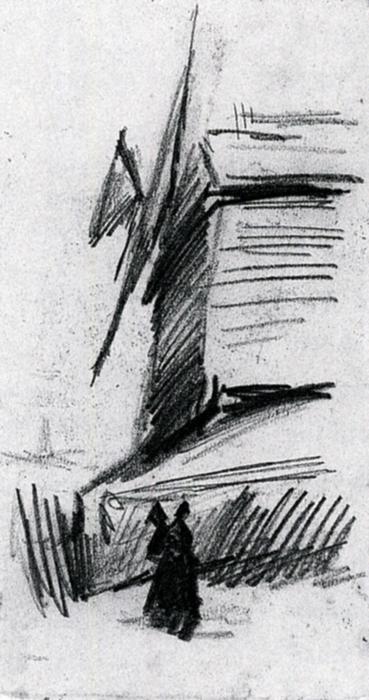
Windmill at Montmartre: A Study in Rustic Impressionism
Vincent van Gogh’s “Windmill at Montmartre,” painted in 1886, stands as a testament to the artist's unwavering dedication to capturing the essence of rural France during his formative years. More than just a depiction of a windmill – a symbol of industriousness and agricultural progress – it embodies Van Gogh’s signature Post-Impressionist style: bold brushstrokes, simplified forms, and an overwhelming preoccupation with conveying emotion rather than achieving photographic accuracy. This remarkable artwork resides within the Carnegie Museum of Art in Pittsburgh, offering visitors a glimpse into the artistic vision of one of history's most influential figures.
- Subject Matter: The scene portrays a solitary windmill against a backdrop of rolling hills and scattered trees—a quintessential landscape motif favored by Van Gogh during his time in Montmartre. It’s not merely scenery; it’s imbued with a palpable sense of atmosphere, reflecting the artist's keen observation of natural light and color.
- Style & Technique: Executed primarily in charcoal or pencil on paper, “Windmill at Montmartre” exemplifies Post-Impressionism’s rejection of Impressionistic optical realism. Instead, Van Gogh employs thick, impasto brushstrokes—heavy application of paint—to build up texture and create a dynamic visual surface. These strokes aren't blended smoothly; they retain their individual marks, conveying an immediacy and energy that speaks to the artist’s emotional state.
- Composition: The vertical orientation emphasizes the towering windmill, anchoring the composition while simultaneously drawing the viewer’s eye upwards. Two figures—likely laborers—are positioned in the foreground, providing scale and subtly hinting at human interaction with the landscape. This deliberate arrangement contributes to a feeling of quiet contemplation amidst the grandeur of nature.
- Color Palette: Although presented as a monochrome reproduction, the original painting utilized a restrained palette dominated by shades of gray – ranging from creamy whites to deep blacks—to heighten contrast and sculpt form. The artist skillfully manipulated tonal variations to create depth and luminosity, capturing the subtle nuances of light on the windmill’s sails and surrounding foliage.
- Symbolism & Emotional Impact: Beyond its visual beauty, “Windmill at Montmartre” resonates with deeper symbolic meanings. The windmill itself can be interpreted as representing both technological advancement and the enduring spirit of rural life—themes central to Van Gogh's artistic concerns. More profoundly, however, the painting conveys a melancholic mood—a characteristic hallmark of Van Gogh’s oeuvre—reflecting his own struggles with mental health and capturing an elusive sense of solitude amidst the beauty of the natural world.
Further Exploration: Le Moulin de la Galette & Montmartre Quarry, The Mills
To appreciate the breadth of Van Gogh’s artistic vision, consider examining “Le Moulin de la Galette,” another iconic Impressionist masterpiece from 1886. Similarly, "Montmartre Quarry, The Mills" showcases his masterful ability to translate emotion into visual form. These artworks offer invaluable insights into the artist's stylistic evolution and underscore his enduring legacy as a pioneer of expressive painting. You can find more prominent pieces of sketch and study at Wikiart.org.
Bringing Van Gogh’s Vision Home
A high-quality reproduction of “Windmill at Montmartre” allows you to experience the captivating beauty and emotional depth of this seminal artwork in your own space. Explore the Carnegie Museum of Art's collection for inspiration, or delve deeper into Vincent van Gogh's life and artistic journey at the Van Gogh Museum in Amsterdam!