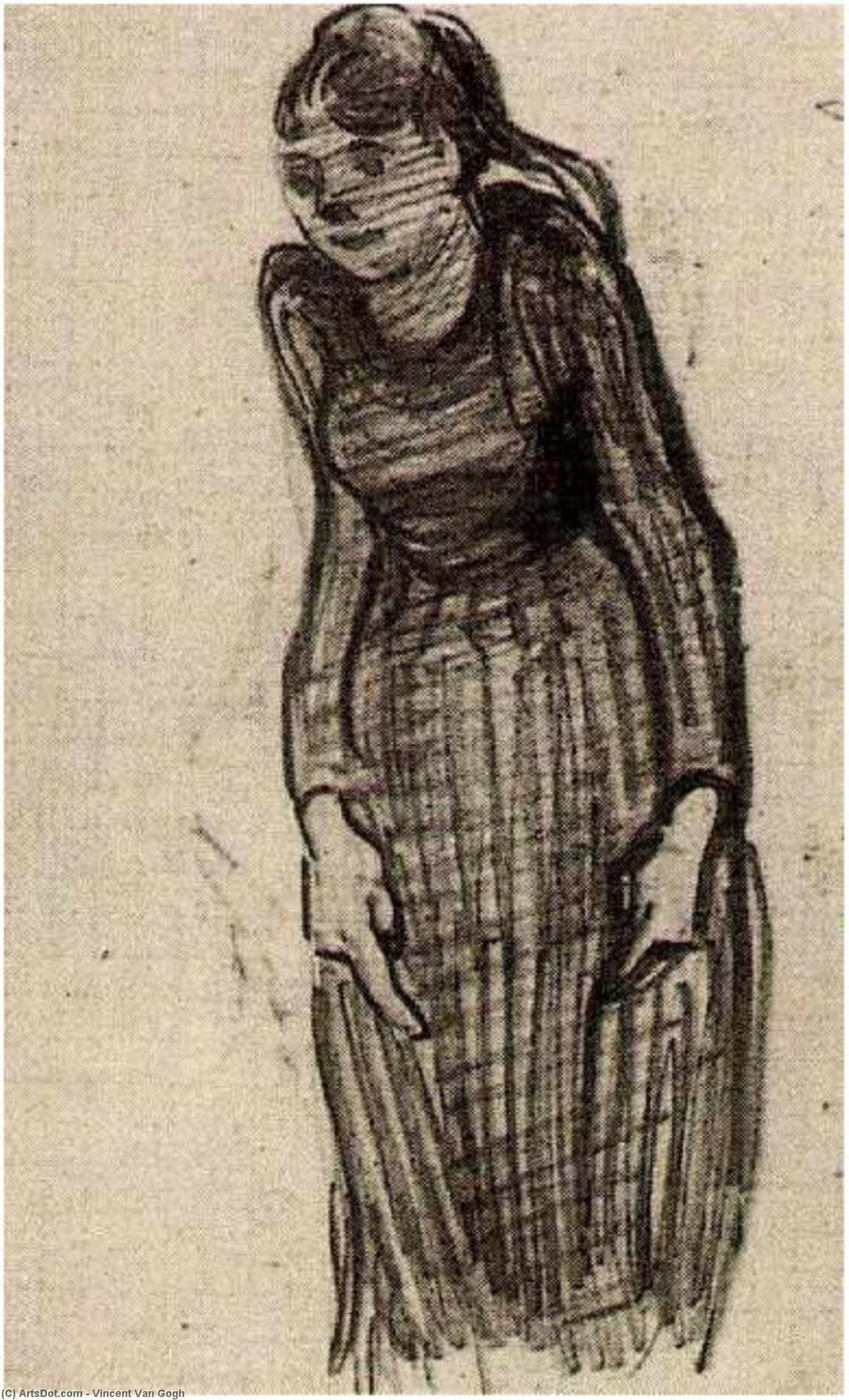
A Portrait of Silent Suffering
In the twilight of his extraordinary life, Vincent van Gogh captured a moment of profound vulnerability that transcends the boundaries of mere portraiture. "Woman Standing," executed in 1890, is not simply a study of a figure, but an intimate window into the depths of human endurance. This charcoal drawing presents a solitary female form, draped in a long, flowing dress that anchors her within a vertical composition designed to evoke both stature and isolation. The most arresting feature, however, is the face—or rather, the lack thereof—as it is obscured by layers of bandages. This striking detail immediately pulls the viewer into a silent narrative of hidden pain, inviting us to contemplate the wounds, whether physical or emotional, that lie beneath the surface.
The technique employed in this work reflects the raw, unbridled energy characteristic of Van Gogh’s final months in Auvers-sur-Oise. Eschewing the polished precision of academic realism, the artist utilizes expressive, dynamic charcoal strokes to build texture and movement. The lines are loose and organic, creating a sense of instability that mirrors the inner turmoil of both the subject and the creator. Through the masterful layering of charcoal on paper, Van Gogh achieves a tactile, almost gritty quality; the shadows are deep and velvety, while the highlights emerge with a ghostly fragility. This interplay of light and dark creates a somber, melancholic atmosphere that is as much felt as it is seen.
Symbolism and the Weight of History
To look upon "Woman Standing" is to engage with the heavy symbolism of Van Gogh’s late period. The bandages serve as a powerful metaphor, representing the concealment of identity, the mourning of loss, or perhaps the societal constraints that shroud the female experience. During 1890, Van Gogh was grappling with intense personal struggles and mental health challenges, and this piece resonates with his preoccupation with themes of marginalization and suffering. The obscured face acts as a canvas for the viewer's empathy, allowing us to project our own understandings of grief and resilience onto the figure.
For the discerning collector or interior designer, this artwork offers a profound emotional anchor. It is a piece that demands attention through its quiet intensity rather than through loud color. Its monochromatic palette and somber tone make it an exquisite choice for spaces designed for reflection, such as a private study, a library, or a minimalist gallery setting. A high-quality reproduction of this masterpiece allows the raw, expressive power of Van Gogh’s hand to breathe within a modern home, providing a sophisticated touch of art history that speaks to the enduring human condition.