The Divine Warrior: Vincenzo Foppa’s St Michael Archangel
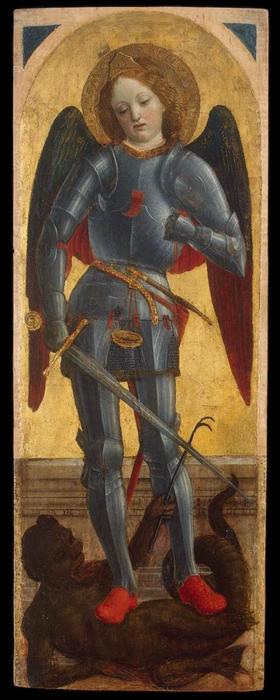
Vincenzo Foppa's “St Michael Archangel,” currently residing within the hallowed halls of The Hermitage Museum in St. Petersburg, offers a captivating glimpse into the burgeoning artistic landscape of early Renaissance Italy. Painted around 1460-1462, this tempera on panel work transcends mere religious iconography; it’s a potent distillation of Gothic tradition interwoven with the nascent humanist ideals that were reshaping European art. Foppa, a pivotal figure in the Lombard school, masterfully balances spiritual grandeur with a remarkably humanistic portrayal of one of Christendom's most revered figures – the archangel charged with combating evil and ushering in divine justice.
A Portrait of Power and Virtue
The central figure dominates the composition: St Michael, depicted not as an ethereal being but as a youthful warrior radiating authority. His features are strikingly realistic for the period, exhibiting a delicate beauty that contrasts sharply with the armor he wears – a meticulously rendered assemblage of breastplate, pauldrons, and greaves, echoing the attire of medieval knights. This deliberate juxtaposition elevates St Michael beyond a purely religious subject; he embodies earthly strength and martial prowess, signifying his role as God’s champion against the forces of darkness. The youthful appearance itself is significant, suggesting an idealization of virtue – a representation of divine power manifested in human form.
Symbolism Woven into the Canvas
The painting's symbolism is rich and layered. St Michael’s two weapons—a gleaming sword held aloft and a lance poised for action—are instantly recognizable emblems of his role as a warrior against Satan. Crucially, at the archangel’s feet lies a formidable dragon, its scales rendered with impressive detail and conveying an overwhelming sense of menace. This imagery is deeply rooted in Christian iconography, where dragons frequently represent the Devil and the temptations that threaten humanity's salvation. The positioning of the dragon beneath St Michael underscores his victory – a visual representation of divine triumph over evil.
Lombard Style and Artistic Technique
Foppa’s style is distinctly Lombard, characterized by its subtle color palette, delicate modeling, and a refined sense of realism. The use of tempera paint lends the work a luminous quality, particularly evident in the rendering of St Michael's skin and armor. Noticeable cracks and discoloration on the original panel speak to the painting’s age and testament to its careful preservation. The background, rendered in a muted golden hue, serves not as a distraction but rather as a symbolic representation of heaven – a realm of light and divine grace. The elaborate border framing the artwork further enhances its sense of grandeur and reinforces its status as a significant religious masterpiece.
A Legacy of Inspiration
“St Michael Archangel” stands as a testament to Vincenzo Foppa’s artistic vision and his pivotal role in shaping the development of painting in Northern Italy. His work, though relatively scarce, profoundly influenced subsequent generations of artists, particularly those working within the Lombard school. Today, through ArtsDot's meticulously crafted hand-painted reproductions, this powerful image can be brought into any space, offering a tangible connection to a rich artistic heritage and a timeless depiction of divine justice and unwavering faith.