Walter Richard Sickert’s ‘Dieppe, Quai Henri IV’: A Study in Urban Melancholy
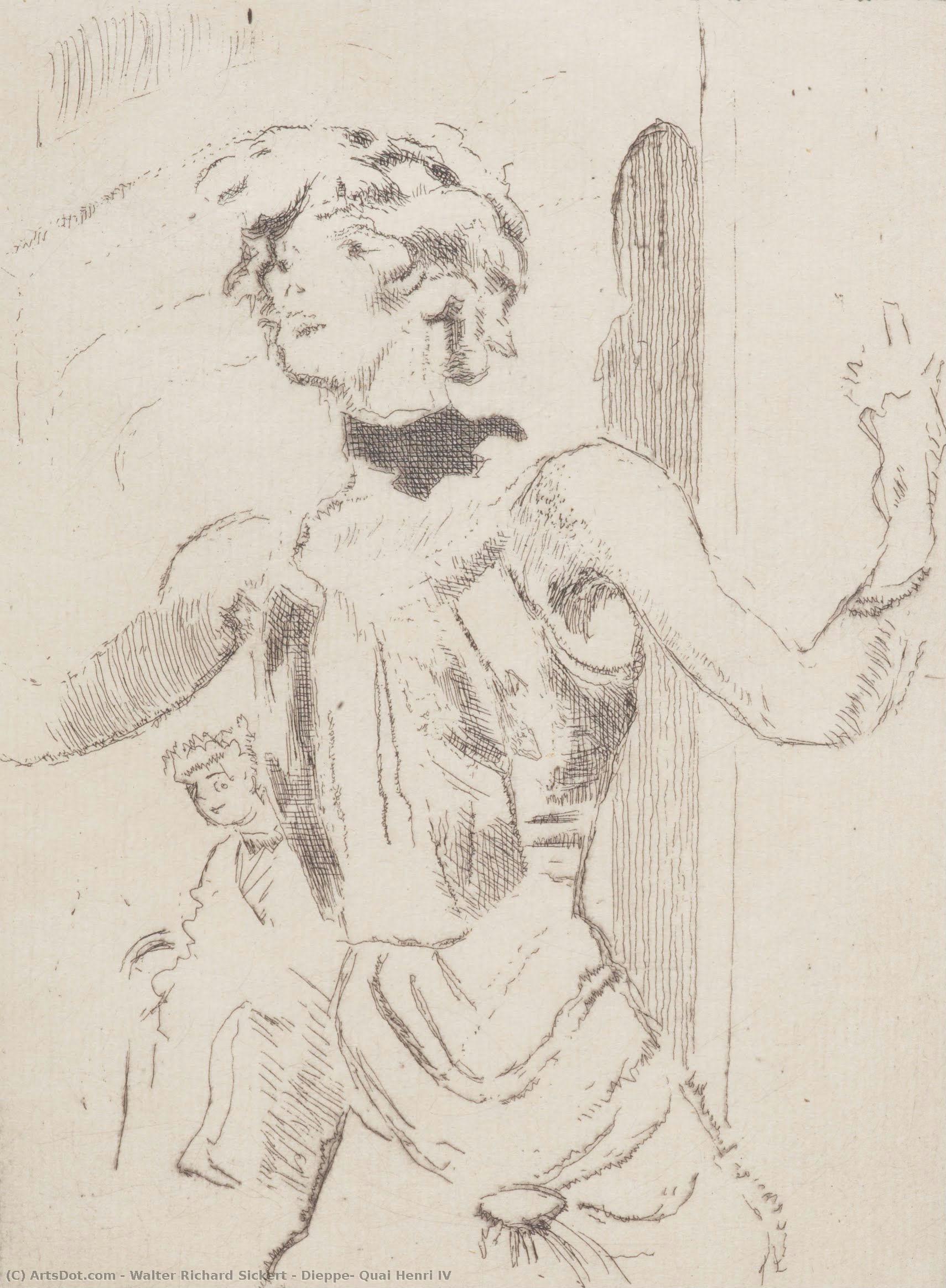
Walter Richard Sickert's “Dieppe, Quai Henri IV,” created in 1915, is more than just a depiction of a coastal scene; it’s a meticulously crafted meditation on urban alienation and the fleeting nature of human experience. Executed as an etching – a technique particularly favored by Sickert – the artwork captures a moment of transient beauty amidst the gritty reality of Dieppe, France, during a period of immense social and political upheaval. The image presents a woman, her long hair flowing freely, seemingly caught in a private dance or hurried flight before a doorway, accompanied by two shadowy figures observing from the background. This scene, rendered in stark black and white, possesses an undeniable power that transcends its simple subject matter.
- Subject Matter: The central focus is on a solitary woman, a figure often associated with vulnerability and perhaps even transgression within Sickert’s oeuvre.
- Technique: Sickert's masterful use of etching demonstrates his control over line and tone, creating a remarkably detailed image despite the limitations of the medium. The drypoint technique, utilizing a needle to incise the plate, contributes to the textured surface and subtle gradations of shadow.
- Composition: The composition is deliberately ambiguous, drawing the viewer into the scene without offering easy answers or resolutions. The placement of the figures and the woman’s posture contribute to a sense of unease and mystery.
A Camden Town Vision: Sickert and the Avant-Garde
“Dieppe, Quai Henri IV” is firmly rooted in the artistic landscape of London's Camden Town Group, a collective of artists who sought to break away from the conventions of academic art. Sickert, as a key member, was instrumental in shaping distinctly British styles of avant-garde art in the early 20th century. The group’s focus on urban life, particularly the darker aspects of London's industrial landscape and its inhabitants, reflected a growing disillusionment with Victorian ideals. This work exemplifies this trend, eschewing idealized representations for a more honest, even unsettling, portrayal of reality.
Sickert’s cosmopolitan background – born in Munich and later residing in England – undoubtedly influenced his artistic perspective. His experiences navigating multiple cultural contexts informed his ability to observe and depict the world with a unique blend of detachment and empathy. The work's subject matter—a woman seemingly lost in her own thoughts—resonates with themes of isolation and introspection, common threads throughout Sickert’s career.
Symbolism and Emotional Resonance
The etching is laden with symbolic potential. The clock in the upper right corner serves as a poignant reminder of time's relentless passage and the ephemeral nature of beauty and experience. The woman herself could be interpreted as representing lost innocence, fleeting youth, or perhaps even the darker aspects of human desire. The shadowy figures observing her add to the sense of unease and suggest a voyeuristic element, highlighting the potential for judgment and scrutiny within urban environments.
The monochromatic palette further amplifies the emotional impact of the piece, evoking a mood of melancholy and quiet contemplation. Sickert’s ability to capture such nuanced emotion through etching is a testament to his artistic skill and sensitivity. The overall effect is one of profound stillness, inviting viewers to ponder the mysteries of human existence.
Historical Context and Legacy
"Dieppe, Quai Henri IV" was created in 1915, a year marked by the outbreak of World War I. This context undoubtedly influenced Sickert’s artistic vision, contributing to the sense of anxiety and uncertainty that permeates the work. The etching reflects a broader trend within early modernism – a rejection of traditional values and a willingness to confront uncomfortable truths about human nature.
Sickert's legacy extends beyond his individual works; he played a crucial role in shaping the course of British art at the turn of the century. His influence can be seen in the work of subsequent generations of artists, solidifying his position as one of the most important figures in the transition from Impressionism to Modernism. This reproduction offers a unique opportunity to experience firsthand the power and beauty of Sickert’s vision.