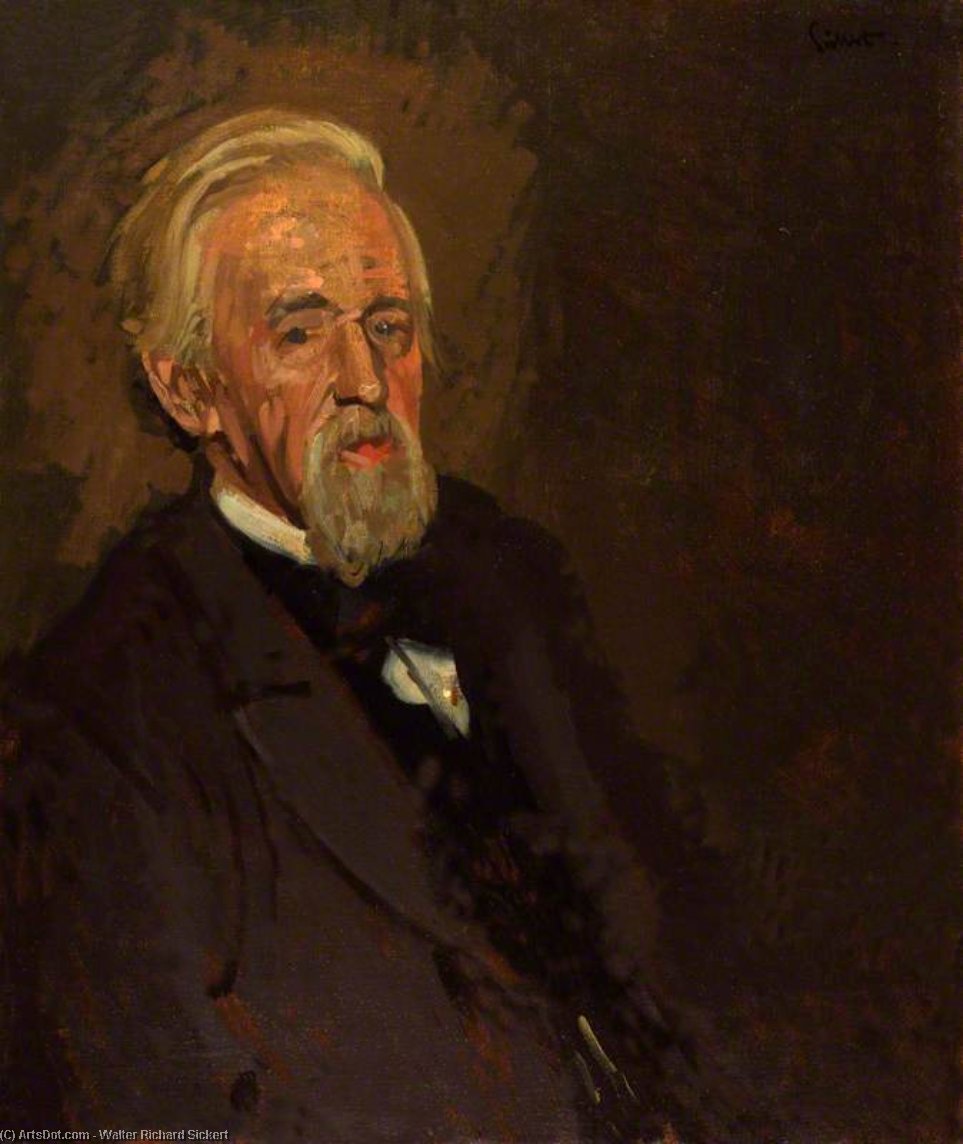
The Enigmatic Gaze: Walter Richard Sickert’s ‘George Jacob Holyoake’
Walter Richard Sickert's 1892 painting, “George Jacob Holyoake,” is more than a simple portrait; it’s a carefully constructed tableau of Victorian intellectualism and quietly simmering dissent. Housed within the National Portrait Gallery in London, this oil on canvas offers a compelling glimpse into the life of a prominent secularist and public figure – a man wrestling with his convictions amidst the rigid social landscape of late 19th-century Britain. The painting immediately draws the viewer in with Holyoake’s intense gaze; he sits slightly turned away from the direct line of sight, creating an air of thoughtful contemplation, almost as if he's grappling with a profound internal debate.
Sickert masterfully employs his signature technique – a blend of Impressionistic color and a deliberately loose, expressive brushstroke. The palette is muted, dominated by browns, greys, and deep blues, reflecting the somber mood and perhaps mirroring Holyoake’s own philosophical stance. Notice how Sickert doesn't attempt to render every detail with photographic precision; instead, he uses broad strokes to suggest form and texture, prioritizing atmosphere and psychological impact over strict realism. The background is deliberately blurred, drawing attention solely to the subject and reinforcing his isolation within the frame.
A Man of Ideas: Holyoake’s Secularist Vision
George Jacob Holyoake (1817-1906) was a pivotal figure in the development of secularism in Britain. A staunch advocate for reason and social reform, he challenged the prevailing religious orthodoxy and championed a society based on ethical principles rather than dogma. His writings, particularly his articulation of “secularism” – a philosophy emphasizing human agency and rational inquiry – profoundly influenced subsequent thinkers and activists. Holyoake’s life was one of intellectual struggle; he faced persecution for his beliefs and tirelessly campaigned for social justice and the separation of church and state.
The painting captures this spirit of intellectual engagement. Holyoake's attire—a dark suit and tie—suggests a man of respectability and standing, yet his posture and expression hint at a deeper complexity. He’s not simply presenting himself; he’s inviting the viewer to share in his thoughts and questions. The painting serves as a visual testament to Holyoake’s importance during a period of significant social and intellectual upheaval.
Sickert's Camden Town: A World of Shadows and Intimacy
To understand Sickert’s approach, it’s crucial to consider his association with the Camden Town Group. This collective of artists—including Walter Sickert himself, George Moore, and Vanessa Bell—rejected the academic traditions of the Royal Academy and sought to capture the gritty realities of London life. Camden Town, a rapidly developing area in North London, became their artistic hub – a place where they explored themes of urban alienation, social unrest, and the darker aspects of human nature. Sickert’s work often reflects this atmosphere of bohemian intensity and psychological depth.
His portraits frequently feature ordinary people—laborers, musicians, and prostitutes—stripped of idealized beauty and presented with unflinching honesty. “George Jacob Holyoake” aligns perfectly with this aesthetic; it's a portrait that eschews romanticism in favor of a raw, unvarnished depiction of the subject’s inner life. The painting is not merely a likeness but an exploration of character and intellect.
Owning a Piece of History: Reproductions by ArtsDot
ArtsDot offers meticulously crafted, hand-painted reproductions of “George Jacob Holyoake,” allowing art enthusiasts to bring this significant work into their homes or offices. Our skilled artists replicate Sickert’s distinctive style and technique with the utmost care, ensuring that each reproduction captures the painting's original atmosphere and emotional resonance. Whether you are a collector of Victorian art, an admirer of Walter Richard Sickert, or simply seeking a beautiful and thought-provoking piece for your interior décor, our reproductions provide an authentic and accessible way to experience this remarkable portrait.