Discover Walter Richard Sickert (1860-1942), a pivotal British painter influenced by Whistler & Degas. Known for evocative scenes of London life, music halls, and interiors, he was central to early 20th-century avant-garde art.
Tate Gallery
(London, United Kingdom)
Discover British & international art at Tate Britain! Explore centuries of masterpieces, from Turner to modern icons – free entry awaits in London’s riverside gallery.
The Enigmatic Gaze of George Moore
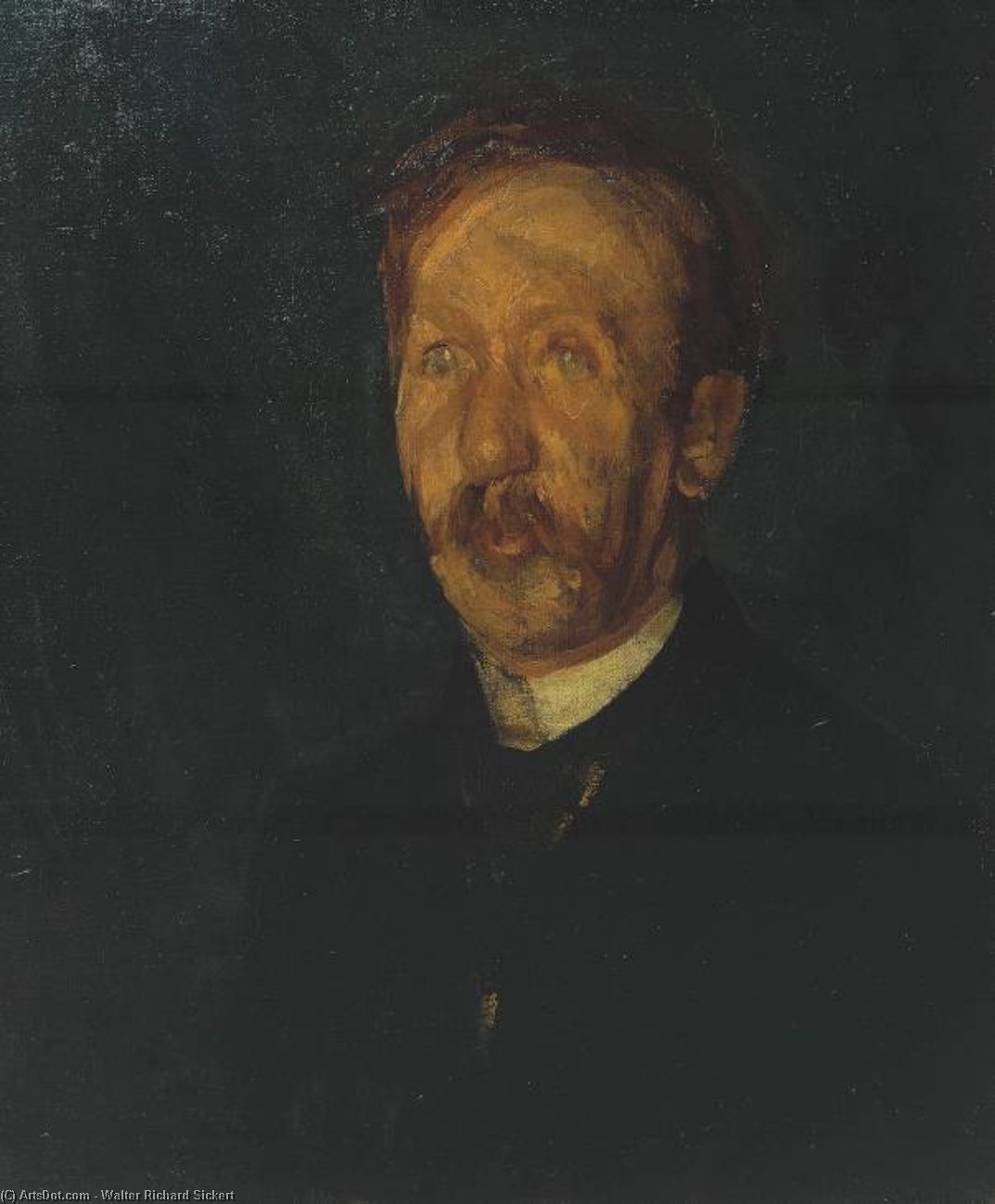
Walter Richard Sickert’s portrait, "George Moore," is not merely a likeness captured on canvas; it is an encounter with a profound, internalized moment. The subject confronts the viewer with an intensity that seems to pierce through the veil of time and paint. Dressed in the formal attire of his era—the crisp collar, the neat tie—he presents a figure steeped in Victorian gravity. Yet, beneath the surface formality lies a palpable tension, suggested by the set of his jaw and the unwavering directness of his gaze. Sickert masterfully isolates this man against a deep, consuming darkness, forcing our attention solely onto the nuances of expression and the subtle play of light across his features.
A Study in Shadow and Psychological Depth
Technically, the painting speaks to Sickert’s signature ability to render atmosphere. The use of chiaroscuro here is dramatic; the background dissolves into an almost velvety void, serving only to push the illuminated figure forward into sharp relief. This technique draws the eye immediately to the subject's face and beard, areas where the artist has concentrated his most delicate brushwork. One senses the weight of history in the oil paint—the rich, matte quality suggesting a careful layering of pigment that builds character as much as it depicts flesh. It is a portrait less concerned with flattering resemblance than with excavating the sitter's inner life.
Historical Echoes and Theatricality
To understand "George Moore" is to appreciate Sickert’s own complex position in art history—a man caught between academic tradition and the restless energy of modernism. Having early associations with the theatrical world, as hinted at by his background, this portrait carries a subtle dramatic flair. The subject seems perpetually poised on a stage, whether that stage is life itself or the quiet drama unfolding within the confines of the painting. It evokes the feeling of observing a character in an unfinished play, rich with unspoken narrative and untold backstory.
Bringing the Masterpiece Home
For the collector or designer seeking to infuse a space with intellectual weight and brooding elegance, this reproduction offers more than just decoration; it offers conversation. The deep tones and focused intensity of Sickert’s hand lend themselves beautifully to sophisticated interiors—a study, a library, or a drawing-room corner where contemplation is encouraged. Owning a piece echoing "George Moore" means embracing a dialogue with the past, acknowledging the enduring power of the human gaze captured by an artist who saw the shadows as vividly as the light.