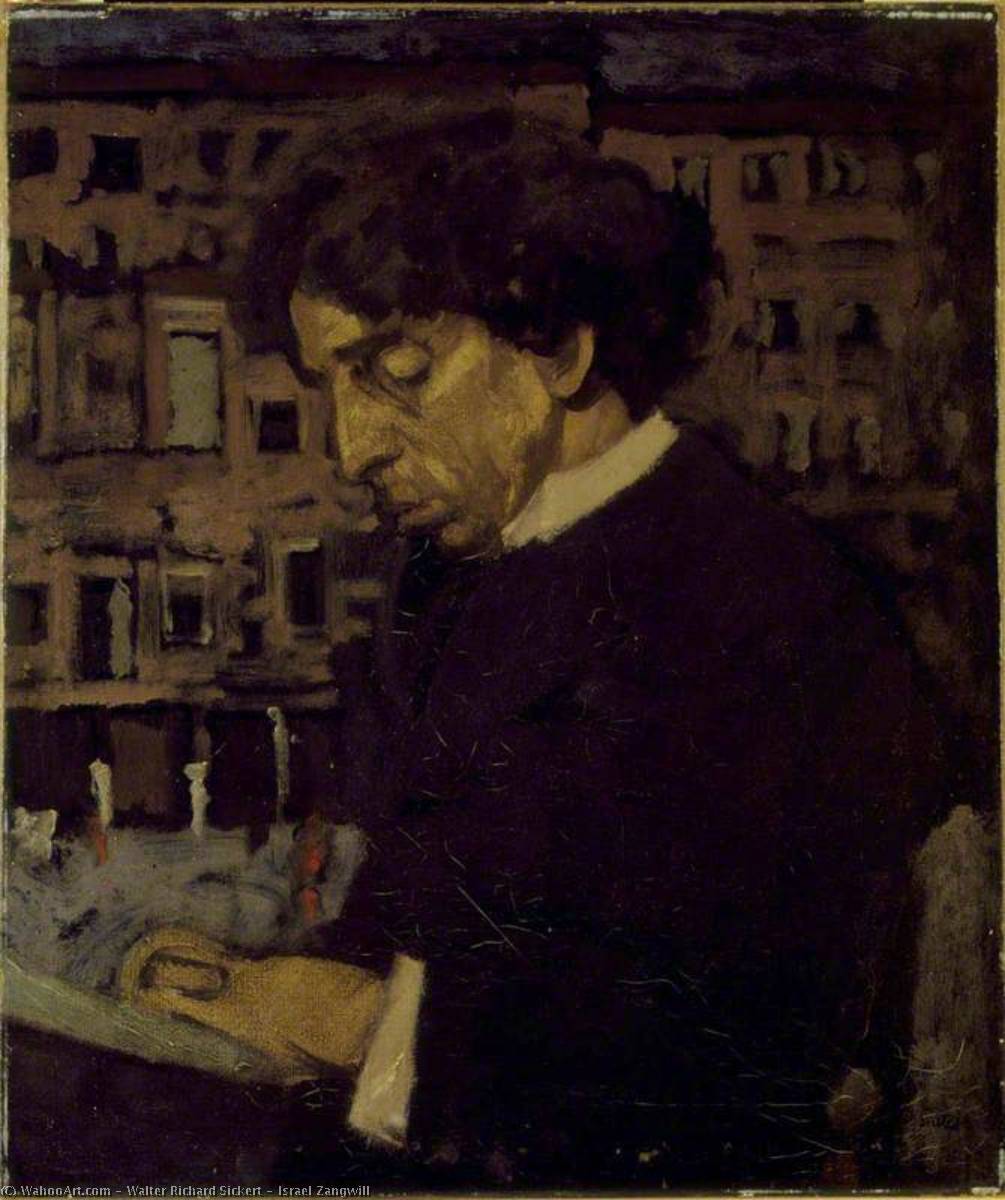
A Study in Contemplative Dignity
In the quiet depths of Walter Richard Sickert’s 1898 masterpiece, Israel Zangwill, we encounter more than just a mere likeness; we are invited into a profound moment of introspection. The portrait captures the essence of the renowned writer and polymath, presenting him not in a moment of public oratory, but in a state of private, heavy thought. Sickert, an artist masterfully skilled at navigating the boundaries between traditional portraiture and the psychological complexities of modernism, utilizes a downward gaze to suggest a soul preoccupied with the weight of intellect and experience. The subject’s hands, clasped gently before him, serve as a silent anchor in the composition, grounding the viewer in the stillness of the scene.
The technique employed here is a testament to Sickert's ability to manipulate light and shadow to evoke character. Through the medium of oil on canvas, the artist builds layers of texture that breathe life into the white fabric of Zangwill’s shirt, creating a stark, luminous contrast against the more muted, atmospheric background. This interplay of light—often referred to as chiaroscuro in classical traditions—is used here not just for dramatic effect, but to sculpt the features of the face and the texture of the beard, lending the portrait a tactile, three-dimensional quality that draws the eye inward.
The Intersection of History and Emotion
To understand this work is to understand the era of its creation. Painted at the close of the nineteenth century, the portrait sits at a fascinating crossroads of history. Sickert, a man whose own life was defined by movement between German roots and British identity, brings a certain cosmopolitan sensitivity to the canvas. The subject, Israel Zangwill, was a figure of immense cultural significance, and through Sickert's brush, we see the embodiment of late-Victorian intellectualism. There is a palpable sense of gravity in the work, an emotional resonance that speaks to the burdens of leadership and the solitude of the thinker.
For the discerning collector or interior designer, this painting offers a sophisticated focal point that transcends mere decoration. It possesses a quiet authority that can anchor a room, providing a sense of historical depth and intellectual prestige. Whether placed in a private library, a formal study, or a contemporary living space, a high-quality reproduction of this work brings with it an aura of timelessness. The subtle palette and the masterful handling of light make it a versatile piece, capable of complementing both classical aesthetics and modern, minimalist environments, inviting anyone who lingers before it to share in its profound, silent meditation.