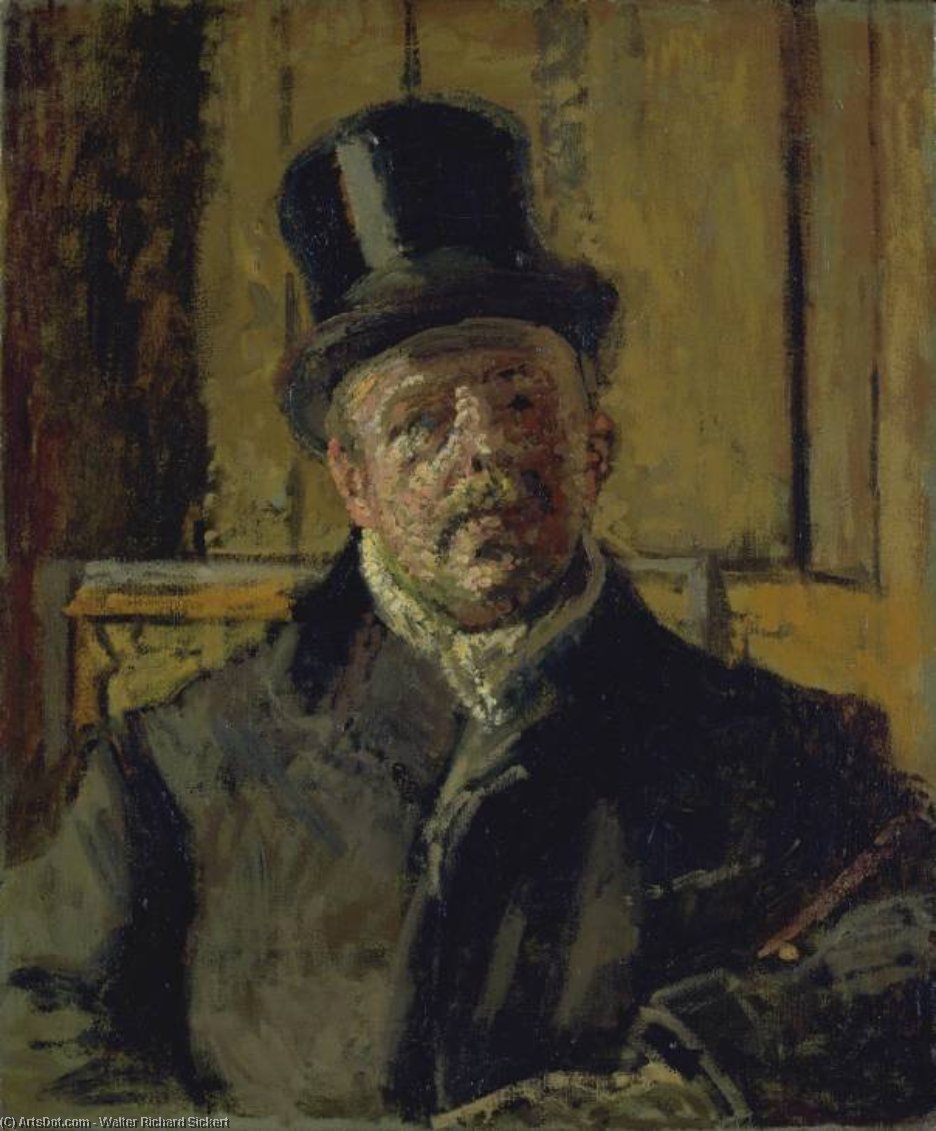
Walter Richard Sickert’s 1910 portrait captures a Parisian gentleman in an Impressionistic style. Explore this textured oil painting featuring a top hat & pipe, reflecting social life and mood.
Discover Walter Richard Sickert (1860-1942), a pivotal British painter influenced by Whistler & Degas. Known for evocative scenes of London life, music halls, and interiors, he was central to early 20th-century avant-garde art.
Tate Gallery
(London, United Kingdom)
Discover British & international art at Tate Britain! Explore centuries of masterpieces, from Turner to modern icons – free entry awaits in London’s riverside gallery.
Jacques-Emile Blanche: A Portrait of Parisian Elegance and Quiet Contemplation
Walter Richard Sickert’s “Jacques-Émile Blanche,” painted around 1910, stands as a quintessential example of Impressionistic portraiture—a snapshot of Belle Époque society captured with remarkable sensitivity and stylistic nuance. More than just a likeness of the celebrated French painter Jacques-Émile Blanche himself, the painting embodies a profound exploration of character and atmosphere, reflecting Sickert’s fascination with capturing fleeting moments of human experience.
Composition and Technique: Impressionistic Brilliance
The artwork employs a distinctive Impressionistic technique characterized by loose brushstrokes—a hallmark of Sickert's oeuvre—that prioritize conveying light and texture over meticulous detail. Thick impasto application is particularly evident on Blanche’s hat and face, creating a palpable surface quality that invites tactile engagement. The artist skillfully utilizes chiaroscuro – the interplay of light and shadow – to sculpt Blanche’s form and imbue the scene with an understated drama. A shallow depth of field draws attention to Blanche's visage, emphasizing his gaze and conveying a sense of introspective contemplation. The muted palette—dominated by earthy tones accented by cooler shades—further contributes to the painting’s mood of quiet dignity.
Subject Matter and Symbolism: Beyond Mere Representation
Blanche is seated indoors, holding a pipe in his hand, suggesting leisure and perhaps philosophical reflection. The inclusion of the pipe isn't merely decorative; it symbolizes contemplation and intellectual curiosity – qualities that Sickert consistently sought to portray in his subjects. The backdrop—a blurred expanse of wall—adds to the painting’s spatial ambiguity and reinforces its focus on Blanche as an individual figure within a broader social context. Notably, the hat itself represents status and formality, aligning with Blanche's position as a prominent artist and social commentator during his time.
Historical Context: Camden Town Group Influence
“Jacques-Émile Blanche” belongs to Sickert’s membership in the Camden Town Group—a collective of artists who championed realism alongside Impressionistic experimentation. This group sought to depict London life with unflinching honesty, capturing both its vibrancy and its darker undercurrents. Sickert's artistic vision was profoundly influenced by Whistler and Degas, whose emphasis on tonal harmony and subtle observation shaped his approach to painting. The painting’s inclusion in exhibitions like “Forty-Seventh Exhibition of Modern Pictures” solidified Sickert’s reputation as a leading figure in British avant-garde art.
Emotional Resonance: Capturing the Soul of Portraiture
Ultimately, “Jacques-Émile Blanche” transcends mere visual representation; it succeeds in conveying Blanche's inner life—his seriousness and contemplative gaze—with remarkable psychological depth. Sickert’s masterful brushwork captures not only Blanche’s physical appearance but also his character and spirit, creating a portrait that lingers in the viewer’s imagination long after viewing. It exemplifies Sickert’s ability to transform ordinary subjects into compelling narratives of human experience.