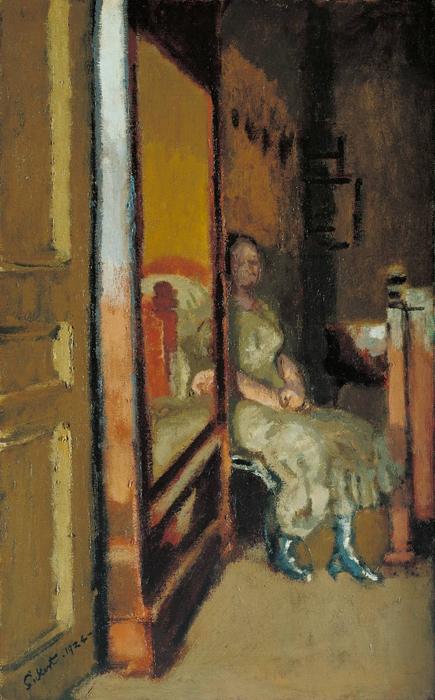
Experience the quiet reflection of Sickert's 1924 masterpiece, L'Armoire à Glace, capturing intimate domestic stillness with masterful light and shadow.
Discover Walter Richard Sickert (1860-1942), a pivotal British painter influenced by Whistler & Degas. Known for evocative scenes of London life, music halls, and interiors, he was central to early 20th-century avant-garde art.
Tate Gallery
(London, United Kingdom)
Discover British & international art at Tate Britain! Explore centuries of masterpieces, from Turner to modern icons – free entry awaits in London’s riverside gallery.
Walter Richard Sickert: A Portrait of Quiet Reflection
Walter Richard Sickert (1860–1942) stands as an enigmatic figure in British art history—a man perpetually adrift between German heritage and fervent embrace of the avant-garde, forever drawn to marginalized subjects and shadowed interiors. His formative years were marked by restless movement; the family’s relocation to England in 1868, spurred by escalating political tensions across Europe, instilled within him a profound sense of displacement that arguably fueled his lifelong preoccupation with outsiders and those inhabiting the fringes of society. Though descended from a lineage steeped in artistic tradition—his father, Oswald Sickert, was a Danish painter—young Walter initially harbored ambitions for theatrical performance, briefly captivating audiences as an actor alongside Sir Henry Irving, gaining invaluable insight into the art of illusion and character portrayal. This early exposure to the stage would indelibly shape his artistic vision, imbuing his paintings with a distinctive theatricality and psychological depth that distinguished him from many of his contemporaries.
L'Armoire à Glace: A Study in Domestic Still Life
“L’Armoire à Glace,” completed in 1924, exemplifies Sickert’s signature style—a masterful blend of realism and expressive abstraction. Painted in oil on canvas, the artwork depicts a woman seated calmly within her bedroom, gazing thoughtfully towards the viewer. The room itself is rendered with meticulous detail, dominated by an ornate armoire positioned centrally, serving as a focal point for the composition. Scattered around are other chairs—some closer to the woman, others receding into the background—creating a sense of spatial depth and inviting contemplation. Subtle nuances of light and shadow play across surfaces, enhancing the atmosphere’s intimacy and conveying a palpable stillness.
Technique and Impressionistic Influence
Sickert's technique reflects his engagement with Impressionism and Post-Impressionism, particularly Whistler and Degas. He employs loose brushstrokes—characteristic of the period—to capture fleeting moments of light and color, prioritizing tonal variations over precise delineation. The muted palette—primarily browns, creams, and greys—contributes to the painting’s melancholic mood and reinforces its focus on psychological observation rather than literal representation. Careful attention is paid to capturing textures – the polished surface of the armoire, the fabric of the chair cushions – adding tactile richness to the visual experience.
Symbolism and Narrative Depth
Beyond mere depiction, “L’Armoire à Glace” resonates with symbolic significance. The armoire itself—a repository of memories and possessions—represents stability amidst change, mirroring the woman's quiet contemplation as she observes the viewer. The room’s interior space serves as a microcosm of domestic life, encapsulating themes of solitude, reflection, and perhaps unspoken emotion. Sickert’s choice to portray a solitary figure engaged in introspection speaks to his broader artistic concern with exploring the complexities of human consciousness—a preoccupation that distinguishes him from many artists of his time.
Legacy and Artistic Significance
Walter Richard Sickert remains a pivotal figure in British art history, recognized for pioneering a distinctive aesthetic rooted in psychological realism and theatrical sensibility. His work continues to inspire artists and collectors alike, demonstrating the enduring power of observation and emotional resonance. “L’Armoire à Glace,” with its evocative portrayal of domestic tranquility and subtle symbolic layering, stands as a testament to Sickert's artistic genius—a masterpiece that captures not only a moment in time but also the profound depths of human experience.