A Glimpse into Kandinsky’s Inner Landscape: The ‘Apple Tree’
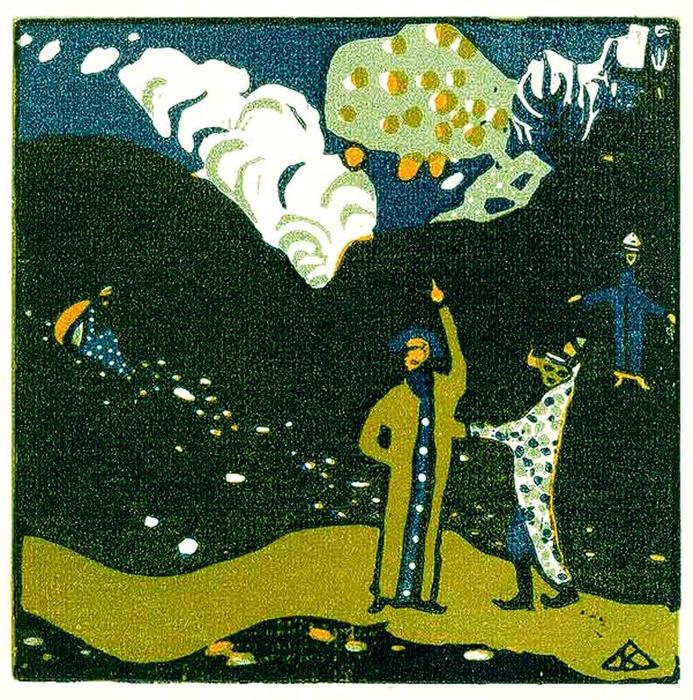
Wassily Kandinsky's ‘Apple Tree’ (Apfelbaum), painted in 1913, is not an invitation to a pastoral orchard scene, but rather a portal into the burgeoning world of abstract art. This small yet powerfully evocative woodcut – measuring just 10x10cm – represents a pivotal moment in Kandinsky's artistic journey and within the broader narrative of modernism. It’s a work that demands not simply to be *seen*, but to be *felt*; an attempt to translate inner emotional states into visual form, bypassing representational accuracy for the sake of spiritual resonance.
From Impressionistic Roots to Abstract Expression
Kandinsky's path toward abstraction was not sudden. Born in Moscow in 1866, his early life was steeped in intellectual and artistic pursuits – a foundation that included both law studies and musical training. A transformative experience witnessing Claude Monet’s ‘Haystacks’ ignited within him a fascination with the expressive potential of color, independent of its descriptive function. This initial spark led him to Munich, where he absorbed influences from Impressionism, Fauvism, and Symbolism before forging his own unique path. ‘Apple Tree’ emerges during this crucial period of experimentation, bridging the gap between recognizable subject matter and the complete non-objectivity that would define his later work. The woodcut technique itself – with its inherent qualities of line and texture – lends a rawness and immediacy to the image, reflecting Kandinsky's desire to strip away artifice and access a more primal form of expression.
Decoding the Symbolism: Beyond the Orchard
While titled ‘Apple Tree’, the work bears little resemblance to a traditional depiction of this familiar subject. Instead, we encounter a dynamic arrangement of geometric shapes and swirling lines that suggest – rather than illustrate – the essence of an apple tree. The apple itself held deep symbolic weight for Kandinsky; it represented not merely fruit, but a connection to nature’s cycles, spiritual awakening, and even the forbidden knowledge of paradise. Within the context of his broader artistic philosophy, outlined in his seminal work ‘Concerning the Spiritual in Art’, the abstraction wasn't about *removing* meaning, but rather about unlocking a deeper, more universal language of feeling. The composition vibrates with an inner energy, mirroring Kandinsky’s belief that art should be akin to music – capable of evoking emotions directly, without relying on narrative or imitation.
A Legacy of Innovation and Emotional Resonance
‘Apple Tree’ stands as a testament to Kandinsky's pioneering spirit. It exemplifies his commitment to exploring the spiritual dimensions of art and his relentless pursuit of non-representational forms. The work’s enduring appeal lies in its ability to transcend time and cultural boundaries, speaking directly to our shared human experience. For collectors and interior designers alike, a reproduction of ‘Apple Tree’ offers more than just aesthetic beauty; it provides a window into the mind of a visionary artist and a powerful reminder of art's capacity to awaken the soul. It is a piece that invites contemplation, encourages emotional connection, and celebrates the boundless possibilities of abstract expression.