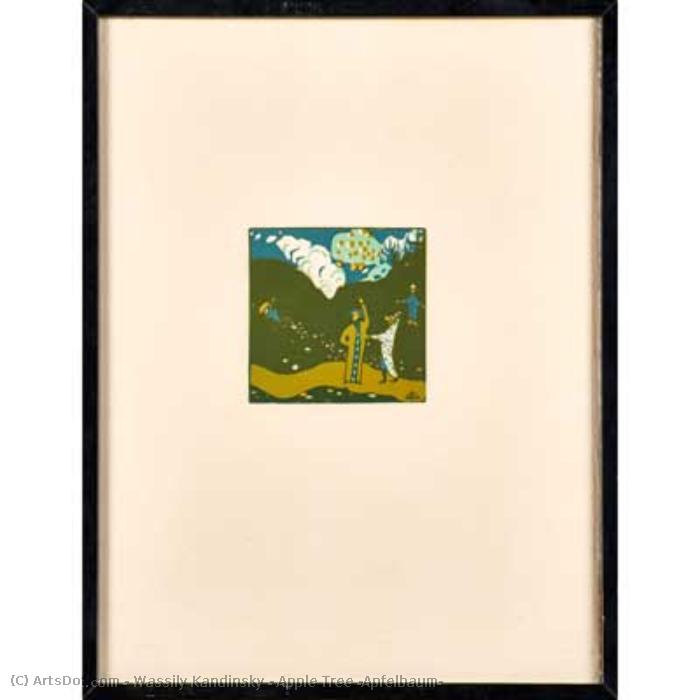
Apple Tree (Apfelbaum) by Wassily Kandinsky: A Glimpse into Spiritual Abstraction
- Artwork Title: Apple Tree (Apfelbaum)
- Artist: Wassily Kandinsky
- Date: 1913
- Dimensions: 10 x 10 cm
- Medium: Woodblock Print
- Location: Museum of Modern Art (MoMA), New York City, NY, US
A Synthesis of Sound and Vision: The Context of 'Klänge'
‘Apple Tree (Apfelbaum)’ is not merely a standalone artwork; it’s a significant piece within Wassily Kandinsky’s larger project, Klänge (Sounds). Created in 1913, this woodblock print forms part of a series of fifty-six prints and thirty-eight prose poems intended to be experienced together. Kandinsky conceived of Klänge as a “musical album,” aiming for a synesthetic experience – the blending of senses. He sought to translate musical structures and emotions into visual form, mirroring his deep interest in music, having previously played both piano and cello. This period marked a crucial shift in Kandinsky’s artistic journey, moving him further away from representational art towards pure abstraction. The work was born out of a desire to explore the spiritual realm through non-objective forms, reflecting Kandinsky's belief that color and form could evoke profound emotions and spiritual experiences.
Deconstructing Nature: Style and Technique
‘Apple Tree (Apfelbaum)’ exemplifies early modernism, showcasing Kandinsky’s evolving style as he moved towards abstraction. The artwork departs significantly from traditional depictions of nature. Instead of a realistic portrayal of an apple tree, we see a stylized representation constructed from geometric shapes – squares, circles, and triangles – arranged in a dynamic composition. The woodblock printing technique itself contributes to the work's unique aesthetic. Kandinsky’s deliberate use of lines and planes creates a flattened perspective, typical of early 20th-century artistic trends influenced by Cubism and Expressionism. The limited color palette—primarily greens and yellows—further emphasizes the abstract nature of the piece, avoiding naturalistic hues in favor of expressive color relationships. The simplification of forms and the bold use of color are hallmarks of Kandinsky’s approach to conveying spiritual meaning through art.
Symbolism and Emotional Resonance
While seemingly simple, ‘Apple Tree (Apfelbaum)’ is rich with symbolic potential. The apple tree itself has long been associated with themes of knowledge, temptation, and abundance in Western culture. Kandinsky’s abstraction of this familiar image invites viewers to move beyond literal interpretation and engage with the artwork on a more emotional and spiritual level. The stylized figures dancing or celebrating within the scene suggest a sense of joy, vitality, and perhaps even ritualistic connection to nature. The overall effect is dreamlike and evocative, prompting contemplation about the relationship between humanity, nature, and the unseen forces that shape our world. Kandinsky aimed to bypass rational thought and directly access the viewer’s emotions through his art, and ‘Apple Tree (Apfelbaum)’ serves as a powerful example of this ambition.
Kandinsky: A Pioneer of Abstract Art
- Born on December 4, 1866, in Moscow, Russia, Wassily Wassilyevich Kandinsky came from a diverse background – his mother was Muscovite, one great-grandmother a Mongolian princess, and his father from near the Chinese border.
- Initially demonstrating aptitude for music, he proficiently played the piano and cello.
- He studied law and economics at Moscow University, graduating in 1889.
- A pivotal moment occurred when witnessing Monet’s “Haystacks” exhibition, sparking his interest in art.
- In 1896, at age 30, Kandinsky abandoned his academic career to pursue painting seriously.
Move to Munich and Early Artistic Development
- Kandinsky relocated to Munich, Germany, studying at Anton Ažbe’s private school and later the Academy of Fine Arts.
- His early style was influenced by Impressionism, Fauvism, and Symbolism.