Experience Wassily Kandinsky's 'Blue Mountain,' an Expressionist masterpiece capturing vibrant movement and emotion. Explore the painting’s history, style, and influence on modern art.
A Symphony in Blue: Kandinsky’s “Blue Mountain”
Wassily Kandinsky's "Blue Mountain," painted in 1908, isn’t merely a landscape; it’s an immersion into the nascent realm of abstract expression. Born from a confluence of influences – the vibrant hues of Monet, the emotional intensity of Expressionism, and a burgeoning desire to transcend representational art – this work stands as a pivotal moment in the history of modern painting. It's a testament to Kandinsky’s belief that color itself could evoke emotion and communicate directly with the viewer, bypassing the need for literal depiction. The canvas pulsates with an inner life, inviting us into a world where form and feeling are inextricably intertwined.
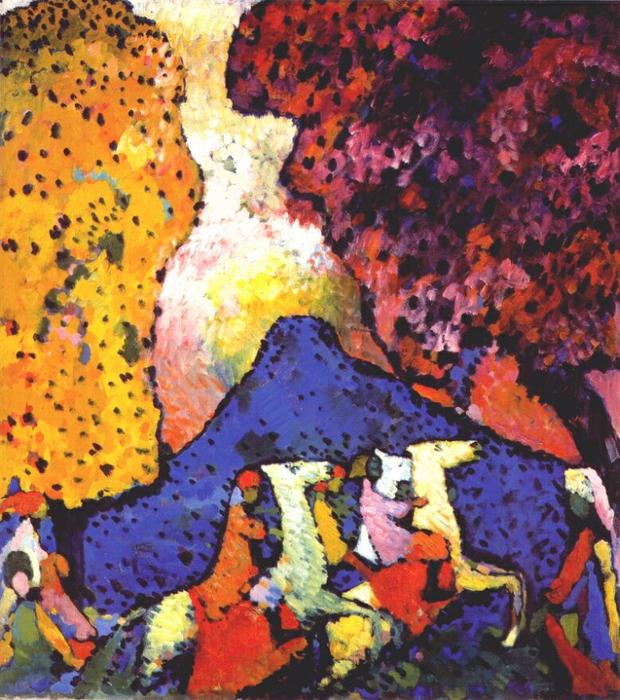
- The Scene Unfolds: At first glance, “Blue Mountain” presents a dramatic vista of towering peaks rendered in layers of deep blues – Prussian blue, cobalt, and ultramarine – punctuated by flashes of white and ochre. Below this monumental backdrop stretches a hazy expanse of ocean, its surface shimmering with reflected light. Yet, the painting resists easy categorization as a traditional landscape. The mountains themselves are not sharply defined; instead, they dissolve into swirling masses of color, suggesting movement and an almost palpable energy.
- Expressionist Roots: Kandinsky was deeply influenced by the Expressionist movement, which prioritized subjective experience over objective reality. “Blue Mountain” embodies this philosophy through its emphasis on conveying a feeling—a sense of awe, perhaps, or even a touch of melancholy—rather than simply mirroring the appearance of a mountain range. The colors aren’t chosen for their realistic representation but for their emotional resonance.
Decoding the Language of Color
Kandinsky's approach to color was revolutionary. He believed that each hue possessed its own inherent power and could trigger specific emotions in the viewer. In “Blue Mountain,” the dominant blues evoke feelings of depth, tranquility, and perhaps even a hint of mystery. The white accents introduce lightness and airiness, while the ochre provides warmth and grounding. Notice how these colors interact—the cool blues are balanced by the warm ochre, creating a dynamic tension within the composition. Kandinsky himself wrote extensively about his theories on color, arguing that it could be used to create “inner necessity” in art – a compulsion to feel and experience.
Technique & Materials: The painting is executed in oil on canvas, demonstrating Kandinsky’s mastery of layering and blending techniques. He built up the colors gradually, creating a sense of depth and texture through subtle variations in tone and saturation. The loose brushwork contributes to the painting's dynamic energy, suggesting movement and spontaneity.
A Bridge Between Worlds
“Blue Mountain” emerged during a period of intense artistic experimentation and intellectual ferment. Kandinsky was grappling with questions about the nature of art itself – how could it transcend representation and communicate directly with the soul? He was also deeply influenced by music, believing that color and form could be arranged in ways analogous to musical notes, creating a harmonious whole. The painting can be seen as an attempt to translate the experience of listening to music into visual terms.
- Historical Context: Painted at the cusp of the 20th century, “Blue Mountain” foreshadows the rise of abstract art and the development of movements like Cubism and Surrealism. It represents a decisive break from traditional representational painting and a bold step towards exploring new forms of artistic expression.
- Symbolic Resonance: While Kandinsky deliberately avoided overt symbolism in his work, “Blue Mountain” can be interpreted as representing the vastness and power of nature—a force that both inspires awe and evokes a sense of humility. The mountains themselves could symbolize spiritual aspiration or the challenges of life.
An Enduring Legacy
“Blue Mountain” remains one of Kandinsky’s most iconic works, captivating viewers with its vibrant colors, dynamic composition, and profound emotional impact. It's a painting that invites contemplation and encourages us to see beyond the surface—to perceive the world through the lens of feeling. Reproductions of this masterpiece continue to inspire artists and designers alike, demonstrating its enduring relevance in the 21st century. For those seeking a piece that embodies the spirit of innovation and emotional depth, “Blue Mountain” offers a truly unforgettable experience.