A Symphony of Form and Color: Exploring Kandinsky’s ‘Circles in a Circle’
Wassily Kandinsky's 1923 painting, *Circles in a Circle*, is not merely an arrangement of shapes and hues; it’s a visual articulation of the artist’s profound spiritual and theoretical explorations into the nature of art itself. A pivotal work from his Bauhaus period, this piece embodies Kandinsky’s belief that color and form possess intrinsic emotional power, capable of bypassing representational imagery to speak directly to the soul.
Deconstructing Geometric Abstraction
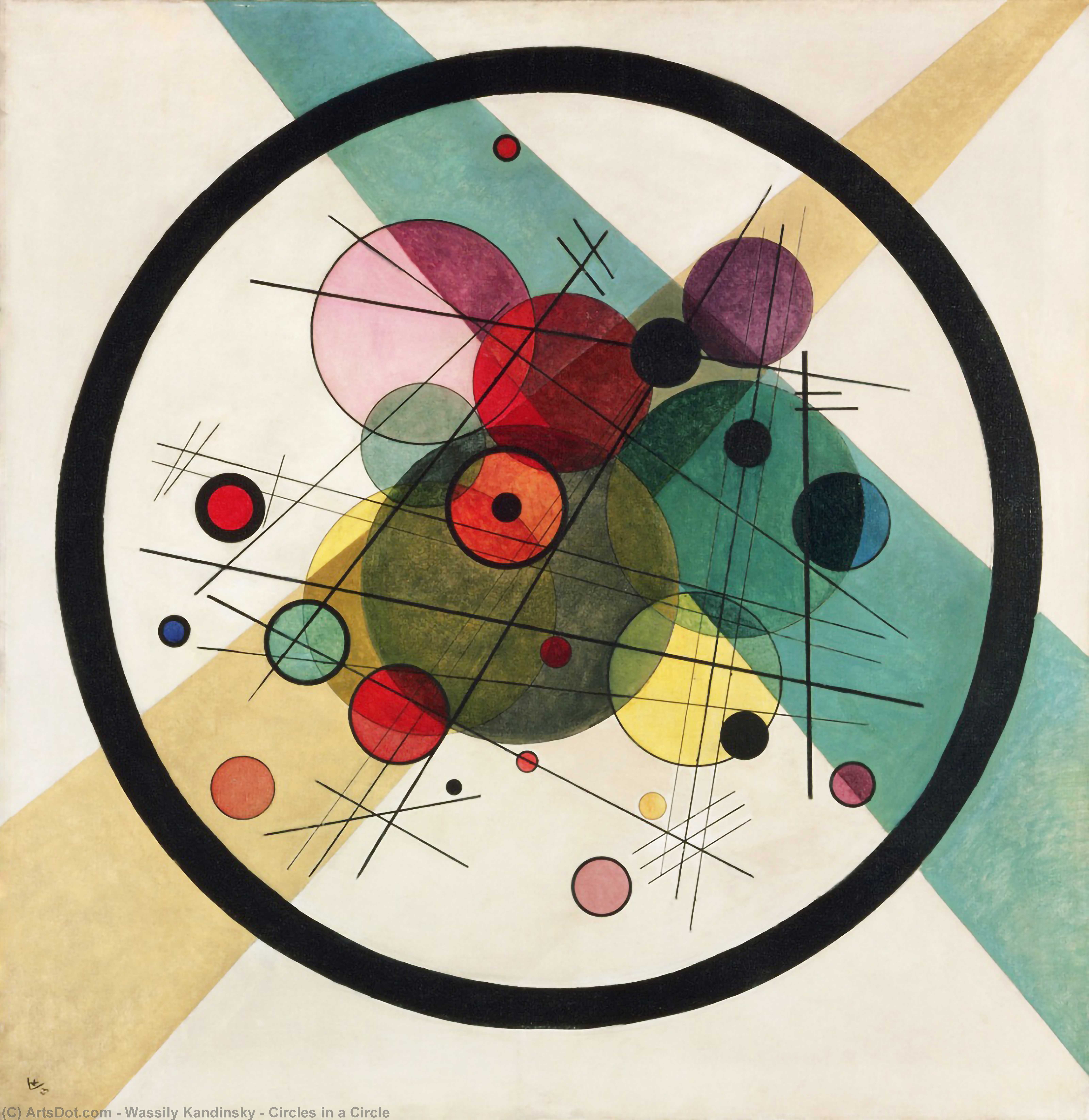
At first glance, *Circles in a Circle* presents a dynamic interplay between geometric elements. A dominant black circle anchors the composition, acting as both a boundary and a stage for a vibrant constellation of smaller circles, triangles, and intersecting lines. Kandinsky masterfully employs a rich palette – reds, yellows, greens, blues, purples, oranges, and pinks – creating a visual rhythm that is simultaneously harmonious and energetic. The inclusion of white dots at the center of many forms adds depth and luminosity, suggesting an inner radiance. This isn’t simply about depicting circles; it's about exploring their inherent qualities: wholeness, dynamism, and spiritual resonance.
The Bauhaus Influence & Artistic Technique
Kandinsky’s time at the Bauhaus school (1922-1933) profoundly influenced his artistic approach. The Bauhaus emphasized the unity of art, craft, and technology, fostering a precision and structural clarity evident in *Circles in a Circle*. While seemingly spontaneous, the painting reveals meticulous planning and execution. Kandinsky employed oil paints with a relatively flat application, prioritizing clean lines and distinct color fields. His technique involved layering colors to create subtle variations and depth, while also utilizing a drier brushstroke for certain linear elements, adding textural nuance.
Symbolism & The Language of Abstraction
For Kandinsky, abstraction wasn’t an abandonment of meaning but rather a shift in *how* meaning was conveyed. He believed that colors and shapes evoked specific emotions – yellow associated with excitement, blue with tranquility, and so on. Circles, for him, represented perfection and spiritual completion. The arrangement within the larger circle can be interpreted as a microcosm of the universe, a dynamic system of interconnected energies.
Circles in a Circle isn’t about *what* is depicted but rather *how* it feels – an invitation to experience art on a purely emotional and intuitive level.
Historical Context & Kandinsky's Legacy
Kandinsky is widely considered a pioneer of abstract art, and his work laid the groundwork for movements like Abstract Expressionism. Alfred Barr, a key figure in American modern art, first used the term “abstract expressionism” to describe Kandinsky’s paintings as early as 1929, recognizing their groundbreaking influence. *Circles in a Circle* exemplifies this pivotal moment in art history – a departure from traditional representation towards a new visual language based on pure form and color.
Emotional Resonance & Contemporary Relevance
Today, *Circles in a Circle*, held within the esteemed Lehmann Collection in New York City, continues to captivate audiences. Its enduring appeal lies in its ability to transcend time and cultural boundaries. The painting evokes feelings of harmony, balance, and spiritual awakening. Its vibrant colors and dynamic composition make it a compelling focal point for any interior space – from modern lofts to contemporary homes.
Further Exploration
- Artist: Wassily Kandinsky (1866-1944)
- Date: 1923
- Style: Geometric Abstraction, Bauhaus
- Medium: Oil on Canvas
*Circles in a Circle* is more than just a painting; it’s an invitation to contemplate the power of abstraction and the profound connection between art and the human spirit.