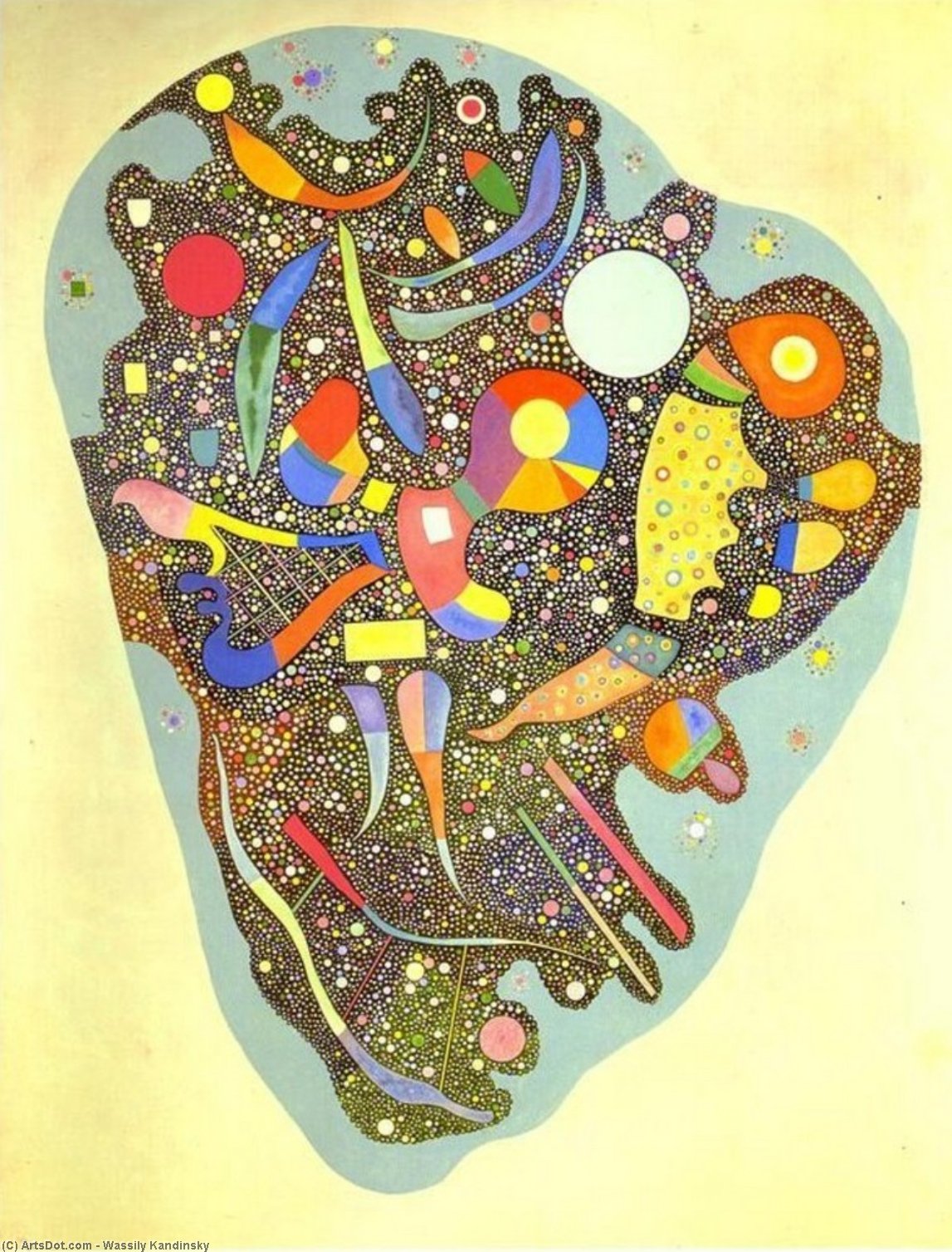
A Symphony of Form and Color: Exploring Kandinsky’s ‘Colorful Ensemble’
‘Colorful Ensemble’, painted in 1938 by the visionary Russian artist Wassily Kandinsky, is a captivating example of abstract art that transcends mere representation. Measuring 45.7 x 35 inches (116.0 x 89.0 cm), this oil and gloss on canvas resides at the Centre Georges Pompidou in Paris, inviting viewers into a world governed by feeling and intuition.
Kandinsky: Pioneer of Abstract Expression
Wassily Kandinsky (1866-1944) stands as a monumental figure in the history of modern art. Initially trained in law and economics, he was profoundly moved by Impressionist works – particularly Monet’s “Haystacks” – which ignited his artistic calling. He progressively abandoned representational forms, driven by a belief that color and composition could directly evoke emotional responses, independent of recognizable objects. His theoretical writings, notably Concerning the Spiritual in Art, articulated this philosophy and cemented his position as one of the first truly abstract artists.
Deconstructing Reality: An Analysis of ‘Colorful Ensemble’
‘Colorful Ensemble’ is a dynamic interplay of geometric shapes, swirling lines, and vibrant hues. While not depicting a specific scene, the composition suggests an underlying structure – some perceive hints of a fragmented face or figure emerging from the abstract chaos. Kandinsky masterfully employs layering and overlapping forms to create depth and movement within the two-dimensional space. The palette is rich and varied, featuring bold primaries alongside softer earth tones, all contributing to a sense of energetic harmony. The meticulous application of paint, with its visible brushstrokes and subtle gloss variations, adds textural complexity.
Expressionism and the Inner Landscape
This artwork is firmly rooted in the Expressionist movement, which flourished in the early 20th century. Expressionism sought to convey subjective emotions and inner experiences rather than objective reality. Kandinsky’s work exemplifies this ethos; ‘Colorful Ensemble’ isn't about *what* it depicts but *how* it makes you feel. The painting invites introspection, prompting viewers to connect with their own emotional responses to the colors, shapes, and overall composition.
Symbolism and Interpretation
Kandinsky believed that each color possessed a spiritual quality and could evoke specific emotions. While he resisted rigid symbolic interpretations, his use of color was deliberate and meaningful. Circles often represented wholeness and spirituality, while triangles suggested dynamism and aggression. The interplay between these forms in ‘Colorful Ensemble’ creates a complex emotional landscape open to individual interpretation. Is it a celebration of life's energy? A reflection on inner turmoil? Or perhaps a glimpse into the artist’s subconscious?
Emotional Resonance and Lasting Impact
‘Colorful Ensemble’ is more than just an aesthetically pleasing arrangement of shapes and colors; it’s an invitation to experience art on a deeply personal level. Its enduring appeal lies in its ability to bypass the intellect and speak directly to the emotions. For collectors, this painting represents a significant investment in a cornerstone of modern art history. For interior designers, a high-quality reproduction can inject a space with energy, sophistication, and intellectual depth. It’s a piece that continues to inspire awe and provoke thought decades after its creation.
- Style: Abstract Expressionism
- Medium: Oil and gloss on canvas
- Dimensions: 45.7 x 35 inches (116.0 x 89.0 cm)
- Location: Centre Georges Pompidou, Paris