A Descent into Abstraction: Exploring Kandinsky’s “Downwards”
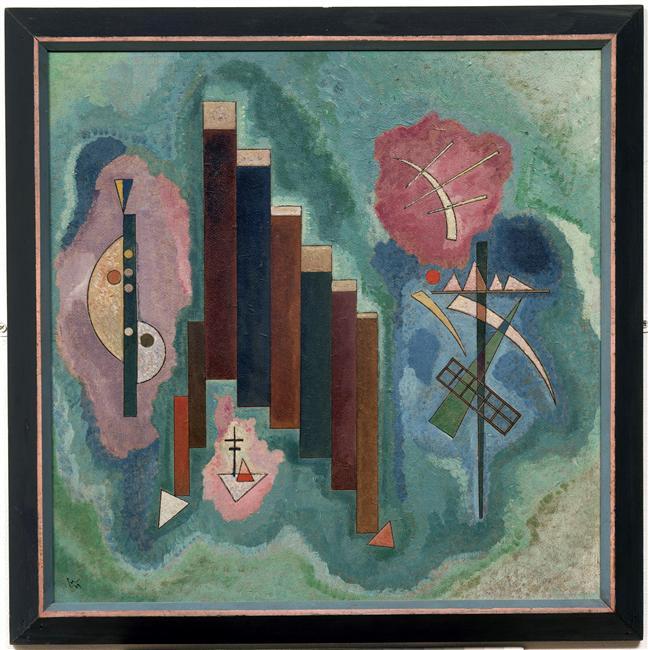
Wassily Kandinsky's 1929 oil painting, "Downwards," is a compelling example of his mature abstract style – a visual poem rendered in geometric forms and evocative color. Measuring 49 x 49 cm, this work isn’t about *representing* the world; it’s about expressing inner necessity, a core tenet of Kandinsky's artistic philosophy. As specialists in fine art reproductions at ArtsDot.com, we are proud to offer meticulously crafted recreations that capture the essence of this masterpiece.
Composition and Visual Language
“Downwards” presents a dynamic arrangement of stacked, block-like shapes – reminiscent of books or architectural elements – cascading across a teal-green ground. These forms aren’t rigidly defined; they possess softened edges and varying opacities, creating a sense of depth and movement. A prominent clock face is integrated into the composition, adding an intriguing layer of symbolism. The interplay between angular lines and subtle curves generates visual tension, while the muted palette – browns, pinks, blues, and greens – evokes a contemplative mood. The painting’s square format reinforces its sense of contained energy.
Kandinsky and the Birth of Abstract Art
Wassily Kandinsky (1866-1944) was a pivotal figure in the development of abstract art. Initially trained as a lawyer, he turned to painting after being profoundly moved by Monet’s Impressionist works. He became convinced that art should express *inner* realities rather than merely imitate external appearances. This belief led him to co-found the influential Der Blaue Reiter (The Blue Rider) group in Munich and ultimately to a completely non-representational style. “Downwards” exemplifies this evolution, demonstrating Kandinsky’s mastery of color and form as independent expressive elements.
Symbolism and Interpretation
While abstract art resists definitive interpretation, several symbolic readings are possible within "Downwards." The stacked forms can be seen as representing the weight of knowledge or experience, while the clock suggests the passage of time and perhaps a sense of mortality. The downward direction implied by the title and composition could symbolize introspection, descent into the subconscious, or even a feeling of melancholy. Kandinsky himself believed that colors had spiritual qualities; the specific hues used here likely contribute to the painting’s overall emotional impact.
Emotional Resonance and Modern Influence
“Downwards” isn't simply a visual puzzle; it evokes a powerful emotional response. The combination of structured forms and muted colors creates a sense of quiet intensity, inviting viewers to contemplate their own inner worlds. Kandinsky’s work profoundly influenced subsequent art movements, including Abstract Expressionism and Minimalism. His emphasis on the expressive potential of color and form continues to inspire artists today.
Collecting Kandinsky: Reproductions from ArtsDot
For those captivated by Kandinsky's vision, owning a piece of his legacy is now within reach. ArtsDot.com offers handcrafted oil reproductions of “Downwards” – and many other significant works by the artist – created by skilled artisans. We meticulously recreate every detail, ensuring that our reproductions faithfully capture the beauty and emotional depth of the original. Explore our collection today, including related pieces like
Points (Ohara Museum of Art) and
Abschied (small version) (Centre Pompidou).
Through “Downwards” and his other groundbreaking works, Wassily Kandinsky redefined the possibilities of painting, leaving an enduring legacy that continues to resonate with art lovers worldwide.