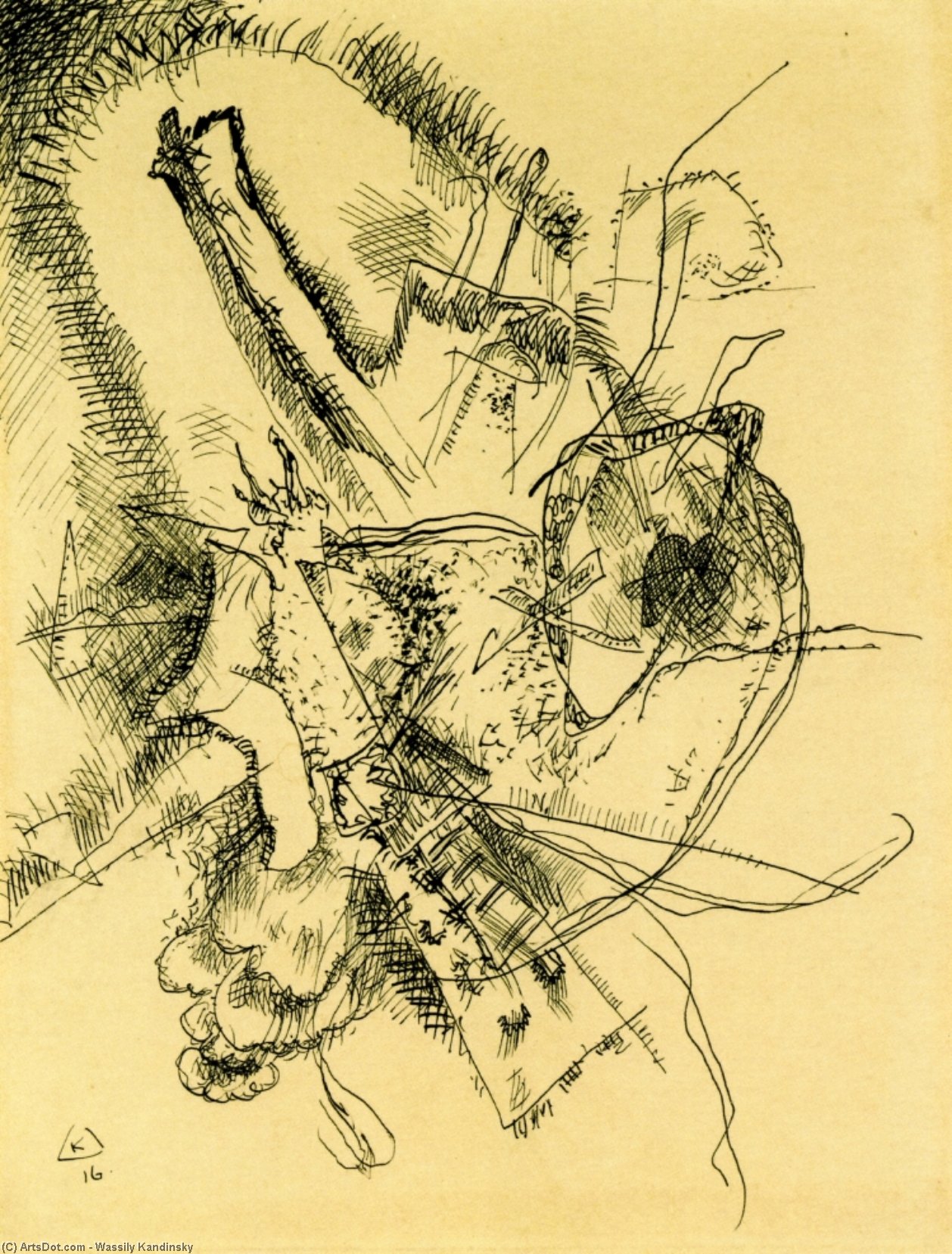
Drawing for Etching II: A Constructivist Vision by Wassily Kandinsky
“Drawing for Etching II,” created in 1916 by the pioneering Russian artist Wassily Kandinsky, stands as a compelling example of his exploration into abstraction and his significant contribution to the Constructivist movement. This ink on paper work transcends mere representation, offering instead a dynamic interplay of geometric forms that evoke emotion and energy.
Artistic Context: From Expressionism to Abstraction
Kandinsky’s artistic journey was marked by a deliberate departure from representational art towards pure abstraction. Influenced initially by Impressionism, Fauvism, and later by the burgeoning Expressionist movement, he sought to express inner spiritual realities through color and form rather than depicting external appearances. The rise of Futurism, with its focus on dynamism and technology, also played a role in shaping his aesthetic sensibilities. “Drawing for Etching II” reflects this evolution, moving beyond recognizable imagery to explore the inherent power of abstract elements.
Constructivist Elements: Geometry and Dynamism
Emerging in Russia after World War I, Constructivism championed industrial materials and techniques, emphasizing functionality and geometric precision. Kandinsky’s “Drawing for Etching II” aligns with these principles through its simplified forms and structured composition. The abstracted bird motif, reduced to essential lines and shapes, embodies a sense of freedom and movement. The piece isn't about depicting a literal bird; it is about conveying the *feeling* of flight and liberation through geometric abstraction. This approach reflects the Constructivist desire to create art that was both aesthetically pleasing and conceptually rigorous.
Symbolism and Emotional Impact
While seemingly devoid of overt symbolism, “Drawing for Etching II” resonates with a profound emotional depth. The swirling lines and overlapping forms generate a sense of dynamism and controlled chaos. Kandinsky believed in the spiritual power of art, asserting that colors and shapes could evoke specific emotions and resonate with the viewer's soul. The monochromatic palette, while seemingly limited, allows for nuanced tonal variations achieved through skillful ink application, creating a captivating visual experience. The absence of color forces the viewer to focus on the interplay of lines and forms, intensifying their emotional impact.
Legacy and Influence
“Drawing for Etching II” holds a significant place in art history, serving as a crucial precursor to Abstract Expressionism. Artists like Jackson Pollock and Mark Rothko drew inspiration from Kandinsky’s pioneering explorations into abstraction, adopting his emphasis on spontaneous gesture and emotional expression. The work's influence extends beyond painting, impacting graphic design and other visual arts. Today, “Drawing for Etching II” continues to inspire artists and art enthusiasts alike, demonstrating the enduring power of abstract art to communicate profound emotions and ideas.