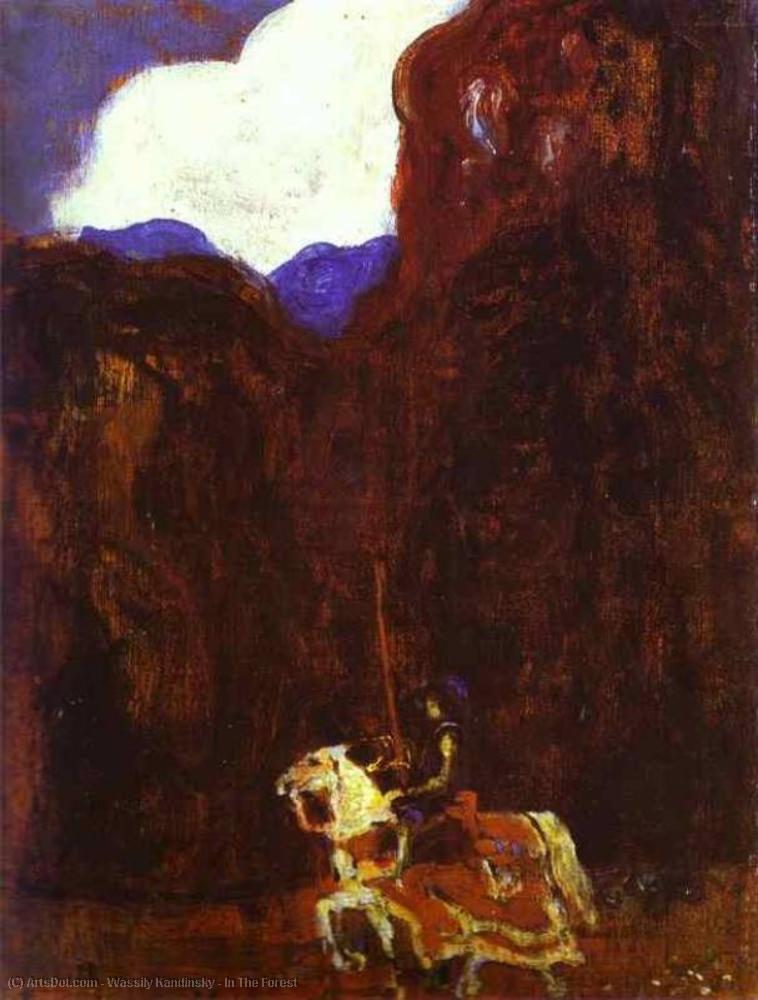
A Journey Into Color and Emotion: Wassily Kandinsky’s “In The Forest”
Wassily Kandinsky's "In The Forest," painted in 1904, isn’t merely a depiction of a woodland scene; it’s an immersive experience—a vibrant portal into the artist’s burgeoning world of abstract expression. Born in Moscow and initially pursuing a career in law, Kandinsky’s artistic awakening arrived later in life, fueled by a profound encounter with Monet's "Haystacks." This pivotal moment ignited a lifelong quest to translate inner emotions onto canvas, a journey culminating in works like “In The Forest,” which stands as a crucial stepping stone toward his groundbreaking abstract style. The painting, measuring a modest 26 x 19 cm, belies the monumental impact it would have on the course of modern art.
At first glance, the composition presents a familiar landscape: a man and horse traversing a mountainous terrain beneath a cloudy sky. However, Kandinsky deliberately strips away representational accuracy, prioritizing instead the raw power of color and form. The figures are rendered with simplified shapes—the man’s hat a distinct geometric element, the horse’s body a blocky structure—while the mountains dissolve into swirling masses of blues, greens, and browns. This deliberate ambiguity invites the viewer to engage not just with what *is* depicted, but with what *feels* depicted – a sense of movement, energy, and perhaps even a hint of unease.
The Language of Form and Color
Kandinsky’s technique in “In The Forest” is characterized by bold, expressive brushstrokes and an almost obsessive attention to color relationships. He employed a technique he termed ‘psychological coloring,’ believing that colors possessed inherent emotional qualities. Deep blues evoke feelings of melancholy and introspection, while vibrant greens suggest vitality and growth. The use of contrasting hues creates visual tension, mirroring the internal struggles and aspirations represented within the painting. Kandinsky’s layering of pigments—often applied in thick impasto—adds a tactile dimension to the work, inviting closer inspection and encouraging the viewer to lose themselves in its textured surface.
Influenced by movements like Expressionism and Fauvism, which prioritized emotional impact over strict realism, Kandinsky sought to create paintings that communicated directly with the subconscious. He famously wrote about his artistic philosophy, stating that “the artist must not depict what he sees, but what he feels.” This sentiment is powerfully realized in "In The Forest," where recognizable forms are subsumed by a swirling vortex of color and shape—a visual embodiment of inner experience.
Symbolism and the Journey Within
The central image – the man on horseback – carries significant symbolic weight. It represents an individual embarking on a journey, confronting challenges and navigating uncertain terrain. The horse itself symbolizes strength, power, and perhaps even a primal instinct. The mountainous landscape serves as a metaphor for obstacles and difficulties, while the cloudy sky hints at both hope and apprehension. Kandinsky wasn’t simply painting a forest; he was exploring the complexities of human existence—the interplay between ambition, vulnerability, and the search for meaning.
Interestingly, Kandinsky's work during this period reflects his own personal journey – a transition from a structured academic life to one dedicated entirely to art. The painting can be interpreted as an allegory for this transformation, a visual representation of shedding old identities and embracing new possibilities. The influence of figures like Pablo Picasso, particularly in his exploration of form and perspective, is subtly present, yet Kandinsky ultimately forged his own unique path toward abstraction.
A Legacy of Innovation
"In The Forest" stands as a pivotal work in the development of abstract art, demonstrating Kandinsky’s pioneering approach to non-representational painting. Its influence can be seen in countless artists who followed, shaping the trajectory of 20th-century art and beyond. As documented by Wikipedia and other historical sources, Kandinsky's exploration of color and form continues to resonate with audiences today, reminding us of the power of art to evoke emotion, stimulate imagination, and transcend the boundaries of conventional representation. ArtsDot.com offers meticulously crafted oil painting reproductions of “In The Forest,” allowing you to bring this iconic masterpiece into your own space and experience its captivating beauty firsthand.
ArtsDot.com is your premier destination for high-quality, handmade oil painting reproductions. Explore our collection today and discover the beauty of art in its finest form. In The Forest by Wassily Kandinsky (1904) | Improvisation XIV by Wassily Kandinsky | Seated man (Self-portrait) by Pablo Picasso
In The Forest by Wassily Kandinsky (1904)
Improvisation XIV by Wassily Kandinsky
Seated man (Self-portrait) by Pablo Picasso
Photo Description: The painting is a representation of a man riding on the back of a horse in front of a mountainous landscape. The man appears to be wearing a hat, which adds to the overall composition of the scene. The horse is positioned towards the center of the image and seems to be walking or trotting through the landscape. The mountains are depicted as a backdrop for the main subject, with their peaks visible in the distance. The sky above the scene appears to be cloudy, adding depth and atmosphere to the painting. Overall, the image captures a sense of adventure and exploration, with the man on horseback navigating through the challenging terrain.
Size: 26 x 19 cm
Date: 1904