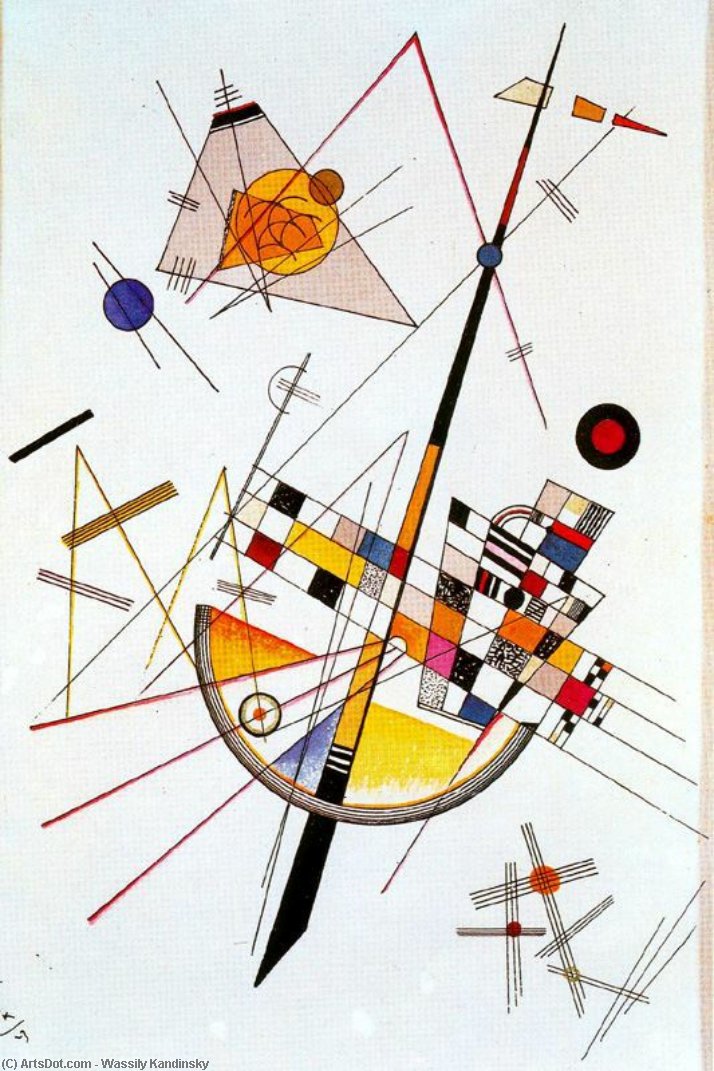
Explore Wassily Kandinsky's 'Mild Stress No. 85,' a vibrant expressionist masterpiece featuring concentric circles and geometric shapes—a testament to his pioneering exploration of abstract art.
Discover Wassily Kandinsky (1866-1944), the pioneer of abstract art! Explore his vibrant expressionism, spiritual themes & Bauhaus legacy through stunning reproductions.
Exploring the Energetic Resonance of Kandinsky’s “Mild Stress No. 85”
“Mild Stress No. 85,” created by Wassily Kandinsky in an unknown date, stands as a cornerstone of abstract expressionism and embodies the artist's profound belief in the transformative power of color and form. More than just a visual spectacle, this painting delves into the realm of spiritual experience, reflecting Kandinsky’s pioneering exploration of non-objective art—a radical departure from representational traditions that fundamentally reshaped the artistic landscape of the early 20th century.
A Symphony of Color and Geometric Forms
The artwork itself presents a deceptively simple composition: a dominant yellow circle punctuated by surrounding shapes – smaller circles interspersed with triangles – each radiating hues of red, blue, and green. This seemingly uncomplicated arrangement belies an intricate layering of visual elements designed to evoke profound emotional responses. Kandinsky meticulously crafted this piece using tempera on canvas, prioritizing color as the primary vehicle for conveying feeling rather than depicting recognizable objects. The deliberate placement of shapes contributes to a dynamic equilibrium, mirroring the artist’s conceptual framework where geometric forms represent spiritual forces and colors embody their respective energies.
Roots in Impressionism and Wagnerian Inspiration
Kandinsky's artistic journey began with an unexpected fascination for Claude Monet’s “Haystacks,” which instilled within him an appreciation for capturing fleeting impressions of light and color—a crucial precursor to his later embrace of abstraction. However, it was the visceral experience of witnessing Wagner’s opera "Lohengrin" that truly catalyzed Kandinsky's artistic vision. The dramatic music and evocative imagery profoundly impacted him, prompting a desire to translate musical sensations into visual equivalents. This impulse fueled his experimentation with color and form, pushing him beyond mere imitation toward an expressive language entirely independent of naturalistic representation.
Symbolism Beyond the Visible Realm
The symbolism embedded within “Mild Stress No. 85” transcends literal interpretation. The yellow circle represents wholeness and luminosity—a visual embodiment of divine radiance—while the surrounding shapes symbolize opposing forces striving for harmony. Kandinsky believed that color could communicate emotions directly, bypassing rational thought and accessing a deeper level of consciousness. The triangles, positioned strategically at the top left corner, are interpreted as representing stability and aspiration, anchoring the energetic circle amidst its swirling companions.
Emotional Impact and Artistic Legacy
Ultimately, “Mild Stress No. 85” succeeds in capturing the essence of Kandinsky’s artistic philosophy—a conviction that art should serve as a conduit for spiritual contemplation. Its vibrant colors and dynamic forms resonate with viewers on an emotional level, inviting them to engage in a dialogue between intellect and feeling. This painting remains a testament to Kandinsky's pioneering role in establishing abstract expressionism as a dominant force in modern art, influencing generations of artists who followed and continuing to inspire those seeking beauty and meaning beyond the confines of visual realism.