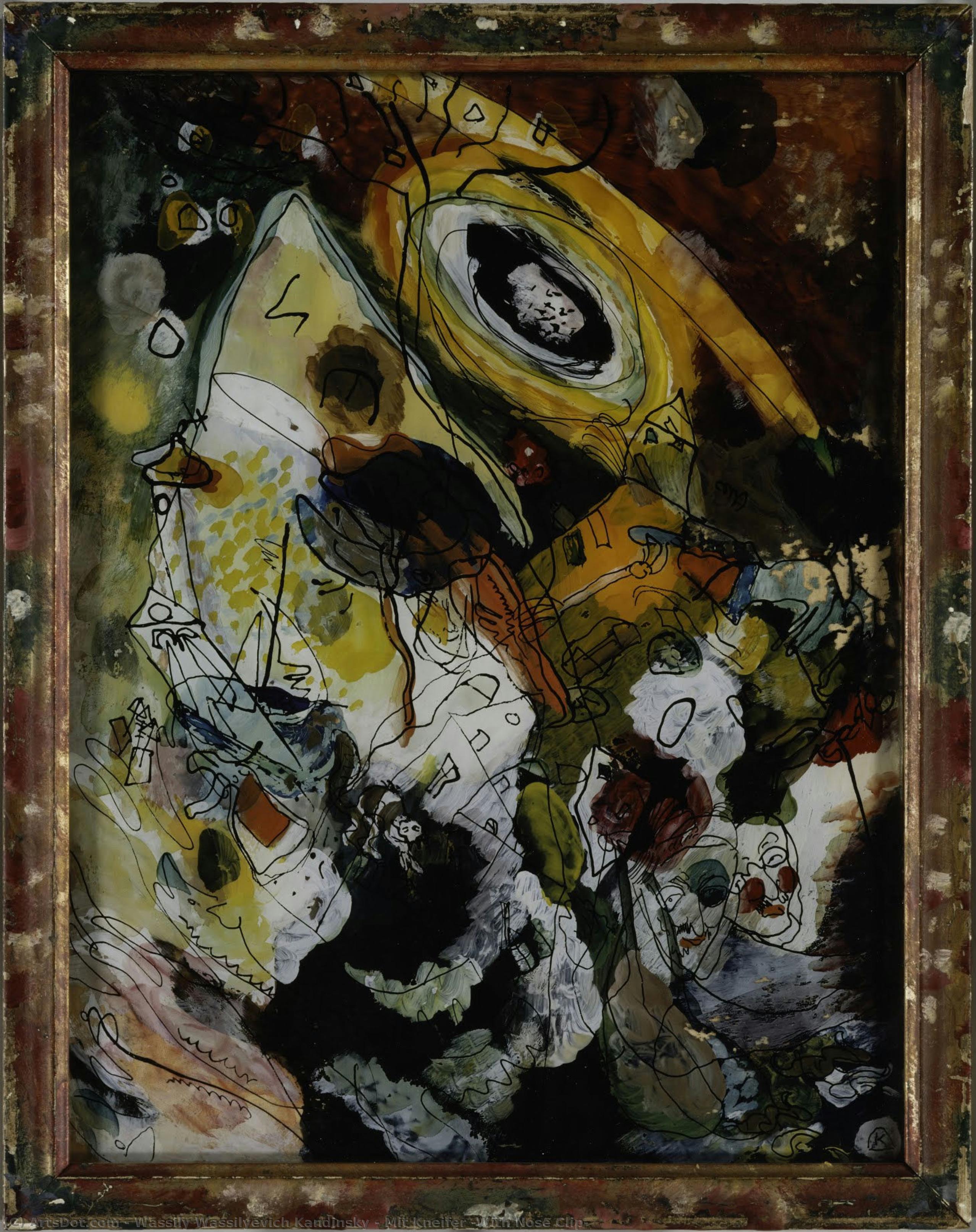
“Mit Kneifer,” or “With Nose Clip,” painted in 1912 by Wassily Wassilyevich Kandinsky, stands as a cornerstone of abstract expressionism—a testament to the artist’s radical departure from representational art and his unwavering belief in the primacy of feeling. This striking monochrome composition explores Kandinsky’s concept of ‘pictorial music,’ distilling emotion into pure visual language.
A Symphony of Form and Color: Exploring Kandinsky’s “Mit Kneifer”
“Mit Kneifer,” or “With Nose Clip,” painted in 1912 by Wassily Wassilyevich Kandinsky, stands as a cornerstone of abstract expressionism—a testament to the artist's radical departure from representational art and his unwavering belief in the primacy of feeling. This striking monochrome composition, housed within a glass enclosure at Paris’ Musée d’Art Moderne et Contemporain (MAM), immediately captivates with its deliberate simplicity yet profound depth. The artwork isn’t merely an image; it's an attempt to distill emotion into pure visual language—a concept Kandinsky himself termed “pictorial music.”
- Subject Matter: At first glance, the painting presents a seemingly unassuming subject – a yellow fish positioned centrally against a stark white background. However, this single element is far from arbitrary. Kandinsky meticulously crafted it to embody spiritual significance, representing not just an animal but also the essence of life and vitality.
- Style & Technique: Kandinsky’s technique exemplifies his pioneering approach to abstraction. He eschewed traditional brushstrokes in favor of a method he termed “Gesture Painting,” prioritizing spontaneous movement and expressive marks that convey inner sensations rather than replicating external reality. The deliberate flatness of the canvas contributes to this effect, emphasizing the visual surface as the primary vehicle for conveying emotion.
The surrounding elements – a bird on the left and a clock on the right – serve as crucial anchors within the composition. These objects aren’t intended to depict specific scenes but rather act as symbols of time and contemplation, mirroring Kandinsky's preoccupation with exploring the relationship between art and spirituality. The placement of these figures subtly guides the viewer’s gaze, encouraging reflection on themes of permanence versus change—a dichotomy central to Kandinsky’s philosophical worldview.
Historical Context: Painted during a period of intense artistic experimentation in Munich, “Mit Kneifer” reflects the broader intellectual ferment surrounding the Bauhaus movement and the burgeoning interest in Jungian psychology. Kandinsky's work aligns with the Zeitgeist of its time—a desire to liberate art from the constraints of academic tradition and embrace new forms of expression that could tap into the subconscious mind. The influence of Russian folk art, particularly its use of color symbolism, is palpable within this piece.
Symbolism & Emotional Impact: Beyond its formal qualities, “Mit Kneifer” resonates with a powerful emotional core. The yellow fish—a symbol of optimism and enlightenment—contrasts sharply with the white background, representing purity and stillness. Kandinsky’s intention wasn't to depict something tangible but rather to evoke an experience – a feeling of serenity and contemplation. It invites viewers to consider how art can transcend literal representation and communicate directly with the human spirit. The artwork continues to inspire artists and designers today who seek to harness the transformative power of color and form.