The Artist and His Work
Wassily Kandinsky, a seminal Russian painter and art theorist, significantly contributed to the development of abstract art in the Western tradition. Born in 1866 in Moscow, Kandinsky's initial career trajectory was in law and economics, graduating from the University of Moscow. Remarkably, at 30, he pivoted towards art, eventually becoming a leading figure in the Expressionist movement.
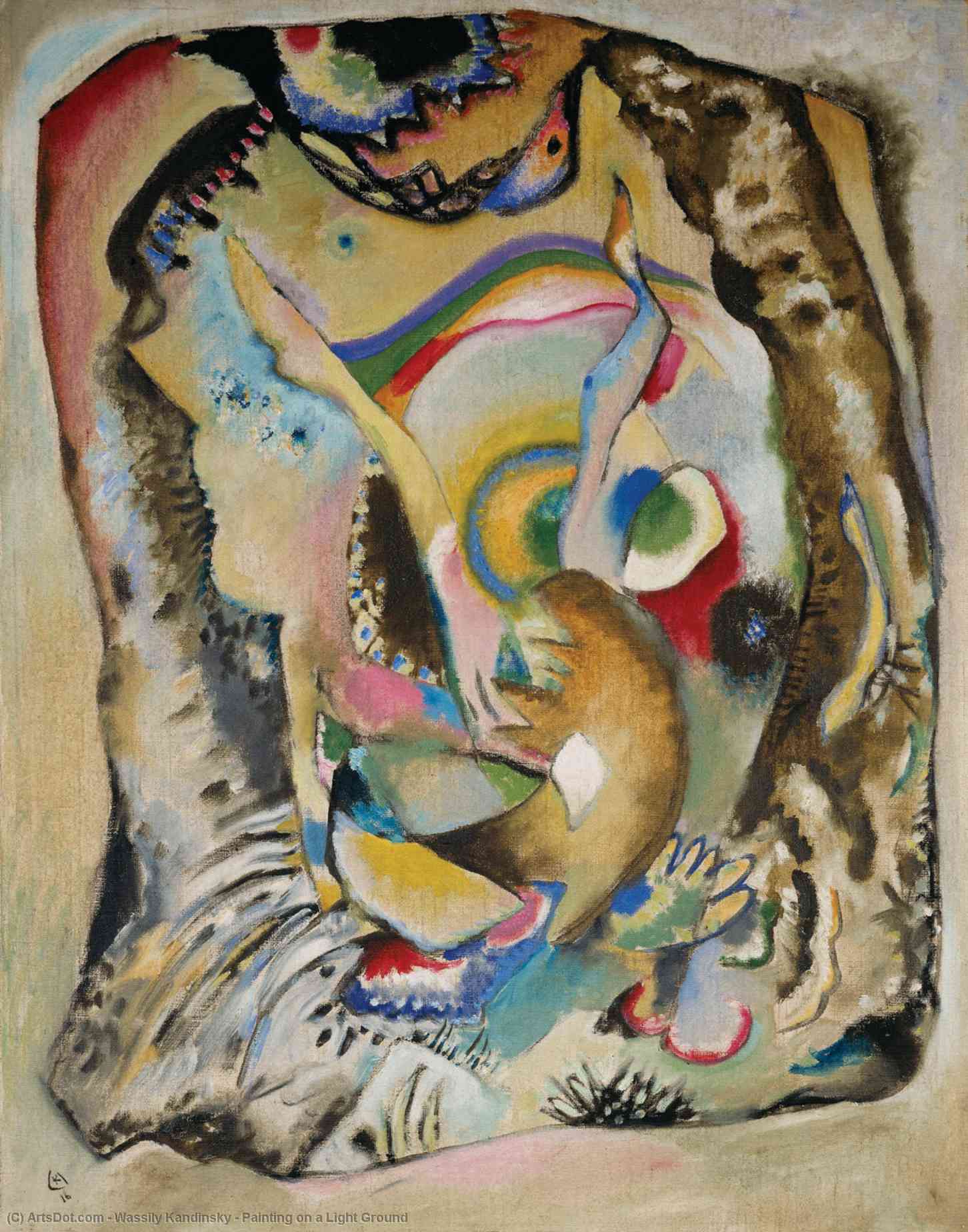
The Painting: "Painting on a Light Ground"
"CITE>Painting on a Light Ground" is a vibrant and dynamic artwork that exemplifies Kandinsky's unique style. The painting features two people in the center of the scene, with one person appearing to be sitting on top of another, creating a sense of depth and complexity within the composition. The colors used are bold and varied, with shades of pink, yellow, green, blue, and orange all present throughout the painting.
Expressionism and Its Influence
Kandinsky's work is deeply rooted in Expressionism, a movement that emphasizes capturing emotions and energy through bold colors and dynamic poses. This style was influenced by various artistic traditions, including German Expressionism, Surrealism, and Synthetic Cubism. The term "abstract expressionism" was first applied to American art in 1946 by the art critic Robert Coates, but its roots trace back to earlier movements.
Historical Context
The history of painting reaches back in time to artifacts and artwork created by pre-historic artists, spanning all cultures. The development of Western painting represents a continuous tradition from antiquity until the present time. Initially serving imperial, private, civic, and religious patronage, Western painting later found audiences in the aristocracy and the middle class.
Relevance to Contemporary Art
The influence of Abstract Expressionism can be seen in diverse movements in the U.S. and Europe throughout the second half of the 20th century, including Tachisme and Neo-expressionism. The cultural reign of Abstract Expressionism in the United States had diminished by the early 1960s, while the subsequent rejection of the Abstract Expressionist emphasis on individualism led to the development of such movements as Pop art and Minimalism.
Conclusion
"CITE>Painting on a Light Ground" by
Wassily Kandinsky is a testament to the innovative spirit of Expressionism. This painting, along with other works by Kandinsky, can be found in various museums and galleries around the world, including the
Museum City Gallery in Lenbachhous, Munich, Germany. For those interested in exploring more of Kandinsky's work, visit
Painting on a Light Ground and other artworks at ArtsDot.
- Key Figures in Abstract Expressionism: Arshile Gorky, Jackson Pollock, Franz Kline, Mark Rothko, Norman Lewis, Willem de Kooning, Adolph Gottlieb, Clyfford Still, Robert Motherwell, Theodoros Stamos, and Lee Krasner.
- Influences: German Expressionism, Surrealism, Synthetic Cubism.
For more information on the history of painting and abstract expressionism, refer to:
History of Painting Abstract Expressionism Western Painting