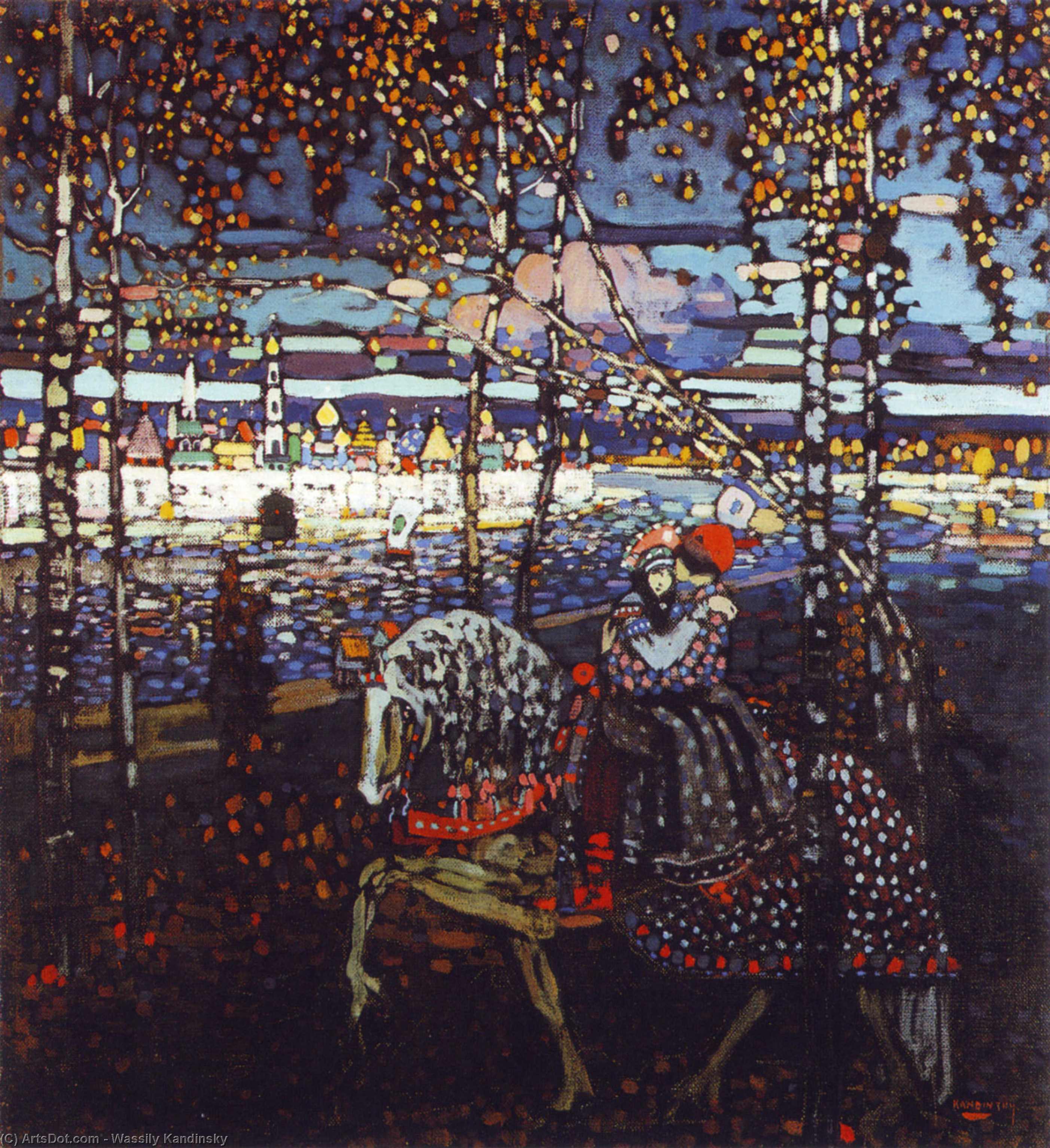
Pareja a caballo – A Symphony of Color and Movement
The painting
Pareja a caballo by Wassily Kandinsky stands as a cornerstone of Expressionist art, radiating an energy that transcends mere representation—it embodies emotion itself. Offered as a meticulously crafted handmade reproduction on
ArtsDot.com, this artwork invites contemplation and celebrates Kandinsky’s singular artistic vision. It's more than just a depiction of a couple riding a horse; it’s an exploration of the subconscious mind rendered in vibrant hues and dynamic geometric forms.
Composition and Color Palette – The Language of Feeling
At first glance, the painting captures a moment of serene activity: a man and woman seated atop a horse against the backdrop of a cityscape. However, Kandinsky doesn't aim for photographic accuracy; instead, he utilizes color—primarily a dominant crimson—to convey profound psychological resonance. This bold shade isn’t merely descriptive; it pulsates with vitality, mirroring the passion and connection between the figures. Scattered throughout the scene are other individuals and a boat on the water, creating an illusion of depth that enhances the overall impression of movement. Kandinsky's masterful manipulation of color echoes his explorations in works like
Grey oval and
Soft roughness, available on
ArtsDot.com—pieces that similarly prioritize emotional expression over literal depiction.
Influence and Style – Bridging Art Movements
Kandinsky’s artistic trajectory was shaped by influential currents such as Abstract Art and Theosophy. These philosophies championed the idea that art could communicate spiritual truths beyond rational thought, a concept deeply embedded in Kandinsky's creative process. Like Hilma af Klint (
ArtsDot.com), Kandinsky sought to transcend conventional artistic conventions and delve into realms of inner experience. His canvases are populated with geometric shapes—circles, squares, triangles—arranged in harmonious relationships that evoke feelings of balance and contemplation. These forms aren’t merely decorative; they represent fundamental principles of visual perception and symbolize the interconnectedness of consciousness and nature – concepts mirrored in his exploration of “Composition” (
ArtsDot.com).
A Legacy of Innovation
The painting’s enduring appeal lies not only in its aesthetic beauty but also in Kandinsky's pioneering role as a trailblazer in abstract art. Artists like Hilma af Klint similarly pursued spiritual inspiration through geometric abstraction, demonstrating the breadth of artistic exploration during this period. To appreciate Kandinsky’s profound contribution to modern art, explore his seminal work “Composition” on
ArtsDot.com and delve into the broader context of Theosophy's influence on artistic thought. For more information about Wassily Kandinsky and his groundbreaking achievements, visit
Wikipedia.