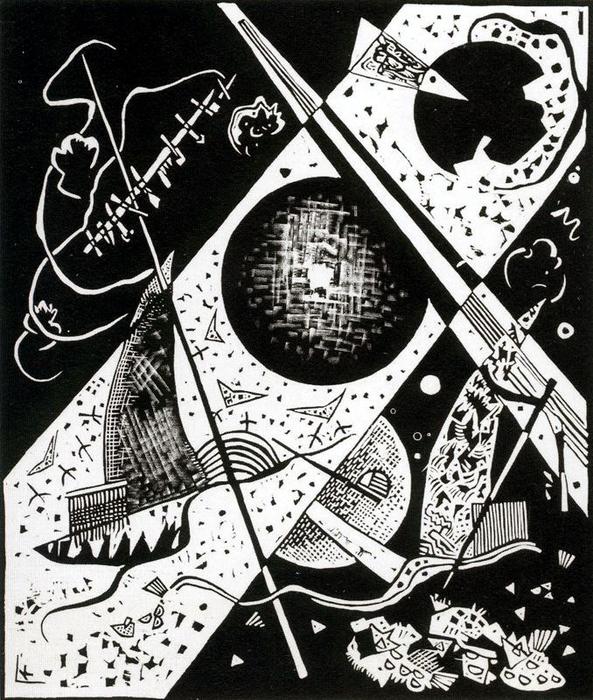
Pequeños mundos VI: A Symphony of Geometric Forms
Wassily Kandinsky’s “Pequeños mundos VI,” created in 1922, stands as a cornerstone of abstract expressionism and embodies the artist's profound exploration into the relationship between visual art and music. Produced during his tenure at the Bauhaus school in Weimar, Germany—a pivotal moment in architectural design and artistic experimentation—this woodcut print exemplifies Kandinsky’s meticulous approach to translating musical concepts onto the canvas of printmaking.
- Composition & Technique: The artwork presents a dynamic square format dominated by a central circle, encircled by overlapping triangles and linear elements. Kandinsky skillfully utilized the woodcut technique—characterized by carving into a wooden block and applying ink—to achieve remarkable textural depth and tonal variation. This method allowed for precise control over line and mark-making, mirroring the composer’s deliberate orchestration of sound.
- Color Palette & Symbolism: Strikingly devoid of color, “Pequeños mundos VI” relies on a masterful interplay of black and white hues. Shades of grey subtly delineate form and contribute to an overall feeling of solemn contemplation. The inclusion of musical instruments—a violin and guitars—within the composition isn’t merely decorative; it symbolizes harmony and creativity amidst apparent chaos – mirroring Kandinsky's belief that visual art could evoke emotional responses akin to music.
- Historical Context & Bauhaus Influence: Produced shortly after Kandinsky began teaching at the Bauhaus, this print reflects the school’s ethos of integrating art and craft. The Bauhaus championed experimentation with new materials and techniques, prioritizing functional aesthetics alongside artistic innovation. “Pequeños mundos VI” embodies this spirit, demonstrating Kandinsky's commitment to pushing boundaries and redefining artistic expression.
- Emotional Impact & Artistic Style: Viewing “Pequeños mundos VI” evokes a sense of controlled dynamism—a visual echo of Wagnerian opera—capturing the artist’s desire to transcend representational imagery. Kandinsky’s style prioritizes spiritual resonance over literal depiction, aligning with the broader movement toward abstraction and its exploration of inner experience.
- Detailed Examination: The woodcut's surface reveals intricate hatching and cross-hatching patterns that create a palpable sense of texture—a deliberate choice by Kandinsky to emulate the physicality of musical instruments. Diagonal lines intersect across the frame, reinforcing movement and contributing to the artwork’s overall visual energy. As documented in Roethel 1970, no. 169, this print exemplifies Kandinsky's masterful manipulation of technique to convey profound artistic ideas.
A reproduction of “Pequeños mundos VI” offers an exceptional opportunity to appreciate the enduring legacy of Wassily Kandinsky’s groundbreaking vision—a testament to art’s capacity for communicating emotion and capturing the essence of musical inspiration.