A Symphony of Form: Exploring Kandinsky’s ‘Plate from Klänge’
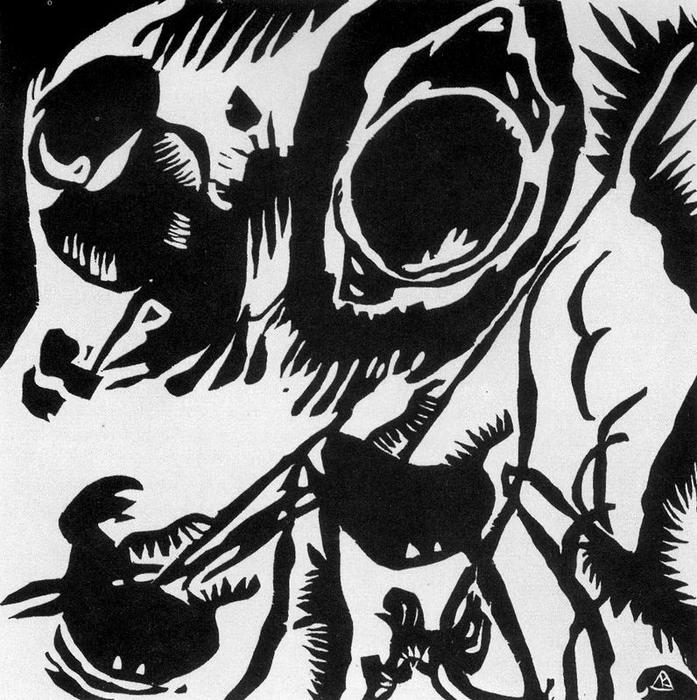
Wassily Kandinsky's ‘Plate from Klänge’ is not merely an artwork; it’s a visual echo of music, a testament to the artist’s lifelong pursuit of synesthesia – the blending of senses. Created as part of a larger portfolio, this black and white woodcut embodies Kandinsky’s radical departure from representational art towards pure abstraction. The image pulsates with energy, a dynamic interplay of geometric and organic shapes that seem to float and collide within the confines of the paper. It's a world devoid of recognizable objects, inviting viewers instead to experience emotion through form and line.
The Genesis of ‘Klänge’: Sound Made Visible
To understand ‘Plate from Klänge’, one must consider its origins within Kandinsky’s broader project of the same name – “Sounds.” This ambitious undertaking, conceived between 1909 and 1912, was a deliberate attempt to translate musical experiences into visual language. Kandinsky believed that color and form possessed inherent spiritual qualities, capable of evoking emotions analogous to those stirred by music. The woodcuts accompanying his prose poems were not intended as illustrations in the traditional sense, but rather as complementary expressions of the same inner impulse. Each plate within ‘Klänge’ is a unique exploration of this concept, a visual improvisation mirroring the spontaneity and emotional depth of a musical composition. The choice of black and white further intensifies this effect; stripping away color allows for an unadulterated focus on the relationships between shapes and their inherent expressive power.
Technique and Expression: The Power of Woodcut
Kandinsky’s selection of woodcut as his medium was far from arbitrary. The technique, with its bold lines and stark contrasts, perfectly suited his desire to create a powerful, emotionally resonant visual language. Unlike the subtle gradations achievable through painting, woodcut demands decisive marks – each line is either present or absent, creating a sense of immediacy and raw energy. The process itself involved carving into a wooden block, then inking and pressing it onto paper; this tactile engagement with the material likely contributed to the work’s visceral quality. The resulting image possesses a graphic intensity that feels both deliberate and spontaneous, reflecting Kandinsky's belief in the importance of intuition in artistic creation. The lack of perspective reinforces the flatness of the composition, pushing the forms forward and enveloping the viewer in a world of pure visual sensation.
Kandinsky’s Legacy: A Pioneer of Abstraction
Wassily Kandinsky was not simply an artist; he was a visionary who fundamentally altered our understanding of art's potential. Born in Moscow in 1866, his journey from law and economics to the forefront of abstract expressionism is a remarkable one. Influenced by Impressionism, Fauvism, and the spiritual philosophies of the time, Kandinsky gradually abandoned representational forms, believing that art should express inner truths rather than merely depict external reality. His association with groups like Der Blaue Reiter (The Blue Rider) further solidified his position as a leading figure in the avant-garde movement. ‘Plate from Klänge’ stands as a pivotal example of this artistic evolution – a bold and uncompromising statement of Kandinsky's belief in the power of abstraction to communicate profound emotional and spiritual experiences. Today, his work continues to inspire artists and captivate audiences worldwide, reminding us that art can transcend the boundaries of language and culture to speak directly to the soul.