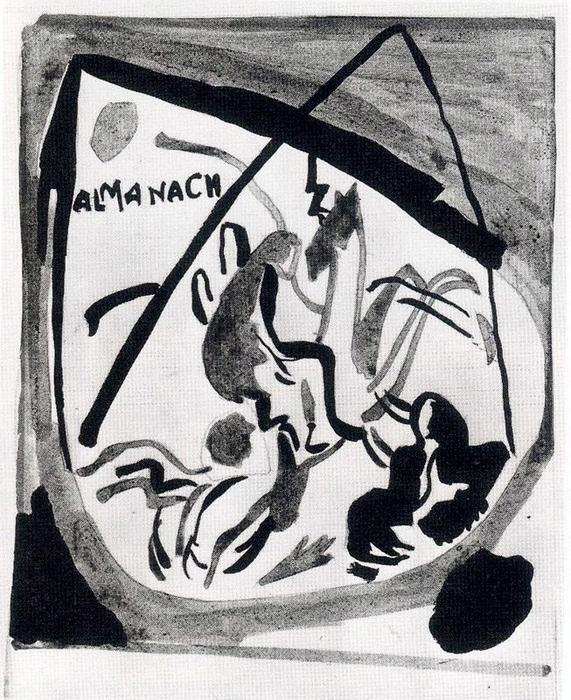
Explore Wassily Kandinsky’s ‘Small Worlds XI,’ a dynamic 1922 abstract sketch in black & white. Discover its Expressionist style, geometric forms, and unique energy – a captivating piece of art history.
Sketch by Wassily Kandinsky
Wassily Kandinsky’s “Sketch” stands as a testament to the genesis of abstract art, born from a profound encounter with Impressionism and fueled by the transformative experience of witnessing Wagner's opera "Lohengrin." Executed around 1922, this monochrome drawing embodies the spirit of Expressionism—a movement that prioritized subjective emotion over objective representation—marking a decisive break from traditional artistic conventions.
- Composition & Form: The artwork’s frame is subtly defined by an implied circular boundary, mirroring the cyclical nature of musical composition and reflecting Kandinsky's fascination with harmony. Dominating the upper left quadrant is a large angular shape—a bold geometric element that disrupts the overall balance and introduces visual tension. Figures are rendered in simplified forms, hinting at influences from Russian folk art and capturing the immediacy of spontaneous gesture.
- Color Palette & Texture: Stripped bare of color, “Sketch” utilizes a masterful grayscale palette characterized by varying shades of gray—a technique employed to heighten contrast and emphasize textural nuances. Dense hatching creates darker areas, conveying depth and suggesting the materiality of charcoal or ink on paper. The artist’s deliberate marks contribute to an overall feeling of dynamism.
- Style & Technique: Kandinsky's approach is distinctly Expressionist, prioritizing emotional resonance over meticulous detail. He employs freehand drawing with ink or charcoal—a technique that allows for rapid mark-making and captures the essence of improvisation. The angular lines juxtaposed against fluid curves underscore Kandinsky’s exploration of visual language.
- Historical Context: Created during the Bauhaus period, “Sketch” reflects the broader artistic ambitions of this influential German art school—a movement dedicated to uniting art, craft, and technology. It aligns with Kandinsky's belief that art should transcend mere imitation of nature and strive for spiritual expression.
- Symbolism & Emotional Impact: The artwork’s chaotic composition conveys a palpable sense of energy and drama—mirroring the theatrical influence on Kandinsky’s artistic vision. “ALMANACH” written on the image serves as a subtle reminder of Wagnerian opera, symbolizing harmony and grandeur. Viewing "Sketch" evokes feelings of spontaneity and invites contemplation on the relationship between form and emotion.
A reproduction of “Sketch” by ArtsDot.com offers an unparalleled opportunity to experience Kandinsky’s groundbreaking vision—a captivating piece of art history that continues to inspire artists and collectors alike.